



The appointment of General Edmund Allenby as commander of the Egyptian Expeditionary force in June 1917 revitalised the Palestine Campaign. His orders from Prime Minister David Lloyd George were to capture Jerusalem by Christmas. And that’s exactly what he did, making a low-key entrance on 11 December, 1917.
Allenby replaced General Sir Archibald Murray, who had led two costly and unsuccessful attempts to invade the Turkish province of Palestine in the First and Second Battles of Gaza.
Murray had also been criticised as an absentee commander, basing himself in Cairo, far from the centre of the conflict. Allenby adopted a different approach, setting up his headquarters in the city of Rafah, close to the frontlines.
 Watch Now
A new strategy in Palestine
Allenby launched the Third Battle of Gaza on 1 November 1917. He threw out Murray’s strategy of a frontal attack against the heavily entrenched Turkish troops. Instead he opted to launch a feint attack against the coastal town of Gaza, while the bulk of his force drove inland against the city of Beersheba.
The aim was to secure Beersheba’s vital water supply and in the process turn the Turkish left flank. A daring charge by a brigade of Australian cavalry at dusk sent the defenders of Beersheba into retreat, leaving the Allies in possession of the critical wells and the Turkish left flank exposed to further attacks.
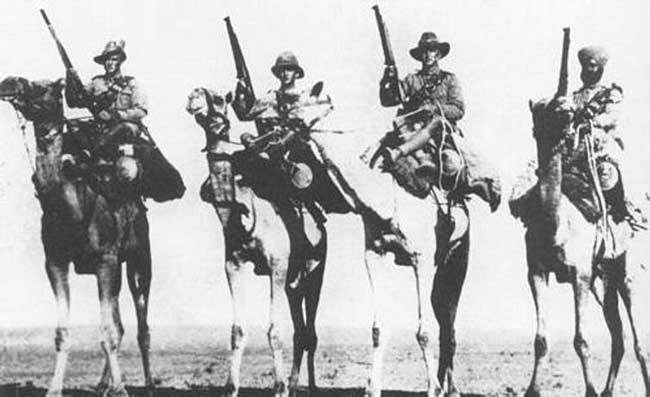
Imperial Camel Corps during the Palestine campaign. Credit: Pearman Douglas (Captain) Collection, Imperial War Museum
Seizing Jerusalem
Next, Allenby pushed on to Jerusalem. He launched his first attack against the city in mid-November but it stalled due to a lack of artillery support and ineffective supply lines.
Allenby was better prepared when he launched his second attack against Jerusalem, which began on 7 December. This time he had his supply line secured.
He attacked from the south of the city, rather than through the Judean Mountains, so that supplies could be moved easily along the road from Ramleh. This plan did however mean that he would be attacking the city’s strongest defences.
 Listen Now
When the attack came, the Allies expected to encounter a determined defence. In fact they found that the morale of the Ottoman defenders had been broken and the city was abandoned after just one day of fighting.
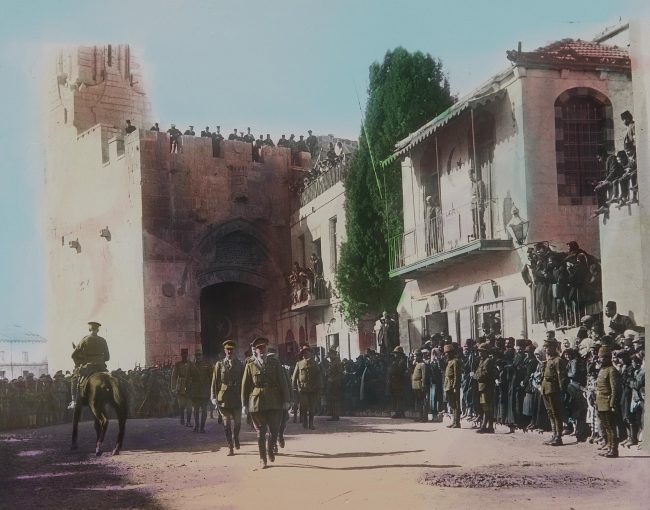
On 11 December, Allenby entered the city. He recognised the religious importance of Jerusalem and so chose to enter on foot. This respectful entrance contrasted sharply with the arrival of Kaiser Wilhelm II in 1898, who rode into the city on a white horse and was viewed as arrogant by the residents.
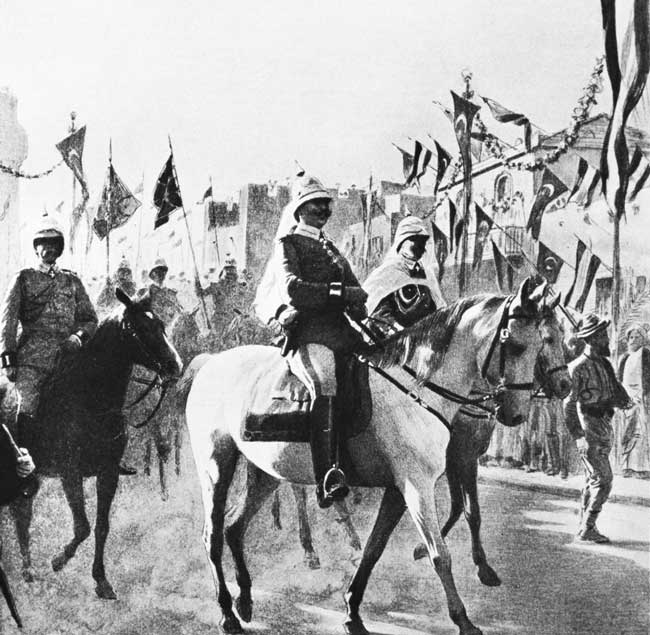
Kaiser Wilhelm entering the city in 1898. Credit: Getty Images
Back home, Lloyd George described Allenby’s victory as “a Christmas present for the British people.”