


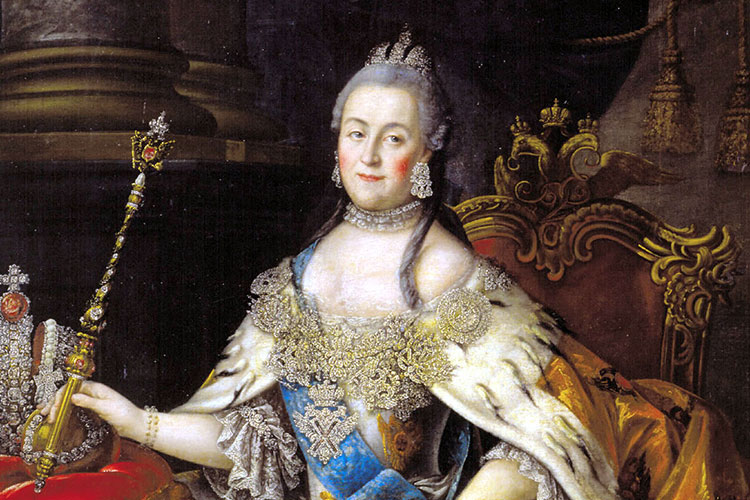

For centuries, Catherine the Great has been portrayed as a monarch of insatiable appetites, her reign as famous for alleged sexual exploits as for monumental political achievements. But who was the woman behind the whispers? And what does her private life truly reveal about power, desire, and the intricate world of 18th-century European royalty?
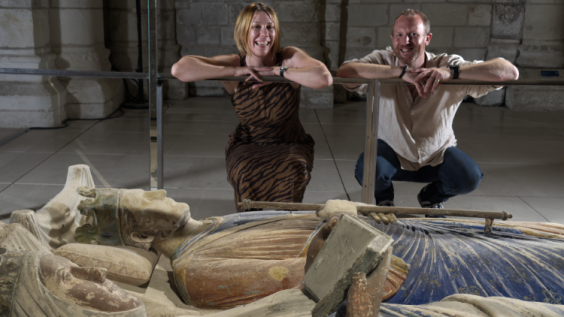
In the third episode of Betwixt The Sheets’ Royal Sex mini-series, Dr Kate Lister is joined by Virginia Rounding, author of ‘Catherine the Great: Love, Sex, and Power’ and a literary critic specialising in Russian and women’s history, to delve into the extraordinary life of this Russian empress. Did Catherine the Great really die having sex with a horse? Was she involved in her husband’s death? And were her lovers selected for political reasons?
Prepare to challenge long-held myths and uncover the fascinating realities of one of history’s most powerful and controversial female rulers.
 Listen Now
Subscribe to Betwixt The Sheets
From German Princess to Russian Empress
Born Sophie of Anhalt-Zerbst in Prussia in 1729, Catherine was a minor German princess never destined for imperial rule. Her path to power was unexpected, a result of intricate family connections and her own formidable ambition. It was her mother, Joanna, who leveraged a sentimental connection with Empress Elizabeth of Russia, who sought a suitable bride for her nephew and heir, Grand Duke Peter.
Aged just 14, Sophie (Catherine) arrived in Russia as Peter’s chosen fiancée. Peter, slightly older and an orphan, was delighted to have company, hoping for an ally against the Russian court.
Their marriage, when it finally occurred after much pomp and religious conversion, was far from auspicious. Catherine was led to the marital chamber only to find Peter absent, engrossed in his supper. Upon his eventual arrival, he simply climbed into bed, remarked on the servants’ amusement if they saw them, and promptly fell asleep. For nearly a decade, their marriage remained unconsummated.
Catherine, intelligent and ambitious, found herself isolated in the Russian court, enduring years of neglect and unhappiness. Yet this period of personal frustration proved to be a crucial crucible for her political development. She dedicated herself to mastering the Russian language, culture, and Orthodox faith, shrewdly cultivating relationships with key figures in the court and military that would later serve her well.
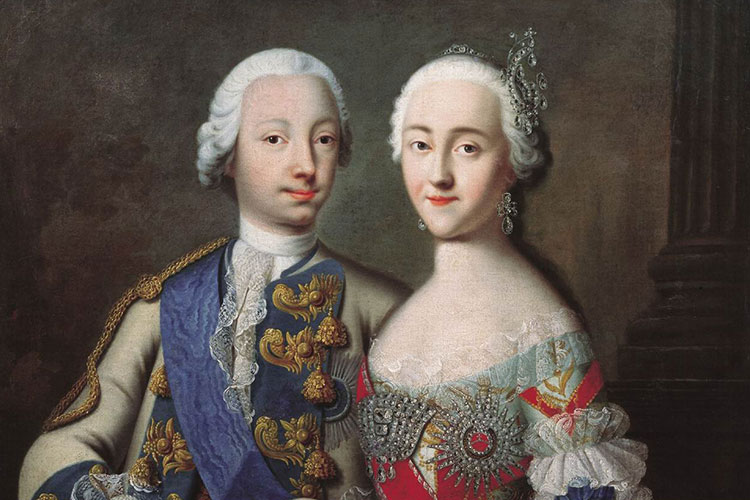
Tsar Peter III and his wife, the future Catherine the Great. He reigned only six months, and died on 17 July 1762.
Image Credit: Georg Cristoph Grooth / Public Domain
An awakening: love, politics, and motherhood
Empress Elizabeth, desperate for an heir, grew concerned about the lack of a child. It was ultimately revealed that Peter simply didn’t know what to do. Elizabeth then employed a shrewd tactic: a young widow was brought in to educate Peter on conjugal matters. Peter, it seems, proved a receptive student.
However, Catherine had already experienced her own “sexual awakening”. By her early twenties, she had fallen deeply in love with a courtier, Sergei Saltykov, her first true experience of physical affection. Later, Peter finally consummated his marriage with Catherine. Catherine fell pregnant following two earlier miscarriages, and when her son, Paul, was finally born, his paternity remained a mystery – was he Peter’s, or Saltykov’s?
Paul was immediately taken by Elizabeth to be raised as the future emperor, leaving Catherine isolated and deeply depressed. This period of intense self-education and introspection, befriended by figures like the British Ambassador Sir Charles Hanbury Williams, cemented her resolve to forge her own path.
Coup and courtly power
When Empress Elizabeth died in 1761, Peter finally became Tsar, but his reign lasted a mere six disastrous months. With little political instinct, he alienated the Orthodox Church and the army, even ceding territory during the Seven Years’ War. Sensing his instability, Catherine, having meticulously built a network of influence, seized her moment.
In 1762, supported by figures like Grigory Orlov and his brothers in the powerful Guards regiments, Catherine orchestrated a swift and largely bloodless coup d’état. Peter was swiftly deposed and, shortly thereafter, died under mysterious circumstances. Catherine was proclaimed Empress. Had she had a hand in Peter’s demise?
Her ascension immediately fuelled the scandalous rumours about her private life.
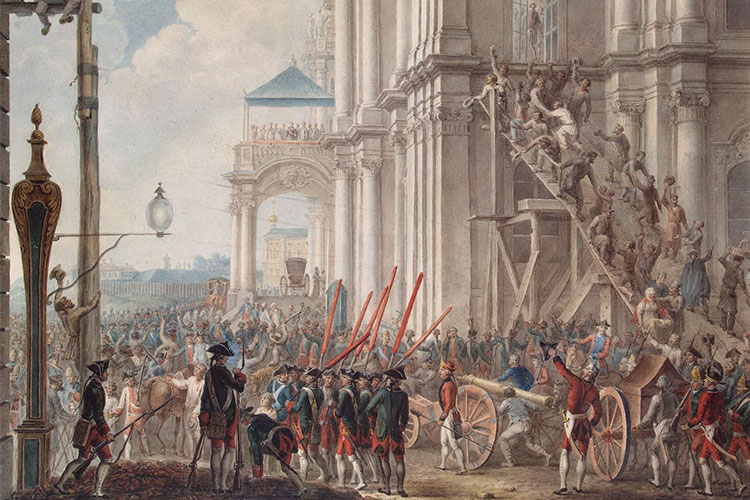
Catherine II on a balcony of the Winter Palace on 9 July [O.S. 28 June] 1762, the day of the coup.
Image Credit: Public Domain
The imperial lovers: power and passion
Catherine’s long reign (1762-1796) saw immense territorial expansion of the Russian Empire, enlightened reforms, and a flourishing cultural court. Yet her succession of male favourites – including Grigory Orlov and Grigory Potemkin – often dominated public discourse. Unlike many monarchs who conducted affairs discreetly, Catherine’s relationships were often openly acknowledged, deeply entwined with political influence.
In the podcast, Kate and Virginia explore whether Catherine’s romantic attractions in her private life may have intertwined in a calculated political move to secure crucial support and enable her ambitious reforms, or whether they were a genuine quest for companionship and love.
They also delve into the personal lives of these influential figures and their complex impact on the Empress and the Empire. You’ll discover how relationships, particularly with Potemkin – her closest confidant until his death – blurred the lines between personal passion and statecraft. Even later in her life, Potemkin continued to play a unique role, even ‘procuring’ younger lovers for her – men who were both pleasing and teachable.
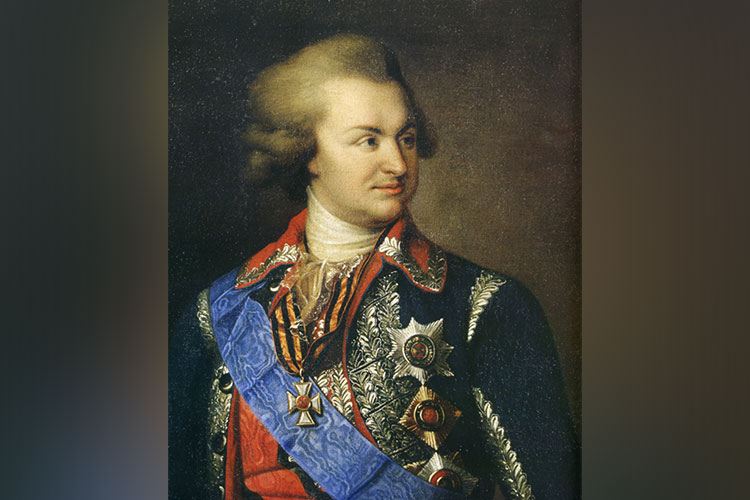
Grigory Potemkin
Image Credit: Public Domain
Servant of Russia?
Catherine the Great died in 1796. For centuries, the popular narrative of Catherine the Great has been dominated by exaggerated tales of sexual excess, most notoriously including the infamous rumour involving Catherine and a horse. The podcast delves into this pervasive myth, aiming to separate fact from fiction. By examining contemporary accounts, diplomatic reports, and Catherine’s own extensive correspondence, Kate and Virginia explore how such salacious rumours originated and why they endured, revealing the profound societal anxieties surrounding female authority in the 18th century.
Catherine the Great was undeniably a woman of intellect, ambition, and extraordinary will. She corresponded with Enlightenment thinkers like Voltaire and Diderot, reformed laws, founded schools, and dramatically expanded Russia’s borders. Her personal relationships, while fascinating, were but one facet of an empress who redefined Russian power.
As Virginia suggests, Catherine “saw herself as a servant of Russia”, a civilising influence who embraced Enlightenment ideals – much of the stigma surrounding Catherine stems from the very fact she was a successful female ruler who defied 18th century expectations.
Join Dr Kate Lister on Royal Sex: Catherine the Great to navigate the intricate world of rumour, power, and passion that defined one of history’s most compelling monarchs. Uncover the true legacy of Catherine the Great – beyond the whispers and into the complexities of her reign.
Listen Now