



The latter years of World War Two were marked by a technological arms race and the search for a super weapon that would force the opposing side into submission. Germany produced a variety of “wonder weapons” that were advanced technological innovations, but the atomic bomb eluded its researchers.
Instead, it was the United States who cracked the secret of the bomb through the “Manhattan Project”, culminating in the only use of atomic weapons in warfare, the defeat of Japan and ushering in a new era of uneasy peace. Here are 10 facts about the Manhattan Project and the development of early nuclear weapons.
1. The Nazi state hindered German progress
While Germany had been the first country to discover nuclear fission and begin research in April 1939, its programme never accomplished its goal. This was due to a lack of state support, as well as the Nazis’ discrimination against minorities, something that made many prominent scientists leave the country.
 Listen Now
2. A British-Canadian atomic bomb programme was absorbed into the Manhattan Project
The “Tube Alloys” project became part of the US programme in 1943. Despite American promises to share the research, the US did not provide full details of the Manhattan Project to Britain and Canada; it took another seven years for Britain to successfully test a nuclear weapon.
3. Atomic bombs rely on the creation of a chain reaction that releases immense thermal energy
This is caused when a neutron strikes the nucleus of an atom of the isotopes uranium 235 or plutonium and splits the atom.
4. The Manhattan Project grew BIG
So much so that it eventually employed more than 130,000 people, and cost almost $2 billion (almost $22 billion in current money).
5. The Los Alamos Laboratory was the project’s most significant research centre
Set up in January 1943, it was led by research director J. Robert Oppenheimer.
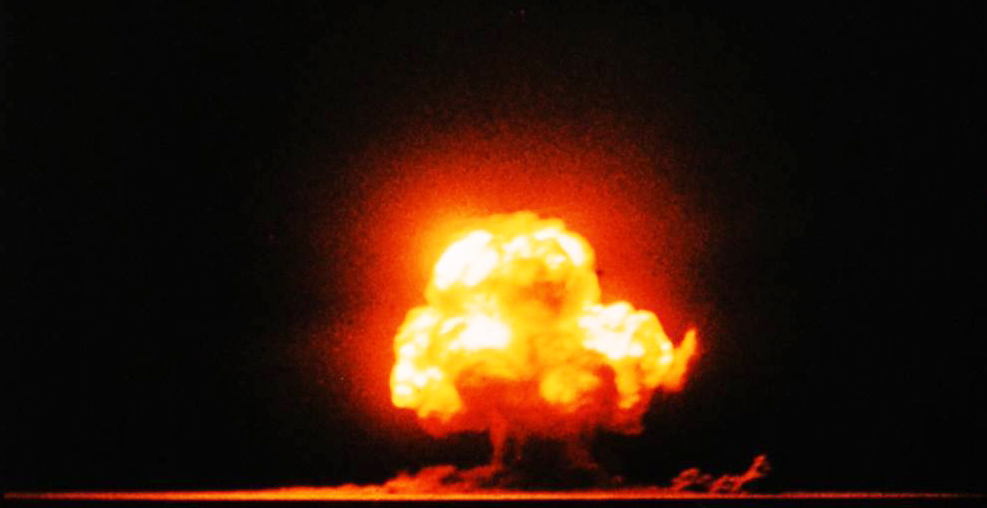
6. The first detonation of a nuclear weapon took place on 16 July 1945
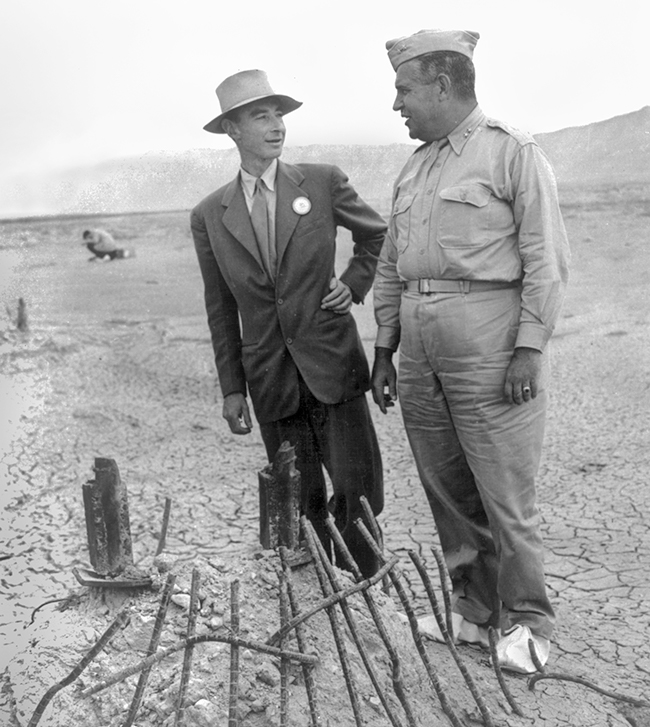
Oppenheimer and Manhattan Project director Lt Gen Leslie Groves of the US Army Corps of Engineers visit the site of the Trinity test in September 1945, two months after the blast.
The test had been code named “Trinity” in homage to the John Donne poem Holy Sonnet XIV: Batter My Heart, Three-Personed God, and took place in the Jornada del Muerto desert in New Mexico.
7. The first bomb was nicknamed “The Gadget”
It had the explosive energy of around 22 kilotons of TNT.
8. Oppenheimer quoted a Hindu text after the test proved successful
“I have become death, destroyer of worlds,” he said, quoting a line from the Hindu sacred text the Bhagavad-Gita.
9. The first nuclear bombs to be used in warfare were nicknamed “Little Boy” and “Fat Man”
 Watch Now
Little Boy was dropped on the Japanese city of Hiroshima,while Fat Man was dropped on Nagasaki, another Japanese city.
10. The two bombs worked in different ways
Little Boy relied on the fission of uranium-235, while Fat Man relied on the fission of plutonium.