



The Battle of Hastings is one of the most famous and significant in British history, despite taking place nearly 1,000 years ago. Like so many battles throughout time, it was sparked by one man’s desire to dethrone a king and claim the crown for himself.
In this case, that man was a French duke whose victory in the battle was to usher in Norman rule over England. Here are 10 facts about the battle.
1. Fighting was sparked by the arrival in England of William the Conqueror
William, who then held the duchy of Normandy in France, wanted to usurp England’s King Harold II. He believed the English throne had been promised to him by Harold’s predecessor, Edward the Confessor.
2. It did not actually take place in Hastings
 Listen Now
Although it became synonymous with this coastal town in Sussex, the battle actually took place in an area seven miles away. Today, this area is aptly named “Battle”.
3. William had an advantage
 Listen Now
The French duke had two weeks in between landing on the Sussex coast and the Battle of Hastings to prepare his forces for a confrontation with the English army. Harold and his troops, on the other hand, had been busy fighting another claimant to the throne in the north of England just three days ahead of William’s arrival.
That, coupled with the fact that Harold’s men had to hurry back down south, meant they were battle-weary and exhausted when they began to fight. But despite this, the battle was closely fought.
4. It was unusually long by medieval standards
Beginning at 9am on 14 October 1066 the battle lasted less than a day and is believed to have been over by nightfall. But although this may seem short by today’s standards, at the time such battles were often over within an hour.
5. It is not clear how many fighters took part
There is much debate over how many men were put forward by each of the opposing sides, though it is currently thought that both armies had between 5,000 and 7,000 men.
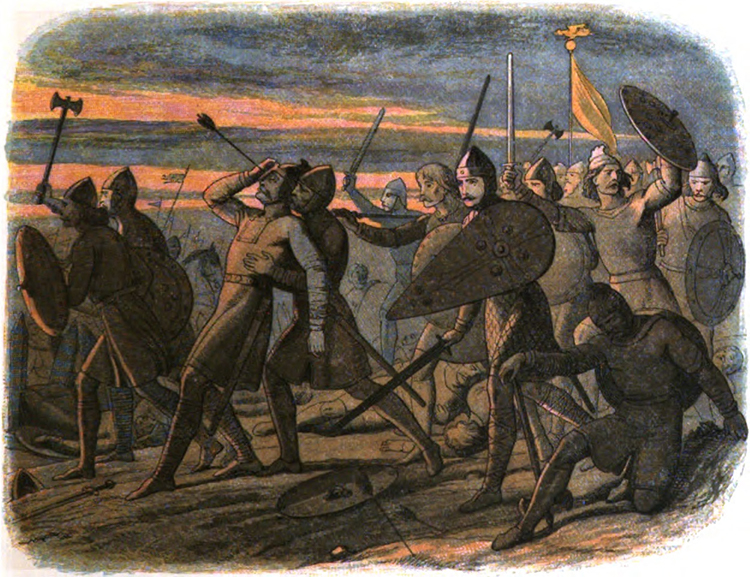
6. The battle was bloody
 Listen Now
Thousands of men were killed and both leaders were feared dead at various points. However, it was Harold who eventually succumbed.
7. Harold met a gruesome end
The English king was killed during the final assault by the Normans but accounts differ as to how he actually died. One particularly grisly telling says he was killed when an arrow became lodged in his eye, while another describes how he was hacked to death.
8. The battle has been immortalised in the Bayeux Tapestry

The tapestry tells the story of how William usurped Harold to become king.
This embroidered cloth, measuring nearly 70 metres in length, depicts scenes from the tale of the Norman conquest of England. The tapestry was made in the 11th century but is remarkably well preserved.
9. Early accounts of the battle rely on two main sources
One is chronicler William of Poitiers and the other is the Bayeux Tapestry. William of Poitiers was a Norman soldier and although he did not fight at the Battle of Hastings himself, it was clear he knew those who had.
10. The battle brought an end to more than 600 years of rule in England by the Anglo-Saxons
In its place came Norman rule and that brought with it many wide-reaching changes, including to language, architecture and English foreign policy.