



About Verona Arena
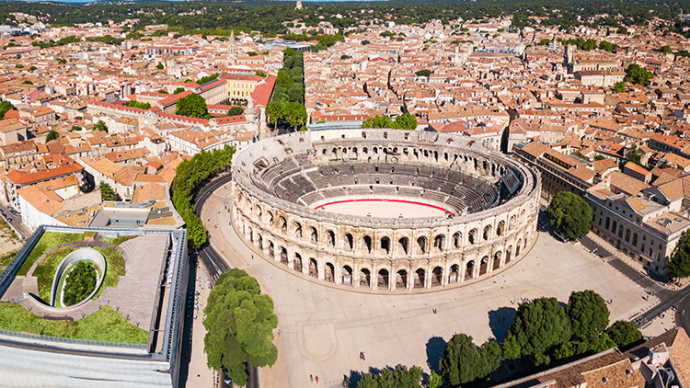
Verona Arena (Arena di Verona) is a stunning Roman amphitheatre built in the 1st century AD and said to have been the third largest of its time after the Colosseum and Campania Amphitheatre, which served ancient Capua.
As with many similar Roman constructions, the arena suffered during the decline and fall of the Empire and was pillaged for masonry during the middle ages. Despite this however, and with a certain amount of restoration, Verona Arena stands in an excellent state of preservation today and still hosts a number of events, operas and open-air performances.
Verona Arena history
Built in 30 AD outside the city walls, Verona Arena was originally made up of three elliptical rings of arches, of which the second is the best preserved and little remains of the first. During its prime the arena could hold up to 30,000 people and would have played host to an array of ancient entertainment, including the famous gladiatorial games.
The main round building was made from white and pink limestone although this was later damaged by an earthquake in 1117, and the stone was used for building elsewhere. Nonetheless, the Verona Arena continued to draw medieval visitors to the city.
Operatic performances started during the Renaissance but exploded after 1913 under the zeal of opera tenor Giovanni Zenatello. Since then, opera summer seasons have continued at Verona Arena except for the years Europe was at war.
Verona Arena today
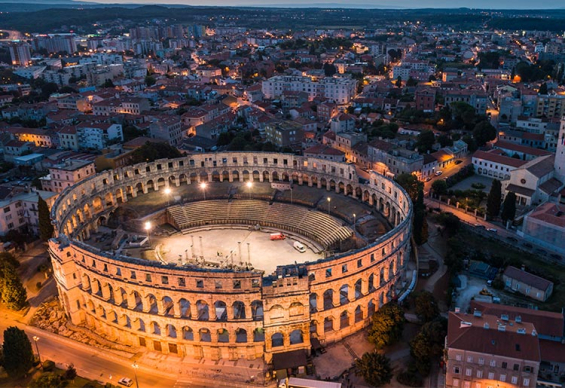
Today, the Verona Arena is internationally renowned for its impressive opera performances and is one of the best preserved ancient buildings of its kind. Open between 8.30am and 6.30pm, the Verona Arena has seating of 44 levels that can hold 22,000 people and visitors can climb to the top level to view the full stadium and city during the daytime. At night, the Verona Arena is spectacularly lit up, showcasing the best of Roman architecture.
Getting to Verona Arena
By car, take the A4 motorway running between Milan and Venic and exit at Verona Sud, or take the A22 motorway and join the A4. By public transport, the blue public buses link the centre of Verona with towns outside and city buses 11, 12, 13, 14, 72 and 73 go from the rail station to Piazza Bra – the central city square where the Verona Arena is located. The main train station is Verona Porta Nuova linking to Milan, Venice and Rome with trains running throughout the day.
Featured In
Roman Amphitheatres
Immerse yourself in the bloody history of Ancient Rome's amphitheatres at these 10 impeccably preserved sites across the globe.