


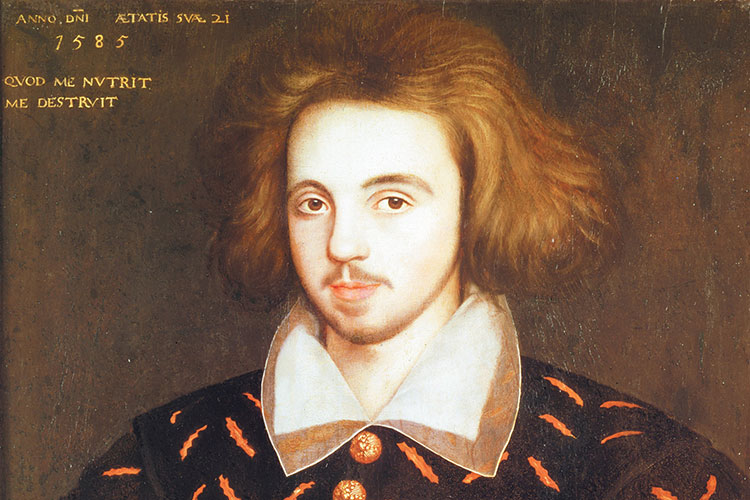

The date is 30 May 1593. The setting is a quiet house in Deptford, a bustling port town on the outskirts of London. In a private room, four men are engaged in conversation. Hours pass, wine is drunk, and a game of backgammon is played. Then, an argument erupts over a seemingly trivial matter: the bill. A dagger is drawn, a scuffle ensues, and within moments, the famed playwright and poet Christopher Marlowe lies dead, a blade plunged through his eye and into his brain.
This is the official account, based on a coroner’s inquest and passed down for centuries – but what if it’s not the whole story? What if the “tavern brawl” was no accident but a planned assassination? Who truly stabbed the titan of the Elizabethan stage, and who, in the dark, conspiratorial world of Tudor England, might have carefully orchestrated his death?
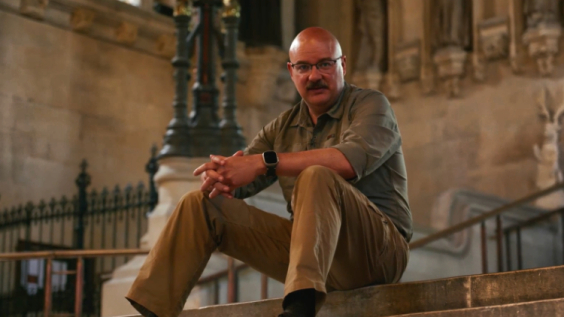
In History Hit’s podcast, Not Just the Tudors, Professor Suzannah Lipscomb steps out of the sunlight and into the shadows to investigate the most notorious true crimes of the period in a Tudor True Crime mini-series. In this episode, she is joined by literary historian and author, Charles Nicholl, whose groundbreaking book, The Reckoning: The Murder of Christopher Marlowe, challenged the long-held assumptions about that fatal day. Together, they re-examine the original coroner’s inquest, a document that, for centuries, kept the true nature of Marlowe’s death a secret, and dig deeper into a mystery that, more than 400 years later, remains a subject of intense speculation and historical detective work.
 Listen Now
Subscribe to Not Just The Tudors
Christopher Marlowe, a writer whose genius rivalled that of Shakespeare, was just 29 years old when his life was cut short. His death, often dismissed as the tragic consequence of a drunken squabble, has long been a source of fascination. It was a scandal whispered about in the streets and immortalised in the work of his contemporary, Shakespeare, who six years later would write in As You Like It of a “great reckoning in a little room.” This phrase, an unmistakable nod to Marlowe’s demise, highlights the widespread suspicion that the official story was a cover-up for something more sinister.
The coroner’s inquest
To uncover the truth, Suzannah and Charles revisit the crucial document that provided the official narrative: the coroner’s inquest. From this account, we learn that four men met at a house belonging to a woman named Eleanor Bull on Deptford Strand. The men were Marlowe and three of his associates: Ingram Frizer, Nicholas Skeres, and Robert Poley. They spent a long day together, talking, eating, and walking in the garden before returning to the private room.
According to the inquest, a dispute over the “reckoning” – the bill for food and drink – escalated violently. Marlowe, lying on a bed while the other three sat with their backs to him, allegedly snatched Frizer’s dagger and struck him twice on the head with the hilt. In the struggle that followed, Frizer supposedly twisted the weapon back and delivered the fatal thrust.
But as Charles Nicholl points out to Suzannah, a closer look at this account immediately raises red flags. “We can dispense straight away from the inquest…that it wasn’t really a tavern brawl,” he explains. The location wasn’t a public house, but a private residence. And with only four men in the room, it’s hardly what one would call a brawl. More damning still, the inquest’s narrative is based on the testimony of the three men who walked out alive.
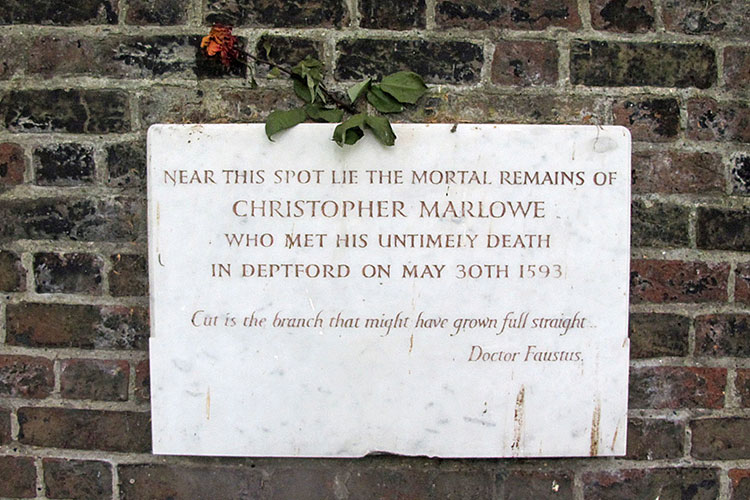
Christopher Marlowe’s memorial in the Churchyard at St Nicholas, Deptford. The epithaph is from the epilogue to Marlowe’s play ‘Doctor Faustus’.
Image Credit: Flickr: Maggie Jones / Public Domain
The suspects
So, who were these three men? As Charles bluntly puts it, they were “a trio of absolute scoundrels.” And their connections to one another and to Marlowe reveal a web of intrigue far more complex than a simple dispute over a bill.
First, there was Ingram Frizer, the man who struck the fatal blow. He was a crooked businessman, but more importantly, he was a servant of Thomas Walsingham, one of Marlowe’s powerful patrons. Marlowe had been staying at Walsingham’s house just 10 days before his death.
Then there was Nicholas Skeres, a low-level operator involved in the world of intelligence and “dirty tricks.” He was also connected to the powerful Earl of Essex, a favourite of Queen Elizabeth I.
Finally, there was Robert Poley, a spy of significant stature. By 1593, Poley was a senior agent working for Sir Robert Cecil, the son of the spymaster Lord Burghley. A man of “dangerous charm,” Poley was a central figure in the Elizabethan espionage machine.
These were not random drinking companions. They were a carefully chosen group of men with deep ties to the very heart of the Tudor secret service, assembled to meet with a man who, for all his literary brilliance, was also a low-level government spy.
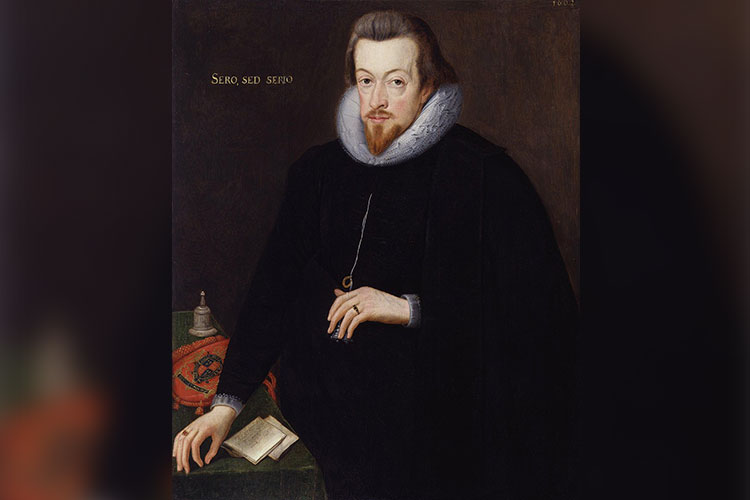
Sir Robert Cecil, 1st Earl of Salisbury, the son of the spymaster Lord Burghley. Robert Poley was working for Sir Cecil at the time of Marlowe’s death.
Image Credit: National Portrait Gallery / Public Domain
Political links and espionage
For centuries, the coroner’s inquest remained the sole surviving official document, its details a closely guarded secret. It wasn’t until 1925 that archivist Leslie Hotson discovered uncatalogued legal proceedings connecting Marlowe’s murder to the shadowy world of politics and espionage. Before this revelation, the truth was shrouded in rumour and misinterpretation, with historical mix-ups even leading to the wrong killer’s name being recorded in church registers for decades.
The real questions, as Suzannah and Charles explore, lie in the motive. Why would three men of such influence, who had spent a full day in Marlowe’s company, suddenly fall into a violent argument?
Charles Nicholl argues that the entire meeting was a ruse – a long, eight-hour “reckoning” that had nothing to do with a bill. The men were there to talk to Marlowe about his “blasphemies” and political leanings. Marlowe was a man of contradictions: a religious subversive, a brilliant dramatist, and a spy for the Crown. Charles suggests that the authorities were worried.
Marlowe’s radical views, often reflected in his plays, were a liability, and his intelligence work gave him dangerous knowledge. The long day in Deptford was likely an attempt to get Marlowe to turn on one of his patrons, Sir Walter Raleigh, in exchange for his own freedom.
Settling scores
Ultimately, the fatal “dispute” was not a spontaneous outburst but a culmination of a life lived on the dangerous borders of acceptable behaviour. Marlowe, the creator of fictions on the stage, was also a creator of fictions in his espionage operations. This double life, as Charles explains, made him both a valuable asset and a ticking time bomb. The “reckoning” in that little room in Deptford was less about a bill for food and drink and more about settling a score for good.
The question of who murdered Christopher Marlowe and why remains, but by re-examining the evidence, uncovering the identities of the men in that room, and peeling back the layers of Tudor espionage, Professor Suzannah Lipscomb and Charles Nicholl offer a compelling and suspenseful account that will challenge everything you thought you knew about one of England’s greatest writers.
Join them as they pull back the curtain on this extraordinary true crime.
Listen to the latest episode of Not Just the Tudors and discover the truth behind the murder of Christopher Marlowe.