


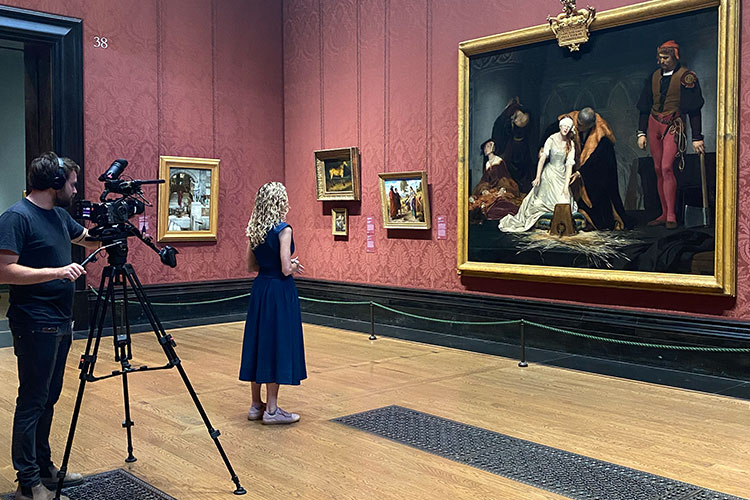

For nearly two centuries, our memory of Lady Jane Grey has been filtered through Paul Delaroche’s celebrated 1833 painting. ‘The Execution of Lady Jane Grey’ is a masterpiece of Victorian pathos: a blindfolded girl in white silk, her neck bared for the axe, radiating a heartbreaking, fragile innocence. This image of the “hapless victim” has become the definitive trope of the Tudor age.
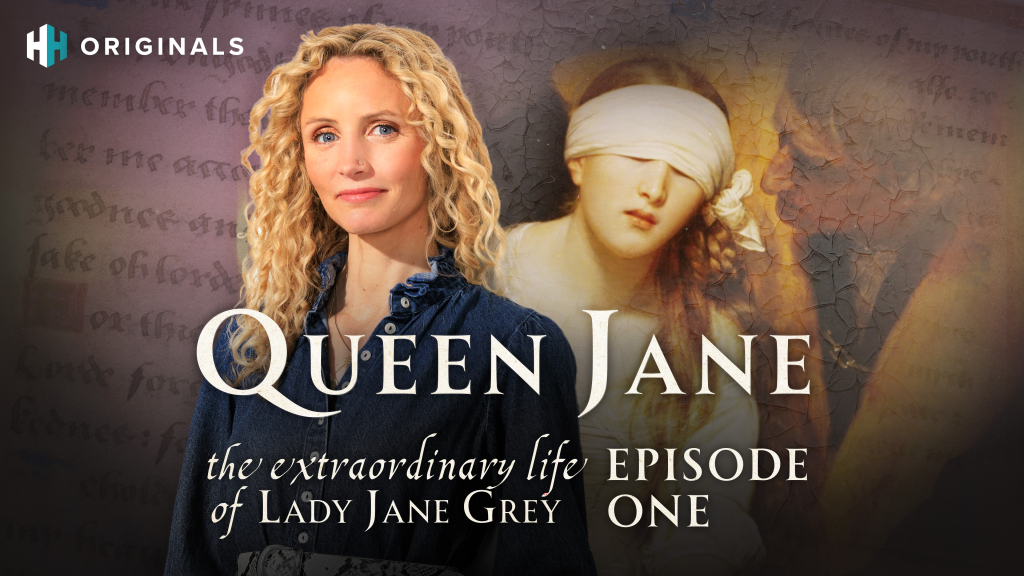
But was Jane Grey truly the passive pawn history suggests? In History Hit’s new documentary series, Queen Jane: The Extraordinary Life of Lady Jane Grey, Professor Suzannah Lipscomb peels back the layers of romantic fiction to reveal the woman behind the myth. By examining Jane’s tragic story, Suzannah uncovers the precarious nature of power in a patriarchal age where a female sovereign defied all precedent.
It is time to meet the real Jane: an intellectual powerhouse, a defiant Protestant, and – as one historian describes her – a “kick-ass woman” of the Tudor court who reigned as Queen of England for 13 days.
 Watch Now
Beyond the ‘Nine-Day’ myth
In Episode One, Suzannah explains how the story of Lady Jane Grey has been mythologised in the centuries since her death, noting how we need to think about how unwittingly we buy into that.
“We refer to her as Lady Jane Grey – using her maiden name – and we don’t give her her title, ‘Queen Jane’”. Even the term ‘the 9 days queen’ is the victor’s perspective – she ruled for 13 days, from the death of Edward VI to the coup of Mary I.
Instead, we should try to reckon with the real 17 year old noble woman and queen – the first queen to rule England in her own right?

‘The Execution of Lady Jane Grey’ by Paul Delaroche, 1833
Image Credit: Public domain, via Wikimedia Commons
Messages from Jane’s final hours
The most visceral evidence of Jane’s character lies in her own hand. At the British Library, Suzannah meets curator Andrea Clark to examine Jane’s personal prayer book – a tiny volume she carried to the scaffold. In its margins, Jane wrote personal messages in her final hours, including a poignant note of comfort to her father and a message she wrote to Sir John Brydges, Lieutenant of the Tower of London, who asked to keep her prayer book as a memento and to write a message to him in it.
While history paints her as a frightened child, these notes reveal a woman of immense poise and an unwavering adult stoicism and faith. “She seems so adult,” Suzannah observes. “We talk about her as this teenage girl, but here she is comforting her father.”

Writing inside Lady Jane Grey’s prayer book, including her own handwriting written in.
A linguistic prodigy
To understand Jane’s steel, Suzannah looks at her upbringing at Bradgate Park in Leicestershire. Born between October 1536 and May 1537 into the royal lineage – her maternal grandmother was Henry VIII’s sister – Jane was never intended for a quiet life. While the average Tudor man was illiterate, Jane was a linguistic genius, mastering as many as eight languages.
Historian Dr J. Stephan Edwards explains how Jane’s father “spent considerable sums of money hiring the best people to teach her, which shows he was invested in his daughter’s learning.” The sophistication of Jane’s learning was extraordinary for the time – her education wasn’t just broad, it was elite, comparable to the finest university minds of the era.
From the metaphysics of Plato to the radical Protestantism encouraged by her mentor, Queen Catherine Parr (whom Jane lived with for a time), Jane was being forged into one of the best-educated people in Western Europe. Her only true intellectual rival was her cousin, the future Elizabeth I.
This was a woman who practiced the intricate art of penmanship with a perfectionist’s flare, a trait that signalled her intense focus and self-control.
Turning the tide of history
Jane’s path to the throne was not paved by her own ambition, but by the dying wishes of her cousin, the 15 year-old King Edward VI. As Edward’s health failed in 1553, he grew desperate to prevent his Catholic half-sister, Mary, from seizing power and dismantling the Protestant Reformation.
At the British Library, Suzannah examines Edward VI’s personal journal, which contains a candid, firsthand account of his intense religious clashes with his Catholic half-sister, Mary. This sets the stage for her visit to the Inner Temple legal library, where she investigates Edward’s ‘Device for the Succession’ – a fascinating map of a young yet dying King’s mind and a radical document that would change the course of English history.
Originally, Edward limited the succession to ‘heirs male’ – excluding his two older half-sisters Mary and Elizabeth out of hand which even his own father had declared illegitimate. Instead he preferred a line of descent through Henry VIII’s sister, his aunt Mary Tudor and her eldest daughter, the Protestant Lady Frances Grey, and through any future male offspring of her Protestant daughters, Lady Jane Grey and her sisters Lady Katherine and Lady Mary.
However, with death approaching and no male heirs in sight, Edward made a “judicious stroke of the pen” and altered his own legal decree by striking through the ‘s’ in ‘Lady Jane’s’ to create: ‘Lady Jane and her heirs male.’ With that single correction, he bypassed his sisters and placed Jane directly on the throne.

Edward VI’s ‘Device for the Succession’
Image Credit: Inner Temple Legal Library / History Hit
The King’s radical gamble
The documentary goes on to reveal the high-stakes gamble that forced the Privy Council “into a rock and a hard place situation”, according to head librarian Rob Ho. Suzannah views the original agreement where the highest lords in the land signed their names to Edward’s plan – a document that many feared was pure treason.
Had Edward lived until the autumn to enshrine this in law via Parliament, Jane’s reign might have lasted 40 years instead of 13 days. She was a woman built for power – assertive, brilliant, and unwilling to be controlled by the men surrounding her.
The precarious nature of power
Jane Grey’s story is a haunting reminder of the precarious nature of power in a patriarchal age. She was a woman built for sovereignty – assertive, brilliant, and unwilling to be controlled by the men surrounding her.
So how did a woman of such formidable intellect and resolve lose her grip on the crown in less than a fortnight? And what happened when the disinherited Mary Tudor began her ruthless, high-stakes march on London?