


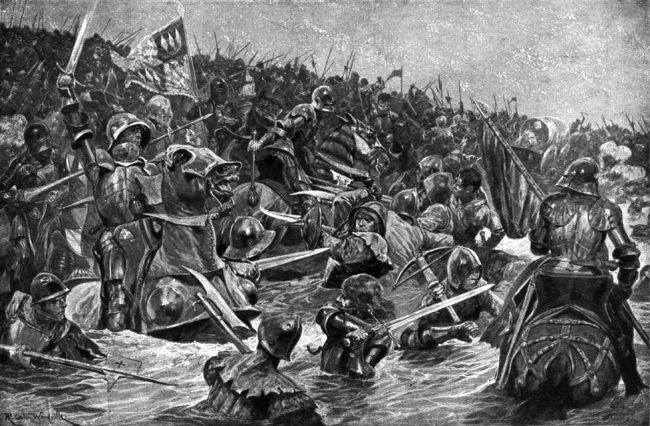

For around 30 years England saw an epic battle between two families – the house of York and the House of Lancaster. The war would see the rise of the Tudor Dynasty and the fall of the Plantagenets. Here are the major encounters.
1. The Battle of St Albans (22 May 1455)
The opening battle of the War of the Roses saw Richard Duke of York lead an army of 3,000 men against London. He had been named Lord Protector while Henry VI recovered from a bout of insanity. However, he had been dismissed as the king’s wife Margaret sensed a threat to the hopes of her own son Edward.

A modern day procession as people celebrate the Battle of St Albans.
The King’s army set up a defensive position in the town of St Albans, but a surprise attack from the Earl of Warwick overran their defences. Henry was captured and taken to London.
2. The Battle of Wakefield (30 December 1460)
After an uneasy peace between the sides, Richard was defeated at the battle of Ludford Bridge in 1459. He escaped to Ireland, to the relative safety of Dublin.
York’s allies returned to England in 1460 and again captured Henry at the battle of Northampton. York returned and tried to claim the throne, but was refused. Instead he would serve as Lord Protector while his sons, rather than Henry’s, would inherit.
Meanwhile the Lancastrians were gathering their strength in the north. Richard, along with Richard Neville, the Earl of Salisbury, marched north where he surprisingly attacked a much larger army. Richard’s forces were overwhelmed and he was killed.
 Watch Now
3. The Battle of Towton (29 March 1461)
Despite Richard’s death at Wakefield, his son Edward had still managed to make it to London where he had claimed the crown. He still needed to win it though and he attacked the Lancastrians at the town of Towton.
Edward’s archers held an advantage. By using the snow and the wind they were able to shoot further than their adversaries. The Lancastrian response was to charge, but just as it seemed the Yorkist line was about to break John Mowbray, the Duke of Norfolk, arrived with reinforcements and Edward won the day. Henry VI and the Queen fled and Edward was crowned formally at Westminster.
4. The Battle of Tewkesbury (4 May 1471)
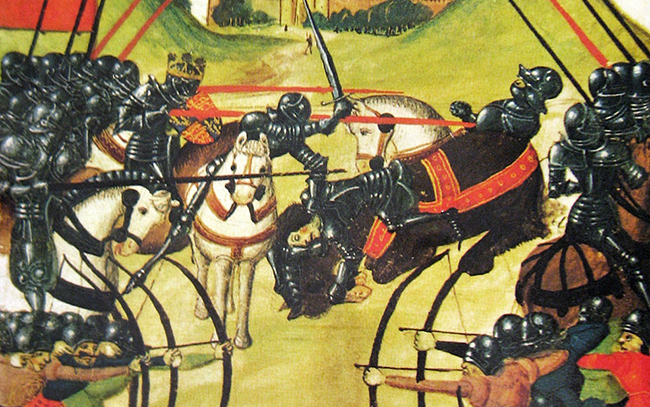
The Battle of Tewkesbury.
Edward had ruled for eight years, but his marriage to Elizabeth Woodville alienated many of his key allies, chief of which was the Earl of Warwick, the so called King Maker. Warwick changed sides and swore his allegiance to the Lancastrian cause. He was defeated, however, and killed just as Margaret was on her way back to England to claim her crown.
The Lancastrian forces fled towards the Welsh border. They were intercepted by Edward at Tewkesbury where Margaret’s son, Edward the Prince of Wales, was killed. Edward was now in complete control.
5. The Battle of Bosworth Field (22 August 1485)
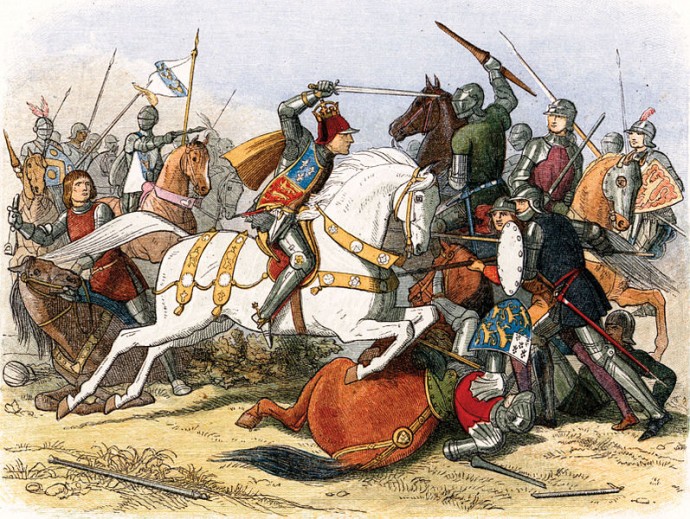
This engraving by James Doyle in 1864 depicts the Battle of Bosworth.
After the death of Edward IV power should have gone to his son Edward. However, both the young princes were killed while in the Tower of London. Though widely suspected in the killing, Edward’s brother Richard became King.
Meanwhile the new Lancastrian claimant, Henry Tudor landed in Wales to challenge Richard for the crown. They met at Bosworth where Lord Thomas Stanley and his brother Sir William switched sides from Richard to Henry.
 Listen Now
The Yorkists were defeated and Richard was killed. Henry was crowned the first of the Tudor Kings. Although a further battle occurred in Stoke, the War of the Roses had effectively come to an end.