


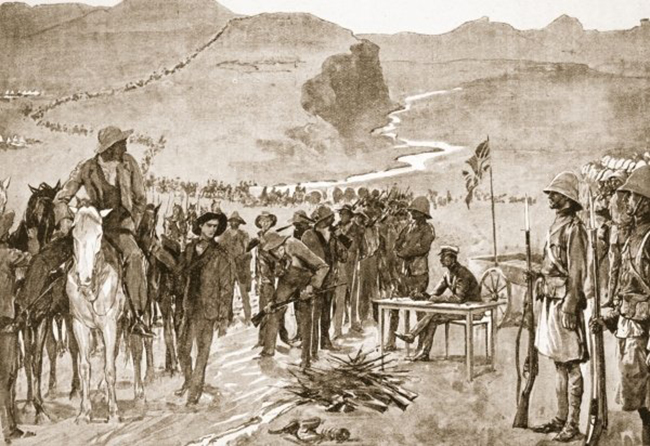

In October 1899 the Boer War began between the British Empire and the Boers of South Africa. The war, which took place at the beginning of the 20th century, left a warning of a new type of warfare, as it involved machine guns, trench warfare and even concentration camps.

A Transit camp for Prisoners of War near Cape Town.
Uneasy neighbours
Relations between the British colony of South Africa and its original Dutch-descended European inhabitants, the Boers, had been worsening throughout the 19th century. The British abolition of slavery in South Africa in 1834 was particularly inflammatory, and many Boers left British lands in what was known as the Great Trek.
There they formed two Boer republics, the Transvaal and the Orange Free State, which were recognised by the British in the 1850s. However, this suggestion of relative harmony was shattered in 1880, when the British attempted to annexe the territories. They suffered defeats, however, and the Republics retained their independence.
 Watch Now
In 1886 relations worsened again as gold was discovered in the Transvaal, leading to massive British and Commonwealth immigration into Boer territories. The immigrants, or Uitlanders, were often treated badly, and this lead to the Jamestown Raid of 1895, where uitlanders were encouraged to rise up against their Boer oppressors.
Such incidents, combined with British demands for full voting rights for uitlanders, led to Transvaal leader Kruger issuing an ultimatum demanding that British troops leave their borders. On 11 October, the ultimatum was rejected and the war began.
A long and bloody war
The war is divided into three distinct phases by historians. In the first, the Boers launched raids into British territory and won a number of victories, most famously at Spion Kop, where Boer rifle fire proved deadly.

British casualties at Spion Kop.
However, throughout 1900 more British and Commonwealth troops arrived, and the Boers were pushed back. By the end of the year their capital Pretoria had been taken.
The final phase, which dragged on for over two years, involved a new kind of guerrilla warfare conducted by the Boers, which drained British resources and infuriated a public eager for an outright victory. However, the Boers were eventually subdued in 1902 and all of South Africa unified in 1910.
 Watch Now