



After the civil war, the killing of the king, and Cromwell’s republic, Britain’s monarchy came back – but nothing would be the same.
Across February and March, Professor Suzannah Lipscomb is exploring the kings and queens of the Restoration on History Hit’s Not Just The Tudors podcast. This era represents one of the most volatile and vibrant chapters in British history, a period where the crown had to be reinvented for a new, skeptical age. This special series, Monarchs of the Restoration, peels back the velvet curtains on the Stuart kings and queens who steered Britain from the brink of collapse toward the birth of a global superpower.
How did a soot-blackened fugitive clinging to a tree become the king who triumphantly sailed home to reclaim his crown? NJTT covers Charles II’s survival, the sheer spectacle of his court, and the seismic transformation of England during the Restoration. From the return of the theatre to the birth of modern science, this series uncovers the drama of the Stuart dynasty’s final act.
Charles II: the Merry Monarch’s mask
The series begins with perhaps the most cinematic escape in royal history. Before he was the “Merry Monarch,” Charles II was a soot-blackened fugitive clinging to an oak tree, evading Roundhead patrols with a price on his head.
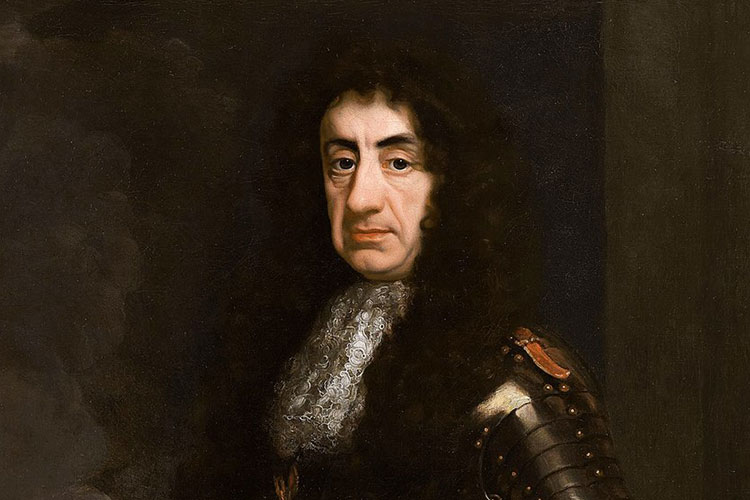
Charles II – Portrait by John Riley, c. 1683–1684
Image Credit: Public Domain
Professor Lipscomb traces this journey from desperate survival to the triumphant day Charles sailed home to reclaim his crown. But the Restoration was about more than just a king returning to his palace. Under Charles II, England emerged from the shadow of Puritan austerity into an age of unfettered pleasure, scientific revolution, and theatrical scandal.
Yet, as Suzannah discovers, this era of “glittering courts” was also defined by the grim realities of the Great Plague and the Great Fire of London. Was Charles a visionary who saved the monarchy, or a hedonist who nearly lost it again?
Listen to Episode 1: Charles II: Restoration of the Monarchy
James II: faith, fear, and the fall
If Charles II was a master of political pragmatism, his brother, James II, was a man of unyielding conviction. In the second episode, Suzannah is joined by Dr Breeze Barrington to uncover the man behind the myth of the “Last Catholic King.”

James II by Peter Lely, circa 1650-1675
Image Credit: Peter Lely, Public domain, via Wikimedia Commons
James II is often relegated to a footnote – the monarch swept aside to make room for William and Mary. However, behind the Glorious Revolution, his story is a high-stakes drama of religious devotion and political downfall. Was James a tyrant blinded by his Catholic faith, or a misunderstood visionary who genuinely sought religious toleration in an intolerant age? This episode unpicks the tensions that brought the nation once more to the brink of revolution.
Listen to Episode 2: James II: The Restoration’s Last Catholic King
Mary II: the power behind the “joint” throne
History often speaks of “William and Mary” as a singular unit, but Queen Mary II was a formidable force in her own right. In the third episode of Not Just The Tudors’ special series, Monarchs of the Restoration, Suzannah welcomes Dr Holly Marsden to discuss England’s first and only joint sovereign.
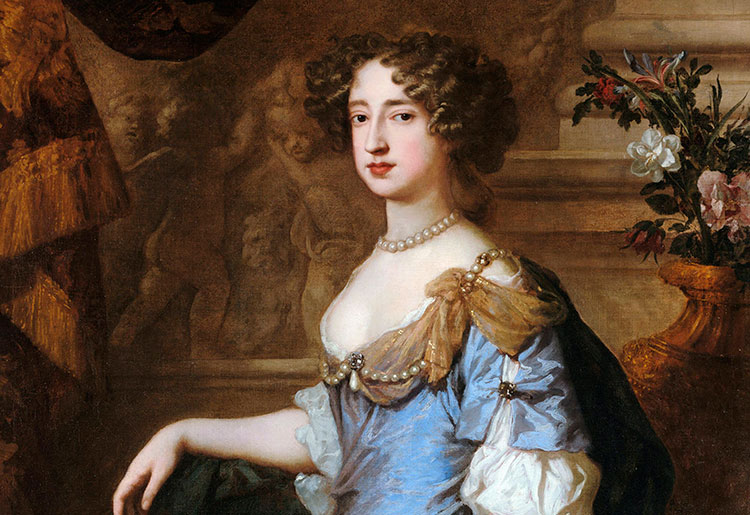
Portrait by Peter Lely, 1677
Image Credit: Peter Lely, Public domain, via Wikimedia Commons
Far from being a passive partner to her Dutch husband, William of Orange, Mary was politically astute, deeply devout, and culturally influential. She played a pivotal role in the “Glorious Revolution” and the crafting of Britain’s constitutional monarchy – the very system that survives today. This episode reclaims Mary’s place in history, exploring her influence on gender roles and the radical political shifts of the late 17th century.
Listen to Episode 3: Queen Mary II & the Glorious Revolution
Queen Anne: the underestimated architect of Great Britain
The series concludes with the monarch who is perhaps the most unfairly caricatured of all: Queen Anne. Long dismissed as sickly, overweight, and easily manipulated by favourites like Sarah Churchill, the reality of Anne’s reign tells a vastly different story.
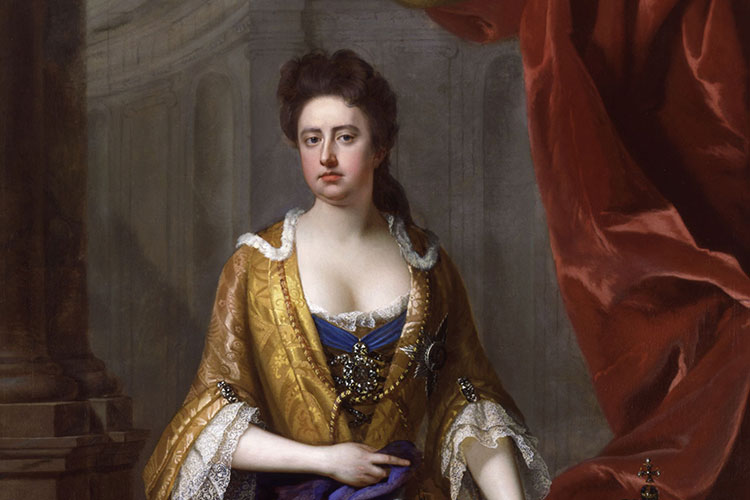
Queen Anne, portrait, 1705, by artist Michael Dahl
Image Credit: National Portrait Gallery, Public Domain
Joined by biographer Lady Anne Somerset, Professor Lipscomb examines the last Stuart monarch – a woman who presided over the Acts of Union that created Great Britain and who navigated a reign defined by near-constant global warfare. Anne attended cabinet meetings more faithfully than any ruler before or since, proving herself to be a conscientious and determined leader. Was she truly the “fragile” queen of legend, or was she actually one of, if not the, most hardworking monarch in British history?
Episode 4: The Last Stuart Monarch
Why the Restoration matters
The Restoration wasn’t just a “restart” for the monarchy; it was the crucible in which modern Britain was forged. It was the era that gave us the Royal Society, the professional theatre, and the legal framework that limits the power of the Crown.
Throughout the series, Not Just The Tudors offers more than just a history lesson – it provides a character study of four individuals who had to prove, against the odds, that the monarchy was still relevant in a rapidly changing world.