



The Dead Sea Scrolls are widely considered one of the most significant archaeological discoveries of the 20th century. Unearthed between 1947 and 1956 within the limestone cliffs of the Judean Desert overlooking the Dead Sea, over 900 papyrus and parchment documents provide an unparalleled window into the world of Judea a century before the birth of Jesus. Among them are the oldest surviving manuscripts of the Hebrew Bible, preserved for two millennia by the arid silence of the Qumran caves.
But hidden within ‘Cave 3’ was an anomaly that defied every convention of the collection. It wasn’t written on fragile papyrus or animal skin, but on pure copper. Heavily oxidised and encrusted with dirt, it contained no prayers or prophecies. Instead it was a cold, hard inventory of unimaginable wealth – recording vast quantities of gold and silver equal to millions today, buried across the Holy Land.
In History Hit’s latest documentary, The Copper Scroll: Dead Sea Scrolls Mystery, Tristan Hughes investigates one of history’s most tantalising cold cases.
 Watch Now
Discovery at Qumran
The story begins in 1947 with a shepherd named Muhammad edh-Dhib. While grazing sheep near Qumran, he tossed a stone into a cave and heard the distinct sound of breaking pottery. This led to the discovery of a cave containing a hidden library belonging to the Essenes.
The Essenes were a respected ancient Jewish sect in Judea that flourished in the 1st century BC. They were known for their strict interpretation of Jewish law and their apocalyptic ‘end times’ predictions. Their theological beliefs are preserved in documents like the Testimonies, a collection of biblical quotes dating to the first century BC that prophesies the arrival of a new prophet and the destruction of the unfaithful.
To protect their most important documents, including sacred guides and communal laws, they meticulously wrapped their scrolls in linen and sealed them inside ceramic jars, effectively transforming part of the Qumran caves into a protected archive. Today, the majority of the discovered scrolls are housed and exhibited in Jerusalem.

Qumran National Park
Image Credit: History Hit
The metal map
Tristan begins his journey at the Jordan Museum in Amman – home to the Copper Scroll. Following its discovery, researchers faced a daunting challenge: two millennia of oxidation had transformed the metal into a brittle, green crust, making it impossible to unroll without shattering the precious text within.
To solve this, the scroll was transported to Manchester University in 1955. Under the supervision of philologist John Allegro, specialist Henry Wright Baker used a modified, hair-thin circular saw to slice the scroll into 23 semi-cylindrical strips. As the layers were peeled back, they revealed a Hebrew script detailing 64 secret locations where a staggering 120 tonnes of gold and silver were purportedly hidden – a fortune valued in the hundreds of millions by modern standards.

Part of the Copper Scroll, with Hebrew text visible on the oxidised copper – on display at the Jordan Museum in Amman
Image Credit: History Hit
The scroll is now the centrepiece of a dedicated gallery in Amman. While the instructions are remarkably specific, experts such as Dr Jihad Kafafi remain divided on whether the scroll records a genuine buried treasury or represents an elaborate ancient legend.
Millions in gold?
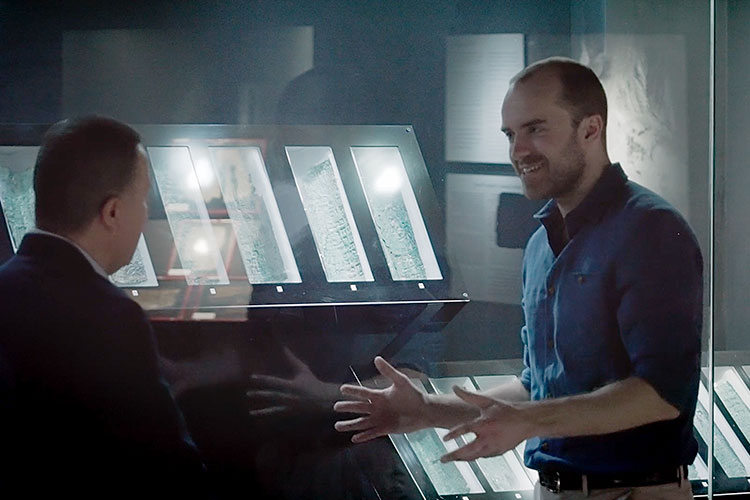
To find out more, Tristan meets a leading expert on the Copper Scroll, Dr Joan Taylor at Manchester University to analyse a replica of one of the rolls that were contained within it. The text uses specific ancient measurements, citing distances in “cubits” and weights in “talents.”
The instructions are maddeningly specific yet geographically elusive:
In the ruin of the valley of Achor, under the stairs that ascend towards the east… at a distance of 40 cubits, there is a silver chest and its vessels, weighing 17 talents.
Dr Taylor points out a fascinating detail: although copper was a luxury material at the time, the script itself appears “rushed”, with letters bunched together, suggesting the scribe was working under extreme pressure or imminent threat.

Replica of some of the Hebrew writing found in the Copper Scroll
Image Credit: History Hit
The Temple connection
Why hide such vast wealth? The scroll mentions sacred items, including a High Priest’s ephod (a ritual garment), leading many to believe this wasn’t a private hoard, but the treasure of the nation from the Temple in Jerusalem.
Historians link this massive concealment to two major periods of crisis: the Great Revolt (70 AD), when the Temple was destroyed by Roman forces, or the Bar Kokhba Revolt (132-136 AD), a final, desperate where the ‘hurried’ script suggests a scribe recording the locations as Roman soldiers closed in on the final Jewish strongholds.
The elusive hoard
To date, no-one has definitively claimed the treasure. Did the Romans torture the locations out of survivors? Or does some of the gold still lie buried beneath the sands of Jericho and the salt-crusted shores of the Dead Sea?
From the high-tech labs of Manchester to the sun-scorched cliffs of the Holy Land, Tristan Hughes pieces together a story of ancient survival and modern obsession.