



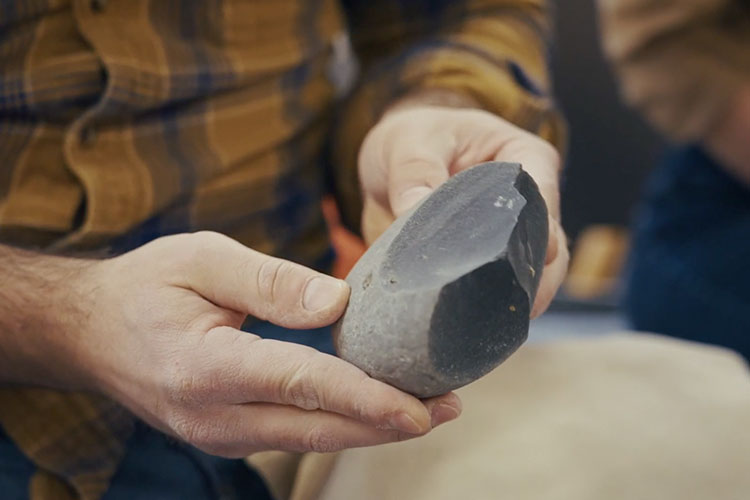

When did humanity truly begin to assert its dominance over the natural world? The answer lies in the very first tools our ancestors wielded at the dawn of the Stone Age, over 2.6 million years ago.
In The Cutting Edge: Testing the Stone Age, History Hit visits Kent State University in Ohio, home to one of the world’s leading experimental archaeology laboratories. Here, Dr Metin Eren and Dr Michelle Bebber are scientifically exploring our distant past, meticulously recreating, experimenting with, and testing the technology of our ancient ancestors.
Join them for a fascinating ‘cutting-edge’ experiment that investigates a vital technological development: the use and creation of tools, particularly those designed for cutting. They put the Stone Age to the test, exploring a key question: did early hominins use naturally occurring sharp rocks before they began to make their own tools?
 Watch Now
The power of experimental archaeology
Using tools to cut was a pivotal step in human evolution, enabling butchering and even the beginnings of combining materials. In the past, it was assumed there was a ‘eureka moment’ where cutting tools were always deliberately made, rather than simply found in the landscape. But is this right?
“We can’t observe ancient people, and we can’t observe how they used the artefacts that we dig-up millions of years later,” explains Metin. “What we do is we recreate their technology, and then we do all sorts of experiments to figure out how it worked. That’s the only way we can kind of bring this stuff back to life.”
Michelle adds that this meticulous replication helps us “understand the behavioural processes that resulted in these tools,” even though we can never access the ancient mind.
Unveiling Oldowan tools
Metin and Michelle begin by crafting replicas of Oldowan tools – some of the earliest known stone tools discovered in sites across Tanzania, Ethiopia, and Kenya. These seemingly simple tools were designed for key evolutionary steps, primarily hammering, and most importantly, cutting.
Recognising and utilising a sharp object as a tool launched humans onto a technological trajectory that continues to this day. As Metin points out “by separating out materials, we would have access to nutrients that would build up our hominin brain”. This pivotal development ultimately led to spears, knives, hunting, and the continuous innovation we see today.
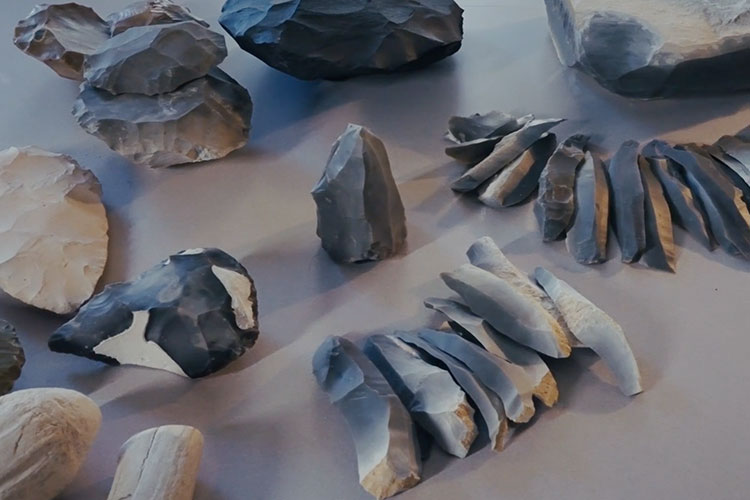
Diversity of forms of recreated Stone Age tools
Image Credit: History Hit
A tapestry of innovation
The Stone Age, spanning millions of years, saw a huge diversity of tool forms, representing varied and unique solutions to survival problems. Metin explains that this period marked “the birth of our high intelligence”.
Beyond efficiency, this variety indicates our ancestors developing an appreciation for tools that were also aesthetically pleasing. As Michelle says, the constant tweaking and refinement of these tools over hundreds of thousands of years “stimulated a lot of the aesthetic and artistic expression we see later in our species”. This full arsenal allowed our species to colonise the globe, demonstrating that diversity in technological, cultural, and behavioural adaptations is our species’ greatest strength.
A hands-on approach
The experimental archaeology lab offers a unique advantage. As Metin notes, while priceless museum artefacts are untouchable, “What we do here is we recreate those artefacts and we can make as many as we need and then we test the hell out of them.”
Michelle and Metin use these replica cutting tools to test their groundbreaking theory: were early tools deliberately manufactured, or did our ancestors simply discover and utilise naturally occurring sharp rocks? Helping them is Emma Finestone of the Cleveland Museum of Natural History, an expert in early tool creation who works in the field in Kenya, finding our ancestors’ early tools dating back over 1.7 million years.
Their controlled cutting tests compare the effectiveness of naturally sharp rocks with hominin-produced stone flakes, with some surprising results. The documentary also examines the much later, highly advanced Clovis culture tools discovered in Ohio, representing the zenith of stone technology from over 10,000 years ago.
Through their innovative scientific techniques, Metin and Michelle are shedding exciting new light on the fundamental question of how and when humanity took its first key steps on its extraordinary journey.
Join us in The Cutting Edge: Testing the Stone Age for a thought-provoking investigation that reveals the extraordinary advances of the longest era of our past, the Stone Age.
Watch Now