



This article is an edited transcript of The Battle of Belleau Wood – Michael Neiberg, available on History Hit TV.
 Listen Now
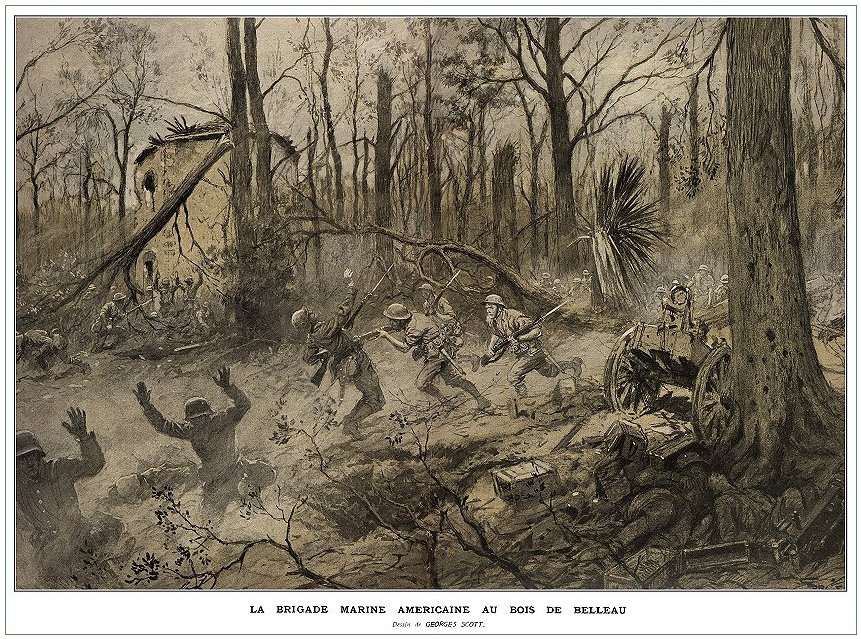
The first major involvement of American troops in the First World War came in June 1918 at the Battle of Belleau Wood. They went on to fight a series of large engagements.
 Listen Now
Germany’s final push to win the war
In the spring and early summer of 1918, Germany made a final attempt to win the war before the American Army could make itself felt. With the Russian army having collapsed in the east, Germany moved as many infantry divisions to the west as it possibly could and launched a series of offensives against the Allies.
…it would have been easy to look at a map and believe that they were moving towards Paris.
The Battle of Belleau Wood took place during the third of five offensives that made up the Spring Offensive. The impression was that the Germans were heading for Paris. Today, historians don’t think this was actually the case. At the time, however, it would have been easy to look at a map and believe that they were moving towards Paris.
You can imagine the panic among the Allies at that thought. So it was a question of whether the Germans can move those units from east to west faster than the Americans can get them from the United States to Western Europe. This is the context to the Battle of Belleau Wood.

The German Spring Offensive made rapid gains but failed to crush the Allied defence
Why were the Americans at Belleau Wood?
In launching their Spring Offensive, the Germans were hoping to force the French and British to move their reserves to meet these offensives, leaving a weakness somewhere on the Western Front. General Ludendorff, the German general who planned the offensive, famously said:
“We’ll punch a hole and then we’ll see.”
Ferdinand Foch, the commander of the Allied armies, must defeat this attack that seems to be threatening Paris, without weakening the reserves that the French and British have up in Flanders. If the American Second and Third divisions go towards Belleau Wood and Château-Thierry, that’s enough men to safeguard Paris and safeguard the communications there, without having to weaken Flanders.
The US Marine Corps’ take on the story is that the Americans go into this fight because they’re the best and they are ready. And there is a small element of that. But the real reason is that Foch really does not want to take divisions away from Flanders.
 Listen Now
America’s biggest battle yet
American troops began arriving in Europe in the summer of 1917. By May 1918, more than a million soldiers had arrived, though most of them were not battle ready. The Americans fought their first battle in May 1918, when the 1st Division was selected to attack around the village of Cantigny. But Belleau Wood was the first multi divisional battle.
An American division is roughly 25,000 to 26,000 men, which is about twice the size of a European division. The later battles of Saint-Mihiel and Meuse-Argonne were both bigger battles than Belleau Wood. But at the time, it is the first large multi-division battle the Americans fight.