



The scientific community was rocked by the announcement that came on 21 November, 1953. The Piltdown Man, a fossil skull discovered in 1912 and supposed to be the ‘missing link’ between ape and man, was exposed as an elaborate hoax.
 Listen Now
The ‘missing link’
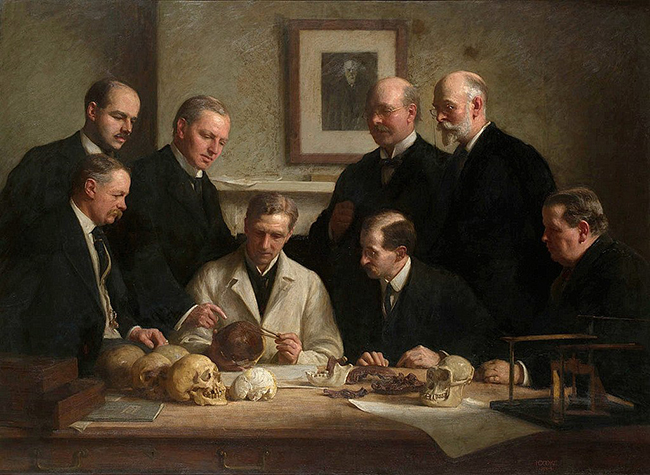
The discovery of the skull was announced at the Geological Society in November 1912. The section of skull was found by amateur archaeologist Charles Dawson near the village of Piltdown in Sussex, England.
Dawson enlisted the help of a geologist from the Natural History Museum, Arthur Smith Woodward. Together the pair excavated further finds at the site, including teeth, an ape-like jawbone and more than forty associated tools and fragments.

A reconstruction of the Piltdown Man skull.
They reconstructed the skull and dated it to 500,000 years old. Dawson and Woodward’s remarkable find was hailed as the ‘missing link’, confirming Charles Darwin’s theory of evolution. The press went wild. The British scientific community rejoiced.
But all was not as it seemed.
The hoax unravels
Subsequent discoveries of Neanderthal skull remains around the world began to call into question the validity of the Piltdown Man. His features didn’t fit the emerging understanding of our physical evolution.
 Watch Now
Then, in the 1940s, date testing suggested that the Piltdown Man wasn’t anywhere near as old as Dawson and Woodward had claimed. In fact he was probably more like 50,000 years old rather than 500,000! This discredited the claim that he was the ‘missing link’ because Homo sapiens had already developed by that time.
Further investigation yielded more shocking results. The skull and jaw fragments actually came from two different species – a human and an ape!
When the hoax was exposed the world’s press heaped criticism on the Natural History Museum for having been so thoroughly “had” for the best part of forty years.

The main hall of the Natural History Museum. Credit: Diliff / Commons.
Whodunit?
But who could have carried out such an elaborate hoax? Naturally the finger of suspicion pointed first at Dawson, who had died in 1916. He had made claims to great discoveries before that had turned out to be fake but a question mark hung over whether he had sufficient knowledge to make the finds so convincing.
Suspicion also hung over a rather famous name who not only happened to live near to Piltdown but also collected fossils – Arthur Conan Doyle. Elsewhere there were whispers of an inside job, had someone at the Natural History Museum been responsible? The truth remains a mystery.