



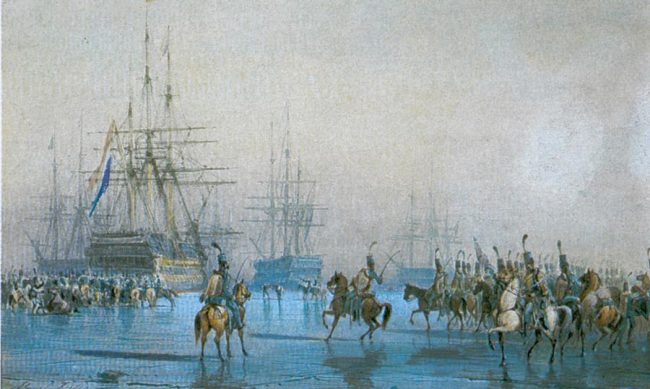

On 23 January 1795 an almost unprecedented event in military history occurred when a regiment of French Hussar cavalry was able to storm and capture a Dutch fleet at anchor during the Revolutionary Wars. A major coup for France, this daring charge was made possible by a frozen sea during the bitterly cold winter of 1795.
 Shop Now
Safe at harbour….under normal circumstances
The fleet was anchored off the northern tip of the North Holland Peninsula, in the narrow and (in January 1795) frozen straights between the Dutch mainland and the small island of Texel. Under normal circumstances it would have been quite safe with the powerful British royal navy prowling around, but enterprising Dutch-turned-French officer Jean-Guillaime de Winter saw a rare opportunity for glory.
The fighting in Holland had come as a result of the French invasion that winter, an aggressive move in the largely defensive wars that followed in the chaos after the execution of King Louis. Amsterdam had fallen four days earlier, another development which made the considerably powerful Dutch fleet uniquely vulnerable.

A romanticised painting of the Battle of Jemmapes, a key war during the French invasion of Holland.
A daring plan
General De Winter heard the intelligence regarding the fleet once he was already safely ensconced in the Dutch capital. Rather than celebrating this important victory, his response was quick and ingenious. He gathered his regiment of Hussars, ordered them to place one infantryman each on the front of their horses, and then covered the beasts’ hooves with fabric so that their swift approach across the ice would be silent.
There was no guarantee that it wouldn’t break under the heavy burden of two men and a fully equipped warhorse concentrated in a very small area, making the plan risky even if the Dutch sailors and their 850 guns failed to awake. In this case, however, the boldness of De Winter’s plan paid off as the silent gallop across the frozen sea yielded the entire fleet of 14 state-of-the-art warships without a single French casualty.
 Watch Now
The addition of these vessels into the French Navy allowed for the genuine possibility of an invasion of Britain, France’s last enemy after 1800, until defeat at Trafalgar in 1805.