



In the concluding episode of Divine Fury: Demeter and Persephone – The Mystery, classicist Natalie Haynes explores the dark compromise that ended the myth of Demeter and Persephone. This narrative provided the ancient Greeks a vital framework for understanding the cycle of the seasons – a bitter bargain marking the transition from the vibrant bloom of spring to the barren, unforgiving hardship of winter.
Join Natalie as she reveals how this myth gave birth to the ancient world’s most profound and secretive religious tradition: the Eleusinian Mysteries. Tracing the path of ancient initiates from Athens to Eleusis, Natalie examines rare fragments like the ‘Great Eleusinian Relief’ and the ‘Ninnion Tablet’ to uncover the only surviving visual clues to these top-secret rituals. She explores why thousands of pilgrims flocked to Eleusis for centuries, and how this visceral tale of maternal fury and restorative love has inspired two and a half millennia of art.

A mother’s strike
Greece has always been a land of harsh agricultural reality. In the ancient world, if the land failed, death followed swiftly. When Demeter, the goddess of the harvest, abandoned Mount Olympus in grief over her daughter’s abduction, the world withered.
Natalie explains that Demeter’s fury was a cosmic strike, refusing to let the earth be fertile until Persephone was returned. This forced the hand of Zeus, who intervened not out of compassion, but because the mortals had stopped sending sacrifices – there were simply no crops to offer the gods.
The pomegranate trap
In the myth, Zeus sent Hermes to the Underworld to retrieve Persephone, but Hades, the possessive and cunning King of the Dead, was prepared – freedom would come at a price. He offered Persephone a parting gift: a handful of pomegranate seeds.
In the ancient logic of the Underworld, eating the food of the dead binds you to that realm forever. This was no romantic gesture; in the oldest versions of the Homeric Hymn, Persephone is trapped by a “trap wrapped in sweetness.”
Persephone was returned to her mother in an ecstatic homecoming. Interestingly, Natalie points out how although the Homeric Hymn was written in patriarchal times, the poet still knew the depth and value of the female bond between mother and daughter. However, their joy was cut short when Demeter realised Persephone had eaten while in the Underworld.
Zeus, keen to restore the flow of mortal offerings, brokered a dodgy deal: Persephone would spend one-third of the year with Hades and two-thirds of each year above ground with her mother. This “dark compromise” created the seasons: the winter of Demeter’s mourning and the spring of her daughter’s return.
Interestingly, Natalie explains how “this is one of the few times in all of Greek mythology that a god or goddess stands their ground against Zeus, king of the gods, and wins – at least a partial victory”.

Hermes delivers the message to Persephone and Hades
Image Credit: History Hit
The Eleusinian Mysteries
The myth explains how in gratitude to the people of Eleusis who sheltered her during her grief, Demeter gifted them sacred rites. These became the Eleusinian Mysteries, a phenomenon that lasted for over a millennium, promising immense spiritual wealth.
The story of Demeter’s gift grew into a phenomenon of the ancient world, with evidence as far back as the 7th century BC of people gathering in Athens to process to Eleusis. Thousands flocked to Eleusis each year. Anyone – regardless of class, age or gender – could take part, provided they hadn’t committed murder – from common servants to philosophers such as Plato, orators like Cicero, and even Roman Emperors like Hadrian and Augustus.
The appeal was simple but revolutionary: the Mysteries offered hope. While most Greeks viewed the afterlife as a dreary existence as a powerless “shade,” initiates were promised a better fate.
Tantalising clues: the archaeology of a secret
Because the rites were protected by a vow of silence – punishable by execution – nothing was ever written down. Natalie visits the National Archaeological Museum in Athens to speak with Dr Tulsi Parikh, an expert on the archaeology of Ancient Greek religion, and piece together the rituals from “tiny, tiny fragments” of evidence that have survived – noting how remarkable it is “how much we can still uncover from so little”.
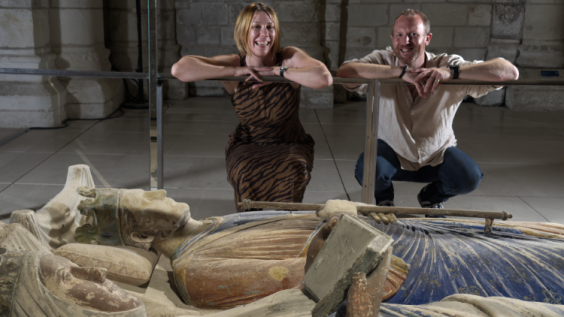
- The Great Eleusinian Relief: A 5th-century marble masterpiece showing Demeter handing sheaves of wheat to Triptolemus, teaching humankind the art of agriculture. He is also pictured with a winged, serpent-entwined chariot, gifted so he could spread agricultural knowledge across the globe.
- The Ninnion Tablet: The only known visual representation of the rituals. It depicts initiates with lit torches and wreaths walking toward the goddesses, suggesting the ceremony’s climax took place in the dead of night.

Dr Tulsi Parikh and Natalie Haynes standing by The Great Eleusinian Relief
Image Credit: History Hit
Ritual purification and hallucinogens?
Natalie follows the 13-mile ‘Sacred Way’ from the Acropolis to Eleusis for the 9 day celebration. Archaeologist Professor Rebecca Sweetman explains the visceral nature of the purification: initiates would carry animals (usually piglets) into the sea to wash them before a massive sacrifice.
After reaching the sanctuary at Eleusis (surrounded by symbols and performances to remind them of the myth), the climax occurred in the Telesterion, the “holiest of holies.” Inside this auditorium, the deepest secrets were revealed. Rebecca shares a fascinating theory: given the massive grain silos nearby, initiates may have been given kykeon – a grain-based drink that potentially contained ergot (mouldy grain). This would have provided a potent hallucinogenic effect, ensuring the “mind-blowing” spiritual experience that kept pilgrims returning for centuries.

Sanctuary of Demeter at Eleusis
Image Credit: History Hit
A legacy of maternal fury
The power of this myth lies in its rare focus on female emotion in what was a patriarchal Greece. Natalie examines how this “maternal fury” has inspired two and a half millennia of art, from 4th-century BC frescos to the modern musical Hadestown.
In the Broadway hit, Persephone is reimagined as a darker queen, a modern woman yearning for the surface, while Hades remains the manipulative schemer of the ancient sources.
The unbreakable bond
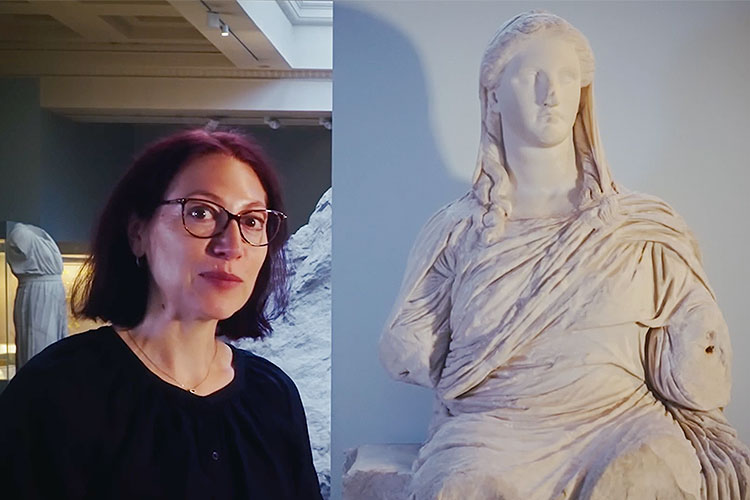
Finally, Natalie views the ‘Demeter of Knidos’, a breathtaking statue capturing the goddess’s patient, serene expression – a reminder that Demeter is a goddess who will wait as long as it takes to get what she wants.
Natalie concludes by reflecting how “The ultimate victory of the myth is that maternal devotion proved to be the single unbreakable force in the Greek cosmos”. The bond between mother and daughter was a source of both destructive fury and creative, restorative love – a power that forced even the King of the Gods to compromise.