



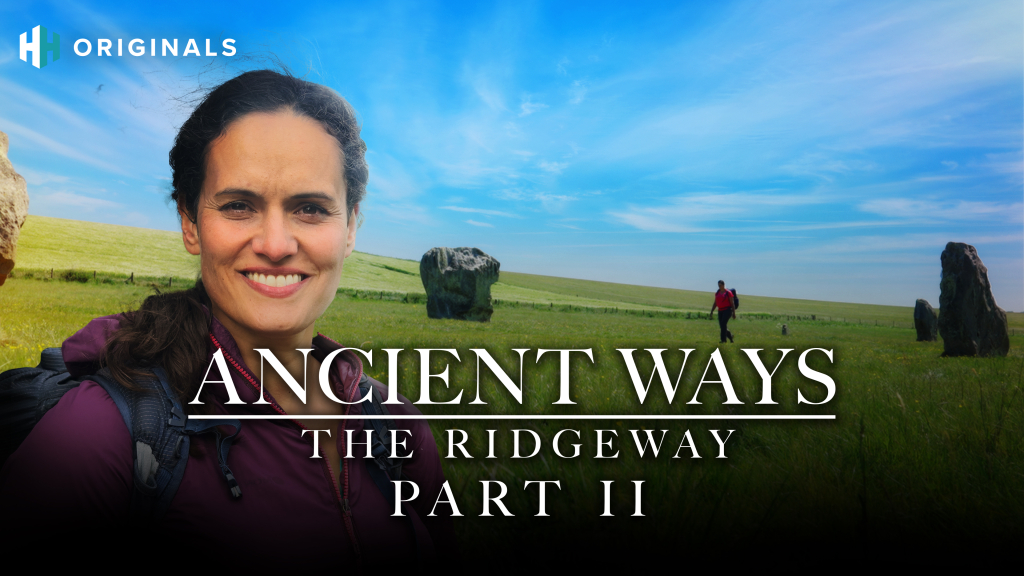
In the two-part special Ancient Ways: The Ridgeway, anthropologist and keen hiker Mary-Ann Ochota tracks prehistoric pathways of the Ridgeway – one of England’s oldest thoroughfares and a genuine ‘Stone Age Highway’.
Following her exploration of the Bronze Age marvels at Uffington and the atmospheric legends of Wayland’s Smithy, the second episode sees Mary-Ann Ochota complete her adventure, heading north through the Avebury World Heritage Site – a landscape so saturated with archaeology that prehistory feels palpable in every step. This is far more than a simple hike; it is a ground-level investigation into the minds of our ancestors, exploring why they spent thousands of hours moving earth and stone to create a landscape dedicated to both the dead and the divine.
 Watch Now
The first architecture: West Kennet Long Barrow
As the Ridgeway winds toward Overton Hill, the landscape undergoes a dramatic transformation. Here, the modern countryside recedes, and every other field seems to reveal a burial mound, an earthwork, or a weathered standing stone. Mary-Ann’s first stop is the West Kennet Long Barrow, a monumental tomb dating back to roughly 3,650 BC. To put its age in perspective, this structure was already over a millennium old by the time the iconic stone circles were raised at Stonehenge.
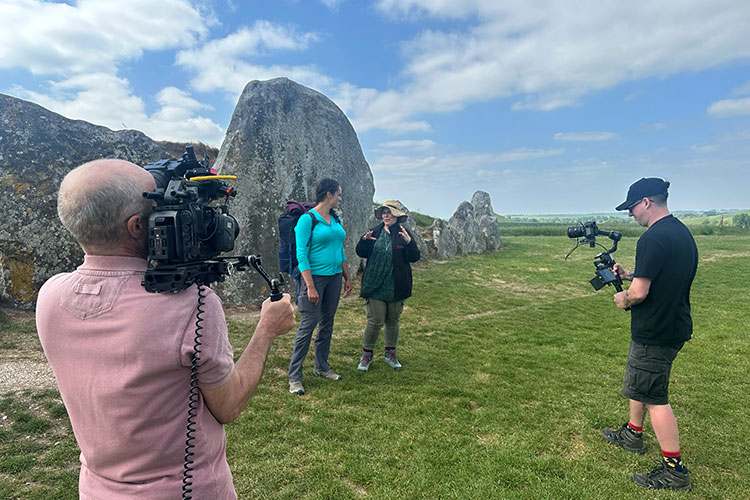
Mary-Ann Ochota talks to English Heritage Prehistory Curator Dr Jennifer Wexler at West Kennet Long Barrow
Image Credit: History Hit
At 100 metres long and three metres high, it is one of the largest and most impressive long barrows in Britain. Accompanied by English Heritage Prehistory Curator Dr Jennifer Wexler, Mary-Ann ventures deep into the dark, stone-lined interior.
“They’re the first architecture that we have,” Wexler explains, “they’re our first standing monuments.” Archaeologists discovered the remains of 46 individuals here, interred alongside pottery and stone tools. Remarkably, the barrow remained a site of active ritual for over 1,000 years. It was only around 2,000BC that the chambers were ceremonially filled with rubble and the entrance sealed by massive sarsen blocking stones.
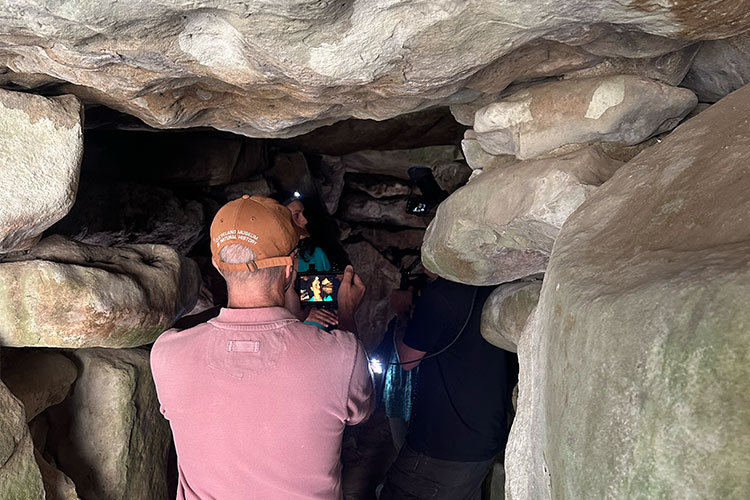
Filming inside the West Kennet Long Barrow
Image Credit: History Hit
Thanks to a meticulous reconstruction in the 1950s, it is one again possible to step inside and experience the heavy, silent atmosphere of the tomb just as the barrow’s original Neolithic builders did five millennia ago.
The mystery of Silbury Hill
Visible from the mouth of the Long Barrow is the enigmatic Silbury Hill. Built in several stages between 2,400 and 2,300 BC, this gargantuan chalk mound is a feat of engineering that continues to baffle experts. Standing nearly 40 metres high, it remains the largest man-made mound in Europe – a structure so vast that the entirety of Stonehenge could almost fit upon its summit.
The folklore surrounding the hill is as tall as the monument itself. Some say the Devil dropped the mound in a fit of rage after a defeat in nearby Marlborough; others believe the golden treasures of King Sil lie buried deep within. However, Dr Wexler explains that modern archaeology has revealed something even more fascinating: the mound contains no central burial or ‘kingly treasure’.
Instead, analysis of the internal layers reveals turf and material brought from across the wider landscape, suggesting Silbury was a massive communal project. Dr Wexler theorises that its construction may have been a response to a period of “crisis” or rapid change at the end of the Neolithic, as new groups arrived from Europe with revolutionary metal-working technology. Perhaps the mound was a final, monumental effort to honour an old religion or anchor a shifting identity to the land.
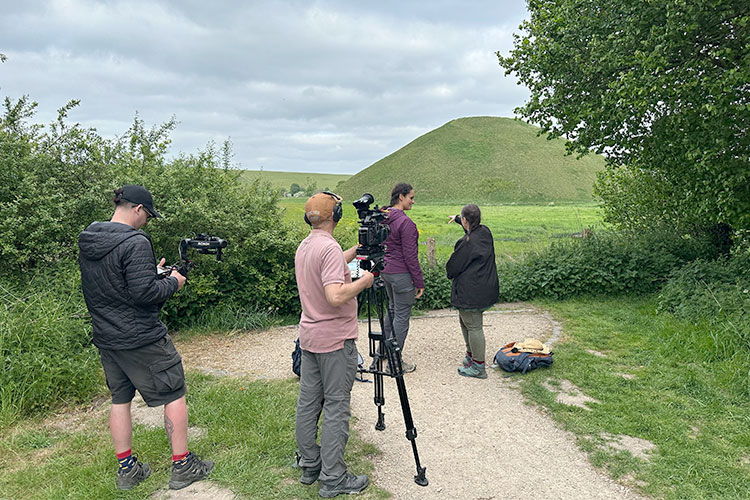
Filming near Silbury Hill
Image Credit: History Hit
The Avenue
After a night camping at the Farm at Avebury – where she meets owner Rob Hughes to hear how his family have worked this land for generations – Mary-Ann follows the ancient tracks toward the village of Avebury, via the West Kennet Avenue. In antiquity, this ceremonial corridor was lined with 100 pairs of massive sarsen stones, some weighing upwards of 20 tonnes.
Experts believe these stones were meticulously paired by shape, often categorised as “male” (tall and columnar) and “female” (broad and diamond-shaped). This intentional design likely served to control, impress or even intimidate pilgrims as they progressed toward the sacred centre. Walking between these giants today, one can still feel the intended psychological effect: a sense of being funnelled toward something immense, ancient, and powerful.
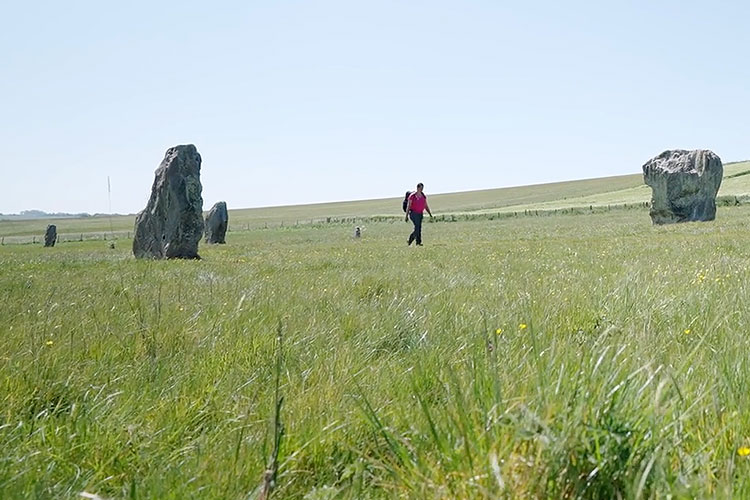
Mary-Ann walking through part of the West Kennet Avenue
Image Credit: History Hit
Avebury Henge: megalithic stadium?
The journey reaches its climax at Avebury Henge. Unlike the fenced-off experience of Stonehenge, Avebury remains a living part of the landscape, where visitors are free to walk among and touch the ancient sarsens.
Construction here began around 2,800 BC, with the site evolving through continuous modifications over the next 600 years. The outer great henge spans almost 500 metres in diameter, and in its prime, the chalk bank towered 17 metres above the floor of a steep, deep ditch. Within this large perimeter stood an outer circle of approximately 100 stones, which in turn enclosed two smaller stone circles containing complex arrangements of stone and timber.
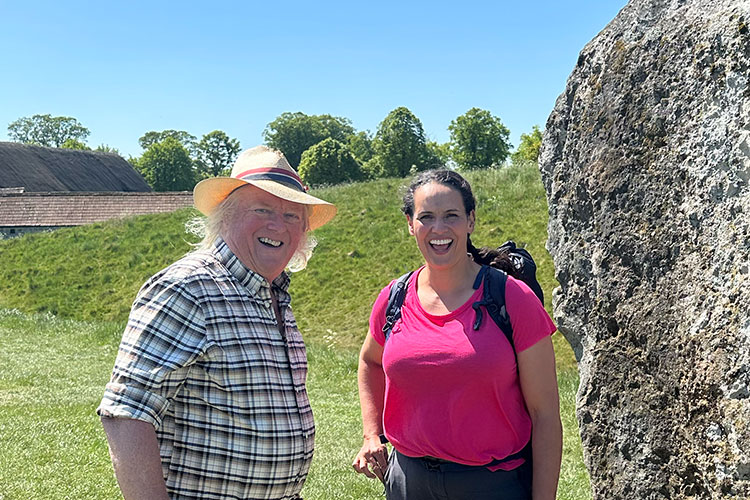
The Ridgeway’s proximity to Avebury is almost certainly no accident. Mary-Ann meets legendary archaeologist Phil Harding to discuss the colossal human effort required to sculpt this terrain. “You don’t build something like Avebury with a gang of ten people,” Harding notes. “You need masses and masses of labour.”
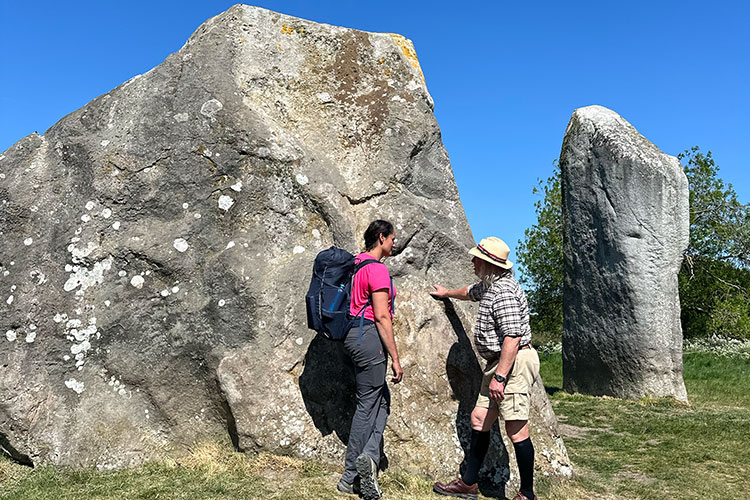
Mary-Ann Ochota and archaeologist Phil Harding at Avebury
Image Credit: History Hit
While we often view these sites with a sense of somber ritual, Phil and Mary-Ann explore a more vibrant, human theory: that Avebury functioned as a prehistoric “stadium.” With the capacity to hold thousands of people, it likely also served as a social hub – a place for festivals, dancing, and meeting new people from far-flung regions – and a site where the spiritual and the social collided in a magnificent, open-air arena.
Preservation
Phil describes walking the Ridgeway as “not just a walk in the countryside, it’s almost a spiritual thing”. The unique geology of the Wiltshire chalk served as the fuel for this prehistoric explosion of activity. Its well-drained, easily cultivated soil transformed the ridge into a bustling Neolithic highway of the Stone Age.
As Mary-Ann reflects on her trek, she observes that walking the Ridgeway is far more than a physical challenge; it’s an act of historical preservation. By following these ancient tracks, we forge a direct connection to the shelter, the industry, and the spirituality of those who came before us. As she poignantly concludes: “When we walk these ancient ways, we keep them alive.”