


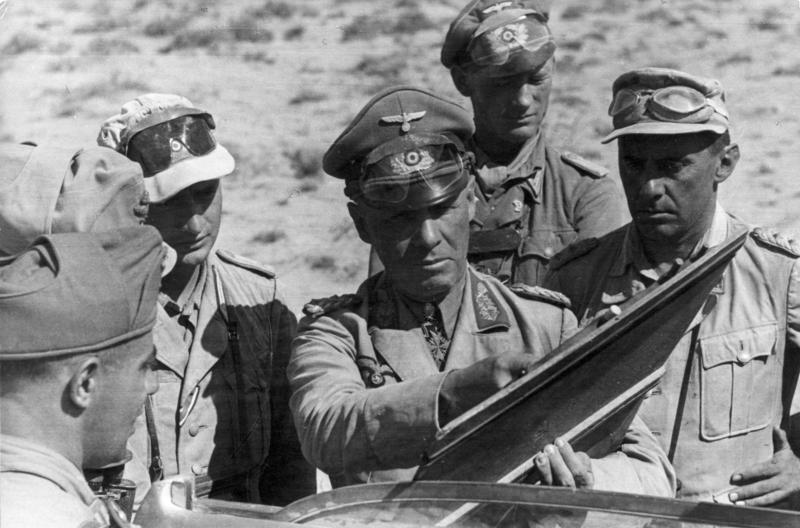

Field Marshal Erwin Rommel is best known for his astounding successes in North Africa against great odds but the man was more complex than the legend.
Winston Churchill once described him as a “very daring and skilful opponent… a great general” but he was also a devoted husband and father and a man that struggled with depression and self-doubt during the most difficult periods of his career.
 Watch Now
Here are some facts about Nazi Germany’s most famous general:
1. First accepted into the infantry
In 1909 at the age of 18 Rommel made his first attempt to join the military. He had originally wanted to be an aeronautical engineer but his father steered him into the army. His early attempts to join the artillery and engineers were rejected before he was finally accepted into the infantry in 1910.
2. Cadet Rommel – ‘the useful soldier’
Rommel thrived as an officer cadet in the Wurttemberg army, in his final report his commandant described him in glowing terms (by German military standards at least) as: “firm in character, with immense willpower and a keen enthusiasm.
Orderly, punctual, conscientious and comradely. Mentally well endowed, a strict sense of duty…a useful soldier.”

A Young Rommel proudly poses with his ‘Blue Max.’
3. World War One service
Rommel was commissioned in 1913, just in time for the beginning of World War One. He served with distinction across several theatres seeing action in Romania, Italy and on the Western Front. He was wounded three times – in the thigh, left arm and shoulder.
 Watch Now
4. Rommel & the Blue Max
Even as a young man Rommel was incredibly driven vowing to win Germany’s highest military honour – the Pour le Merite (or Blue Max) before the end of the war. In 1917 at the Battle of Caporetto Rommel led his company in a surprise attack which captured Mount Matajur, outflanking thousands of Italian troops.
Rommel proudly wore his Blue Max for the rest of his life and it can be seen around his neck with his Iron Cross.
5. Hitler’s general
In 1937 Hitler had been impressed by ‘Infantry Attacks’, a book Rommel wrote and he appointed him as the German Army’s liaison with the Hitler Youth before giving him command of his personal bodyguard during the Invasion of Poland in 1939. Finally in early 1940 Hitler promoted Rommel and gave him command of one of the new panzer divisions.

The general and his master.
6. A close call in France
As a Panzer commander during the Battle of France Rommel fought the British for the first time. At Arras the retreating Allies counterattacked catching the German Blitzkrieg by surprise, when British tanks attacked his position Rommel was in the thick of the action directing his divisions artillery onto the enemy tanks only halting them at close range.
The battle had been so close Rommel’s aide was killed by shellfire just feet from him.
7. Rommel makes his name
During the Battle of France Rommel’s 7th Panzer division enjoyed magnificent success racing from Sedan on the Franco-German border to the Channel coast in just seven days covering an astounding 200 miles. He captured over 100,000 Allied troops including the entire 51st Highland Division and the French garrison of Cherbourg.
 Listen Now
8. Dark times
Rommel struggled with depression throughout his career and his diary and letters home at times depict a man racked by self-doubt. With the Afrika Korps position in North Africa deteriorating in 1942 he wrote home to his wife Lucie: “…this means the end. You can imagine what kind of mood I’m in… The dead are lucky, it’s all over for them.”

Rommel Wearing his Blue Max & Knight’s Cross.
9. Rommel’s last victory
Rommel won his last victory from his hospital bed – as the Allies tried to capture the strategic city of Caen Rommel’s defensive preparations held them at bay causing heavy casualties, Rommel meanwhile was recuperating after being seriously injured when his car was strafed by Allied aircraft.
10. Valkyrie
In the summer of 1944 Rommel was approached by a group of officers planning a coup to kill Hitler. When the bomb intended to kill Hitler failed the coup unravelled and Rommel’s name was linked to the conspirators as a potential new leader.
Hitler moved quickly executing many of the Valkyrie conspirators. Rommel’s fame saved him from that fate, instead he was offered the option of suicide in return for the safety of his family. Rommel committed suicide 14 October 1944.