



This article is an edited transcript of Italy and World War 2 with Paul Reed, available on History Hit TV.
 Listen Now
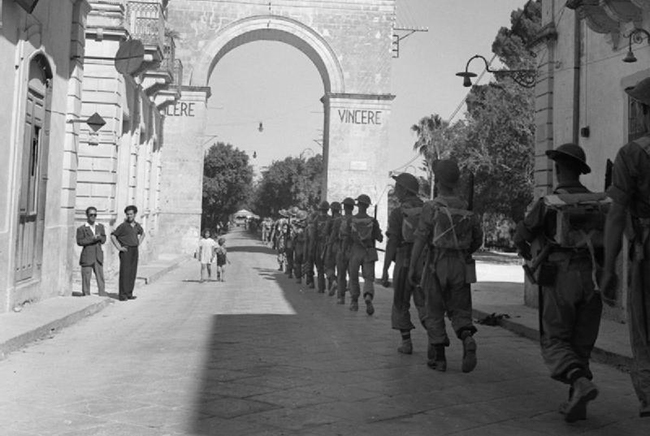
The Italian campaign of September 1943 was the first large-scale invasion of the European mainland involving British and American forces in World War Two. The plan was to land on both sides of the Italian coast, on the toe of Italy as well as at Salerno, and drive towards Rome.
On the eve of the landings at Salerno, Italy was split between forces that were sympathetic to the Allies and forces that remained loyal to the Germans, most of which moved up into the northern part of Italy.
The Germans then effectively took control of Italy as a satellite nation, whereas before it had been an ally, a part of the Axis.
There was thus a curious situation in which the Allies were about to invade a country that was technically about to become their ally as well.
That might even have made some of the men going into Salerno, and indeed some commanders, believe that it was going to be a walkover.
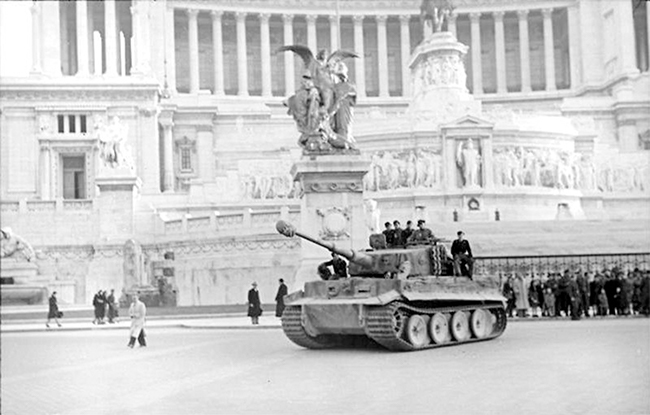
A German Tiger I tank in front of the Altare della Patria in Rome.
Rejecting the airborne approach
Before the Allies’ Italian campaign had begun, there was a plan to drop the 82nd American Airborne near to Rome to try and meet up with partisans and potential forces that might be sympathetic to the Allies.
Fortunately, that plan was never put into operation because it seems likely that local Italian support would have been less than expected, and that the men would have been isolated, surrounded and destroyed.
It was different to D-Day, where significant airborne forces were used to capture key targets.
The Allies chose Salerno for a landing, because it was a perfect bay with level ground. There was no Atlantic Wall in Italy, which made it different to France or Belgium. There, the Wall’s significant coastal defences meant that calculating where to land was extremely difficult.
 Listen Now
Rome was the prize. Salerno was the compromise.
Italy is an elongated country, with a couple of coastal roads on the Mediterranean flank, mountains that are effectively impassable, and a couple of roads on the Adriatic flank.
Eighth Army forces landed on the toe of Italy to advance up the Adriatic front and, on 9 September, Fifth Army troops under General Mark Clark landed at Salerno to advance up the Mediterranean front towards Rome.
 Watch Now
The idea was that both those sets of forces would sweep up the German troops in Italy, the “soft underbelly” (as Churchill put it), push them through, take Rome, then up into Austria, and the war would be over by Christmas. Oh, well. Perhaps not Christmas.