



When we think of the great powers of 16th-century Europe, our minds often turn to the Tudor court of England or the sprawling Spanish Empire. But in France, a different kind of power was at play: a family so charismatic, cunning, and violent that they left a lasting mark on a continent consumed by religious and political war.
They were the Guise, and in an era of intrigue and bloodshed, they were Europe’s most murderous dynasty.
In the final episode of the Not Just the Tudors mini-series on Tudor True Crime, Professor Suzannah Lipscomb talks to historian Professor Stuart Carroll, author of Martyrs and Murderers: The Guise Family and the Making of Europe. Together, they investigate this cultivated, yet utterly ruthless family. They reveal how the Guise, in their pursuit of power, orchestrated assassinations, incited massacres and civil war, and nearly brought down a monarchy.
 Listen Now
Subscribe to Not Just The Tudors
The intersection of religion and power
While our modern view of the 16th century in France often focuses on the Wars of Religion, Professor Carroll argues that the bloodshed was driven as much by politics as by piety. For the Guise, their rise to power was rooted in a long-standing feud against a rival noble house, the House of Habsburg. They were a fiercely French family, and their success in fighting Spanish hegemony was rewarded with a powerful marriage alliance: their niece, Mary Stuart, Queen of Scots, married the young French king, Francis II.
The Guise now had unprecedented influence, but it came with a price. Their power alienated other noble houses, particularly the Protestant-leaning Bourbons. This opposition boiled over in the Amboise Conspiracy – a plot to overthrow and murder the Guise family. The Guise’s brutal response cemented their reputation for ruthlessness. However, it also forced them to a difficult conclusion: a policy of outright suppression of Protestantism was untenable.
At the same time, this powerful dynasty had their sights on a greater prize. Through Mary Stuart, they laid claim to the English throne, a threat that made Elizabeth I a firm supporter of Protestant insurgency in France, aiming to keep the Guise “firmly out of her neck of the woods.”
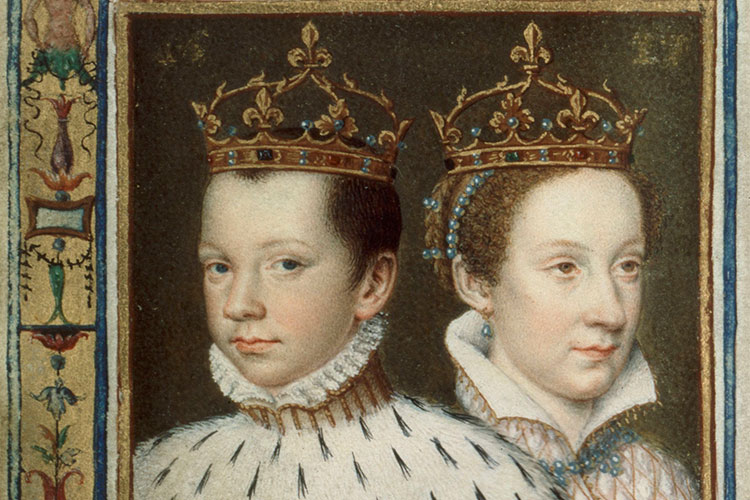
Francis II, King of France, and his wife, Mary Stuart, Queen of France and Scotland. Miniature taken by Catherine de’ Medici’s Book of Hours, c1574.
A cycle of vengeance
As the Guise’s enemies grew bolder, a cycle of violence began. As Professor Carroll explains, French Protestants, drawing on classical ideas about tyranny, began to use political assassination as a tool. Their violence caused a violent response from the majority Catholic population, with the Guise often at the centre of the bloodshed.
This volatile situation came to a head on 1 March 1562, in the Massacre of Vassy. Francis, the 2nd Duke de Guise, discovered a group of Huguenot (French Protestant) worshippers meeting inside a city wall, in violation of a recent law. What happened next lit the fuse of the French Wars of Religion. The duke’s men massacred the worshippers, a brutal act of violence that ignited a civil war that would last for over 30 years.
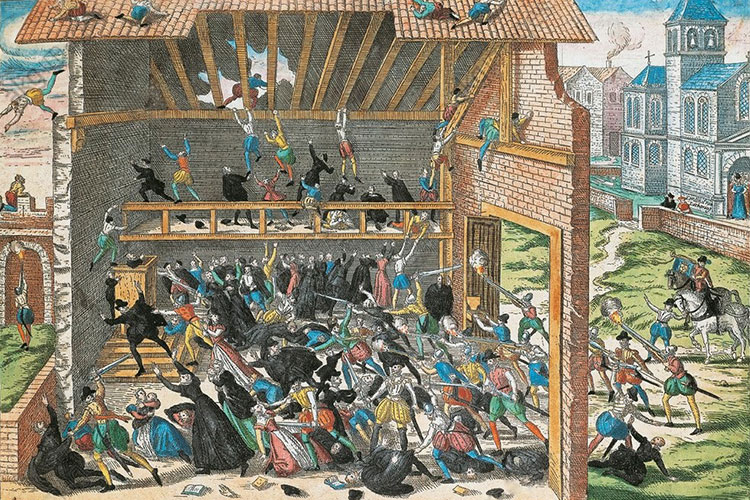
Massacre de Vassy in 1562, print by Hogenberg end of 16th century.
Image Credit: Hogenberg / Public Domain
The violence of this period became increasingly personal and brutal. When François, Duke of Guise, was himself assassinated a year later, the Guise family vowed vengeance. Their personal vendetta became the engine of the conflict, as they actively opposed any peace treaties that might have ended the fighting – revealing a society where violence was not just a last resort, but a weapon of political power.
The St. Bartholomew’s Day Massacre: a modern atrocity
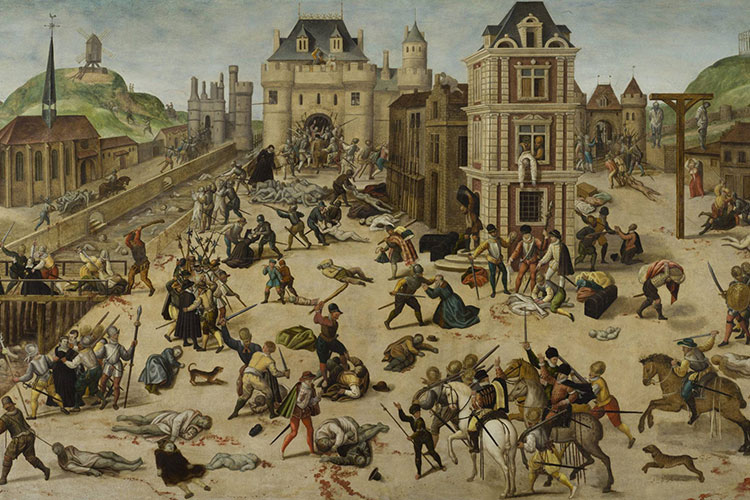
The Guise family’s name is most often associated with one of the most infamous acts of violence in European history: the Saint Bartholomew’s Day Massacre in August 1572. While some historical accounts place the full blame on the Guise, the podcast reveals a more complex story. The massacre began as an aristocratic plot by the king’s mother, Catherine de’ Medici, to eliminate the top Protestant leadership. However, when the city militia joined in, the violence spiralled out of control, leading to the murder of an estimated 4,000 Protestants in Paris alone.
Professor Carroll describes the popular violence as something that “looks forward to the violence of the 20th century,” with brutal acts of mutilation and depravity committed by ideologically driven killers. For the Guise, this was a moment of retribution, a settling of scores that fed their insatiable quest for power.
A lust for power and a fatal end
The Guise family’s radical actions peaked in 1588 with the Catholic League, a political wing that sought to reconstitute the monarchy and prevent a Protestant succession. Their actions amounted to a revolution, forcing the King of France to flee Paris. But the king, seeing the threat to his power, took a page from the Guise’s own playbook.
Fearing their immense power, King Henry (Henri) III lured the Guise brothers into the royal chambers in December 1588, where they were murdered by his guards.
Yet the Guise’s story is more than a tale of bloodshed, In a world where mistrust and fear reigned, and the state was often unable to dispense justice, violence was seen as a legitimate – and sometimes necessary – tool. As Professor Carroll notes, the Guise were a product of their time, a family that hardened its position as the civil wars dragged on, becoming ever more willing to resort to violence in the pursuit of power.