



Few objects connect us so directly to the birth of England as the Alfred Jewel. Found buried in a Somerset field over three centuries ago, this dazzling piece of gold, enamel, and rock crystal is more than just an artefact – it’s a rare, tangible link to King Alfred the Great, the King of Wessex who famously turned back the Viking advance in the late 9th century.
In The Ashmolean Up Close: King Alfred’s Jewel, historian Dan Snow explores what he calls “one of the greatest treasures of the Ashmolean Museum.” Guided by the museum’s Director, Dr Xa Sturgis, Dan gets exclusive access to the meticulous craftsmanship and revolutionary clues contained within the jewel and other spectacular finds that are rewriting the history of Anglo-Saxon England.
 Watch Now
The enigma of the Alfred Jewel
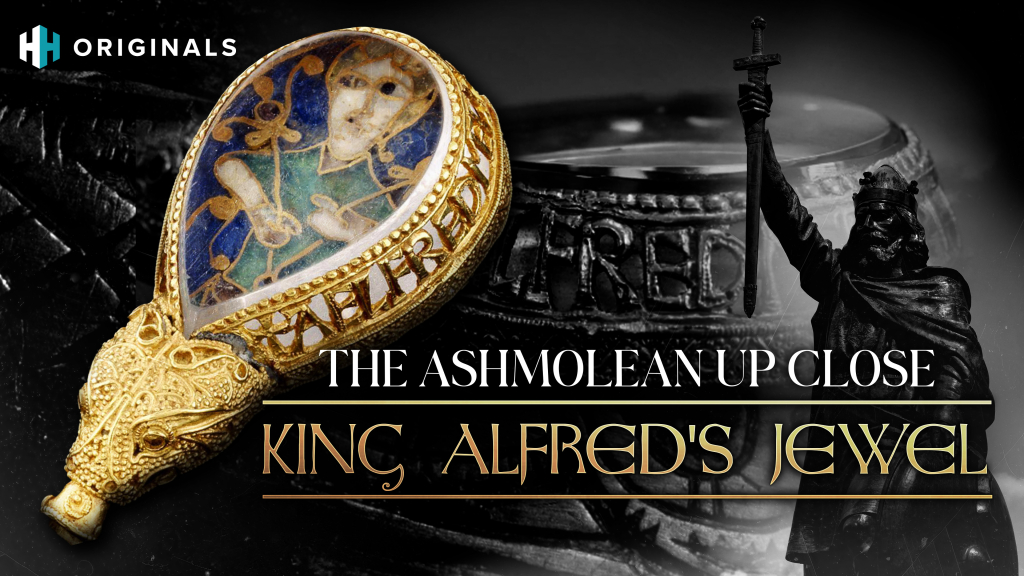
The Alfred Jewel is renowned for its intricate beauty, but also for its mystery. The original Alfred Jewel is too precious to be removed from its case, but Dan is allowed to handle a replica of the jewel, which features a tear-shaped rock crystal and a stylised enamelled figure set beneath it. Crucially, around the edge, a gold inscription mentions “Alfred” by name – an extraordinary link, as it makes the jewel one of the only objects besides coins that can be directly attributed to the King, even though the writing doesn’t specifically state the word ‘king’.
However, the identity of the figure remains debated: Is it Christ? Is it Alfred himself? Dr Sturgis explains that the lack of a crown or halo suggests it could be a personification of the sense of sight. Even the jewel’s purpose is a puzzle. Given a creature carved at the base has a hole for a rivet, the most accepted theory is that the jewel functioned as an “aestel” – a valuable pointer used by priests to keep their place while reading or copying precious manuscripts and to prevent damage to pages.
This theory aligns perfectly with a statement Alfred wrote in a book he sent to all his bishops, commanding that “in each book there is an aestel of gold, and I command in God’s name that no man take the pointer from the book.”
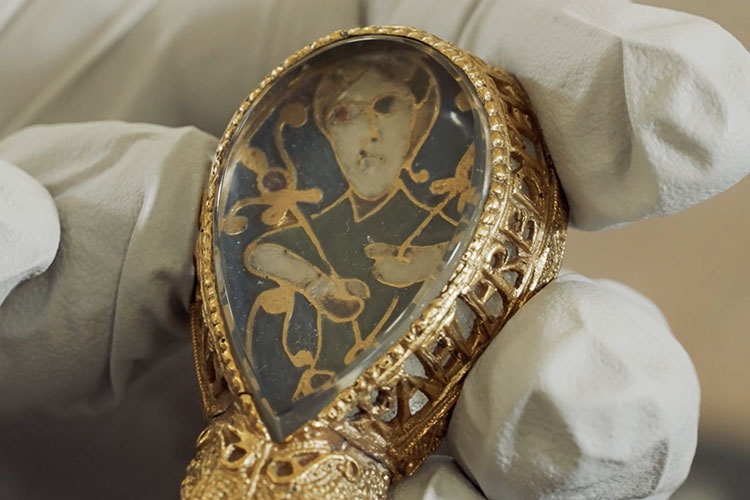
The Alfred Jewel
Image Credit: History Hit / Ashmolean Museum
Athelney and the turning point
The location where the jewel was found – near the Somerset bogs of Athelney – is “very suggestive indeed,” according to Dr Sturgis. Athelney is famously associated with the nadir of Alfred’s reign: the low point when he was driven out by the Vikings and forced to hold out on the marshy isle (giving rise to the legend of the burnt cakes). Ten years later, following his spectacular victory at the Battle of Edington in 878 AD, Alfred founded an Abbey near Athelney.
It makes historical sense that if Alfred were to send an aestel to the Abbey, it would be a particularly magnificent one, linking the grand object directly to the most critical turning point of his life and reign.
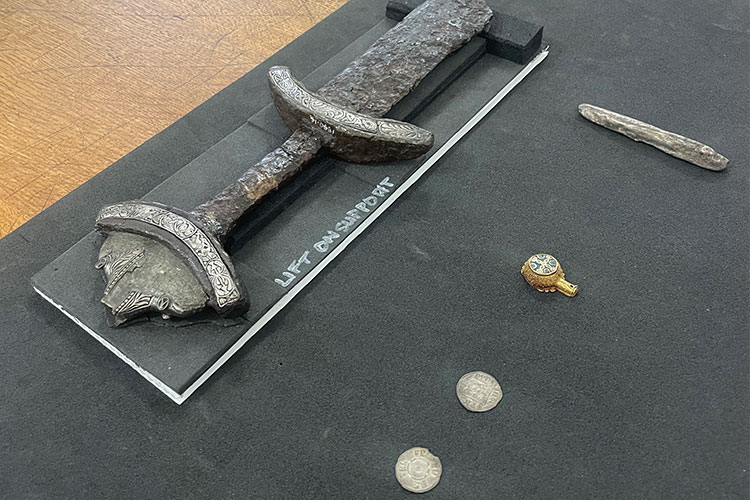
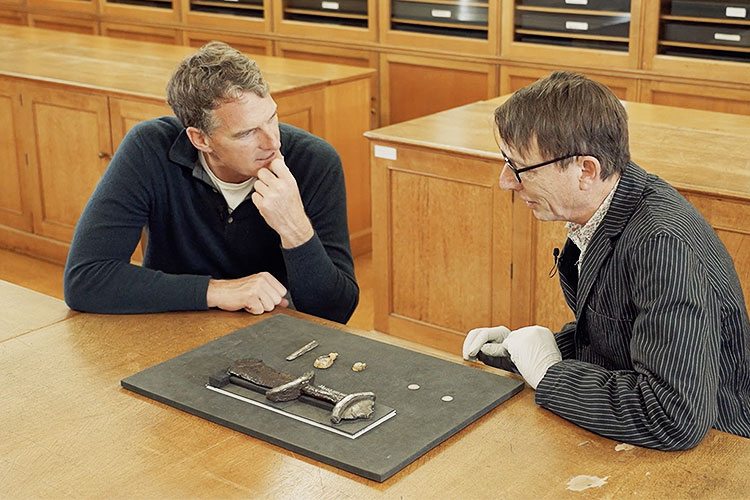
Anglo-Saxon broken sword handle and coins found in the Watlington Hoard
The secret life of a kingdom
Dan also examines other objects from the Ashmolean that reveal the complex power politics of Alfred’s time, a period when England was divided between Alfred’s Kingdom of Wessex, the Danes, and the independent Duchy of Mercia.
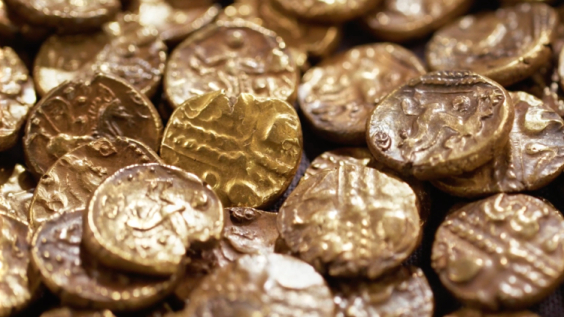
The key to rewriting this history lies in the Watlington Hoard, a recent discovery of coins and silver found by a metal detectorist in 2015. The hoard, believed to have been buried by a Viking around 880 AD due to the hack-silver (used as currency by weight), contained Anglo-Saxon coins that are a unique record of the shifting political balance. Dr Sturgis points out that most coins in the hoard are a combination of King Alfred’s coinage and coins of Ceolwulf of Mercia.
The coins feature images of Alfred and Ceolwulf side-by-side, strongly suggesting that at some point they were co-equals, cooperating on coinage and perhaps even military payments. This detail shatters the long-held historical view that Mercia was simply a powerless “zombie kingdom” controlled by the Vikings, which Alfred simply absorbed. Instead, the coin evidence suggests Alfred was happy, at least briefly, to accept another great English ruler as almost co-equal.
As Dr Sturgis points out, “this idea that a metal detectorist in a field near Watlington can rewrite a period of Anglo-Saxon history just from 200 things found in the ground is extraordinary and gives a sense of the fragility of our knowledge of this period”.
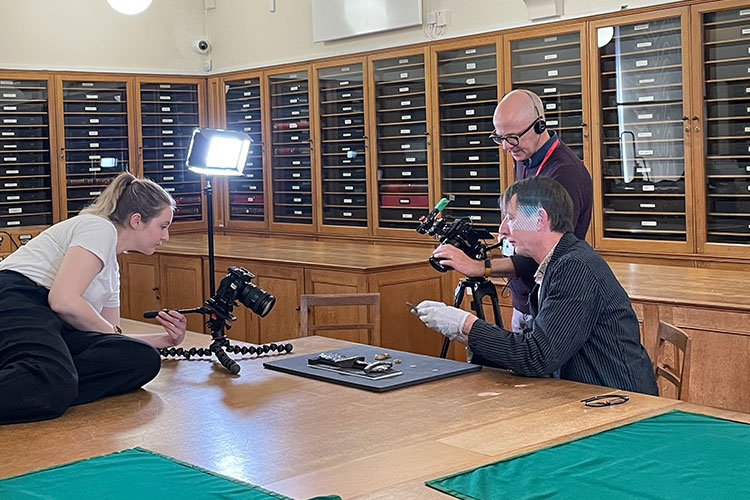
Producer Fiona Turnock and Bill Locke (Head of Programming) film some of the objects featured in the programme with Dr Xa Sturgis.
Image Credit: History Hit / Ashmolean Museum
The legacy of conflict
The tumultuous era is also revealed as Dan examines a broken sword handle found in a river – a common way Anglo-Saxons decommissioned weapons after a warrior’s death. The intricate silver decorations prove it belonged to a high-status individual, likely dating from the same critical period of the late 870s.
The handle is not only Anglo-Saxon in style, but a Christian object, bearing the symbols of the Four Evangelists. This powerful artefact could have been present at the pivotal Battle of Edington, connecting the ultimate victory to faith and elite warfare.
The objects in the Ashmolean Museum clearly show that the late 9th century was a period of intense conflict and change. From the artistry of the Alfred Jewel to the political secrets held in a handful of coins, these treasures are not just relics of the past. They are a bridge to understanding the minds and motivations of the people who lived, fought, and died while England was born.