



On 14 October 1066, two fundamentally opposed military philosophies collided on a wind-swept hill in Sussex. On one side stood the Anglo-Saxon shield wall: a dense, bristling fortress of infantry pledged to King Harold. On the other waited Duke William’s Normans: a fluid, dynamic war machine leveraging combined arms, mobile missile archers, and heavy cavalry.
The outcome changed the trajectory of British history forever. Yet nearly a millennium later, military historians are still unpicking how the Normans managed to shatter an apparently unbreakable Saxon line.
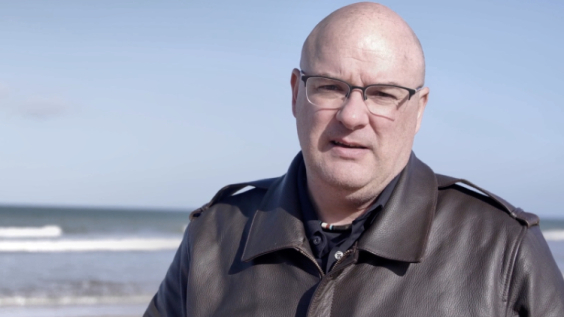
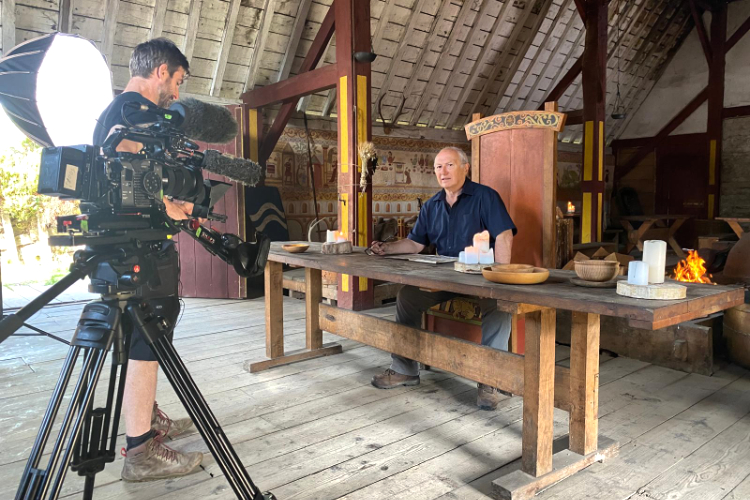
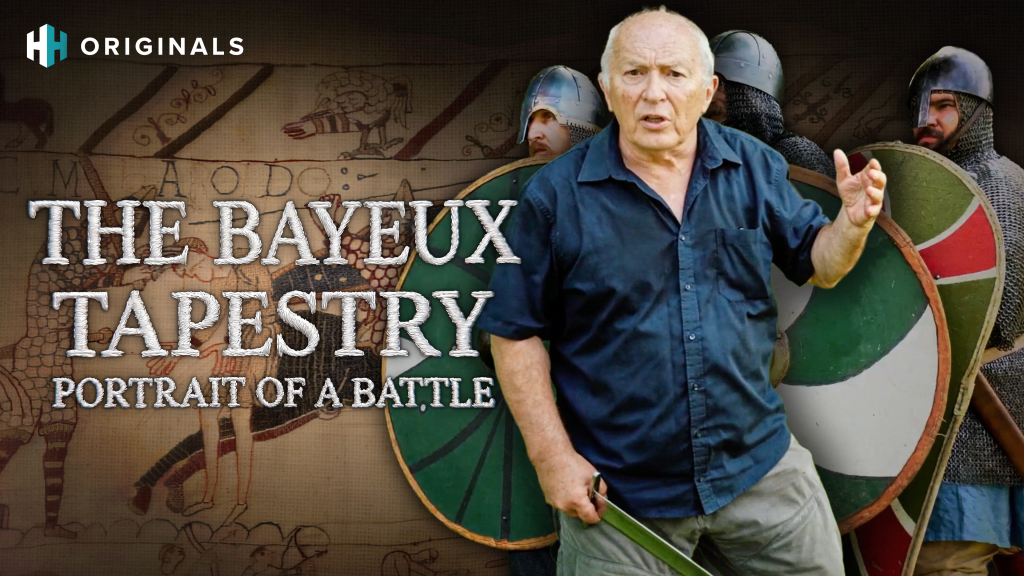
In History Hit’s compelling new documentary The Bayeux Tapestry: Portrait of a Battle, renowned military historian and arms expert Mike Loades dives headfirst into this historic detective story. Armed with experimental archaeology, a squad of veteran re-enactors, and a fresh eye for detail, Mike sets out to discover whether the world’s most famous embroidery is merely victory propaganda – or a remarkably accurate 11th-century action movie in thread.
 Watch Now
A 70-metre action film on linen
“I’ve had this book with images from the Bayeux Tapestry for over 50 years,” Loades reflects. “It’s a compelling tale. It’s a great movie. If you think about it, it’s a strip of film – only on linen instead of celluloid.”
Commissioned by Duke William’s half-brother, Bishop Odo of Bayeux, and embroidered in Canterbury by English needlewomen, the 70-metre-long linen frieze is undeniably a victor’s narrative. Yet beneath the Norman bias lie granular, authentic details about 11th-century warfare.
To separate battlefield reality from artistic spin, Mike Loades partnered with the historical re-enactment society Regia Anglorum to test the physical mechanics of the weapons, armour, and formations depicted on the linen.
Cracking the shield wall
For centuries, the Saxon shield wall was the ultimate defensive formation – holding the line in the same spirit as the Greek phalanx or the British squares at Waterloo. Elite, fully armoured huscarls stood shoulder-to-shoulder, overlapping heavy wooden shields to create a wall that denied the enemy a single inch of breakthrough.
Testing the formation at Wickhurst – a reconstructed fortified Saxon settlement in Kent – re-enactor Nigel Amos demonstrated the borsnout (boar’s snout), a wedge formation used by the Saxons to crack open rival infantry lines.
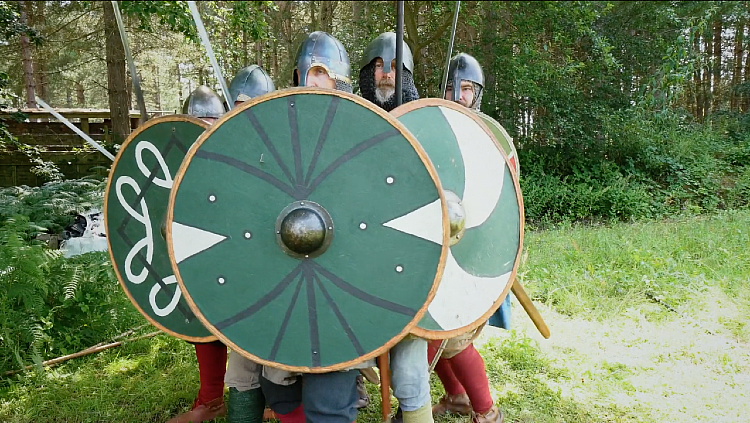
‘Borsnout’ formation of Saxon troops
Image Credit: History Hit
While devastating against infantry, Mike notes its fatal flaw: it was completely useless against cavalry.
“If I’m on a horse, I’m way out of the way. There is no way they can get me. It would be like swatting flies. …For all their ferocity, the shield wall is useless against cavalry that can come in, turn tail, and be out of the way.”
However, the tapestry shows that the Saxons were far from helpless prey. Housecarls frequently stepped out of line wielding the terrifying Dane axe – a two-handed weapon with a ferocious reach capable of taking out a warhorse’s leg or felling its rider in a single blow.
Mike Loades’ experiments with spear thrower Roland Williamson revealed another vital tactical metric. Uninhibited, a Saxon warrior could throw a javelin approximately 20 paces. But when forced to keep the shield wall locked tight under a hail of Norman arrows, that throwing distance plummeted to approximately just 12 paces.
This 8-pace difference was the critical window the Normans exploited.
The Norman secret weapon: burst-shooting and mobile cavalry
The tapestry depicts 190 horses, underscoring that warhorses defined William’s army. But Norman cavalry did not charge head-on into spears like late-medieval knights. Instead, they rode in obliquely – at 30 to 45-degree angles – using long kite shields to create a glancing surface against incoming Saxon javelins, sweeping past to hurl spears before wheeling away to reset.
To make these cavalry strikes effective, William relied heavily on combined forces – specifically an elite archery corps. Analysing the lower borders of the tapestry, Mike identified depictions of archers holding multiple arrows in their bow-hands while shooting on the move.
By pairing mobile archers with tactical cavalry, the Normans achieved a textbook tactical cycle:
- The Suppression: Mobile archers advanced on foot, firing rapid bursts to force Saxon shields closed, cutting their javelin range nearly in half.
- The Strike: The moment archers reached 20 paces, Norman cavalry sprinted through the line, hurling heavy barbed spears at point-blank range.
- The Covering Fire: As cavalry wheeled away to reset, archers covered their retreat with fresh volleys.
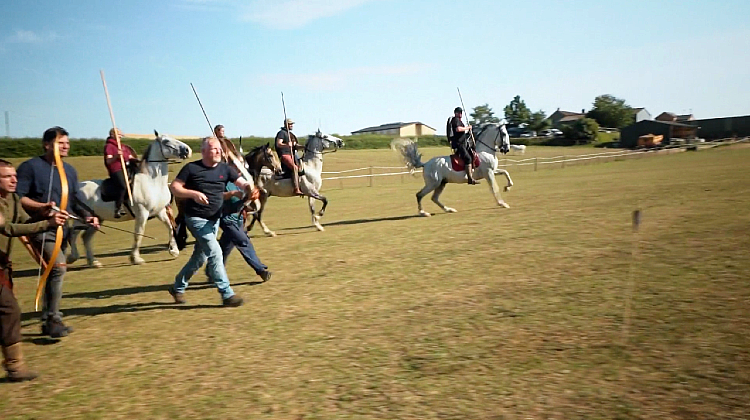
Re-enactors from the historical re-enactment society Regia Anglorum showcasing the Norman cavalry and archers formation
Image Credit: History Hit
Mysteries stitched in thread
Beyond broad battlefield tactics, Portrait of a Battle investigates several enduring historical puzzles embedded in the linen:
- Trousered Hauberks: Both sides are depicted wearing unique, full-length mail trousers (hauberks). Master mailmaker Nick Checksfield notes this style appears nowhere else in medieval art or archaeology. Was it a short-lived 11th-century fashion, or a stylistic convention for suit-ventails?
- Wiggly Bows & Mercenary Forces: The tapestry depicts distinct “wiggly” archer bows. Mike argues these represent composite recurve bows brought by elite southern Italian mercenaries recruited from Norman territories in Apulia and Sicily.
- The Death of Harold: Was King Harold really killed by an arrow to the eye? Mike points out that the Latin text Haroldus rex interfectus est (“King Harold is killed”) aligns with the figure being cut down by a Norman knight, suggesting the famous “arrow in the eye” figure may be a 19th-century restoration mistake.
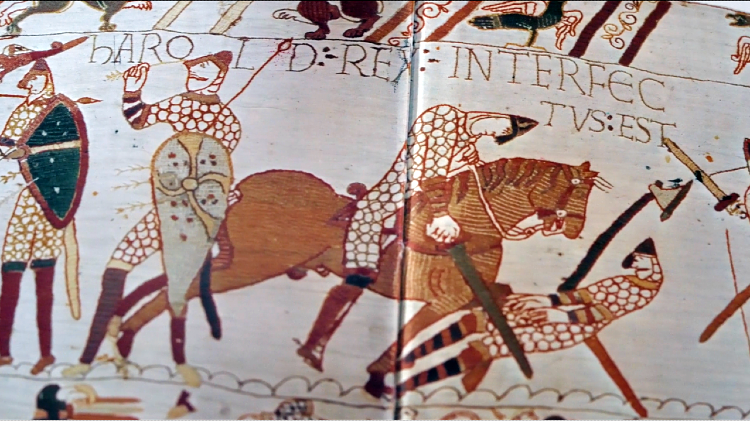
The Bayeux Tapestry showing King Harold’s death – but is it with the arrow under ‘Harold’, or after the words finish, with the figure slain by the sword?
Experience the detective story
From the double-barbed spearheads that slotted neatly into cavalry stirrups to live-fire weapon demonstrations, The Bayeux Tapestry: Portrait of a Battle brings 1066 to life with unmissable clarity.
Whether you are a lifelong medieval history enthusiast or simply love a great historical detective story, join Mike Loades as he steps inside the tapestry to unlock the true secrets of the Battle of Hastings.