


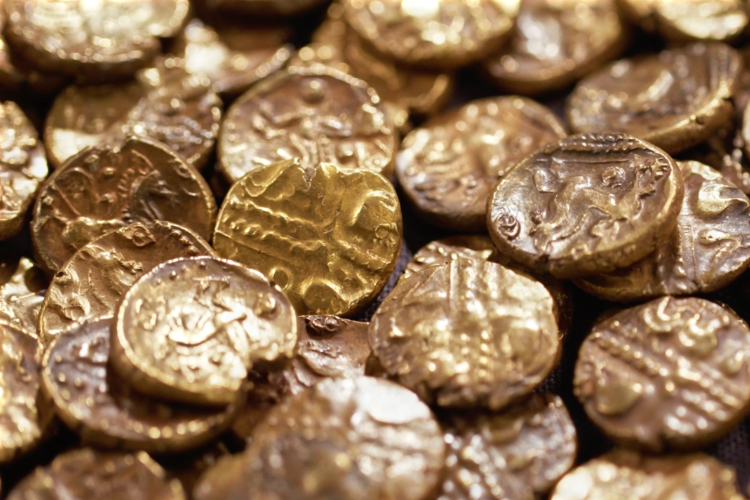

Over 900 gleaming gold coins. A cold case buried for more than 2,000 years.
Unearthed in the quiet village of Great Baddow near Chelmsford, Essex, The Great Baddow Hoard is the largest collection of Iron Age gold coins ever discovered in Britain. Placed deliberately into the ground during the Late Iron Age – around the very same time Julius Caesar was launching his first military expeditions to the island – this breathtaking treasure of 935 decorated staters is finally being revealed to the public in a landmark new exhibition at the Museum of Chelmsford.
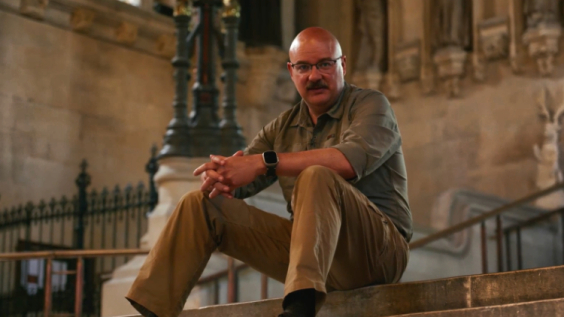
In History Hit’s captivating new documentary, The Great Baddow Hoard: Decoding the Iron Age, presenter Tristan Hughes gains privileged, behind-the-scenes access to examine this fortune up close. Joining forces with museum curator Claire Willetts and leading experts from the British Museum and Archaeology South-East, Tristan investigates the extraordinary artistry of the coins and tackles the ultimate lingering question: why was a massive fortune in gold buried in the Essex countryside, and did the shadow of Rome spark its concealment?
 Watch Now
Laying out a fortune
The documentary opens with a thrilling moment for any history enthusiast: laying out the hoard for the very first time before it goes on public display.
Working alongside curator Claire Willetts, Tristan helps unpack bag after bag of shimmering gold staters. Claire admits that the process feels like unpacking pure treasure. Each coin, roughly the size of a modern five-pence piece, consists of approximately 55 percent gold.
What immediately strikes the eye is that despite being struck over two millennia ago – dated roughly between 60 BC and 20 BC – the coins remain in pristine condition. Because every single coin was individually struck by hand, no two are identical. Some are thick, others thin, while some form perfect circles and others carry slight irregularities that reveal the human touch of the ancient metalworkers who crafted them.
Historically, the Great Baddow area was considered a quiet backwater compared to major nearby Iron Age strongholds like Colchester or Danbury. Previous digs in the region yielded relatively humble finds, such as pottery, loom weights, and spindle whorls. This makes the sudden discovery of nearly a thousand gold coins in Great Baddow entirely unexpected and suggests far more was happening in the local area than archaeologists previously realised.

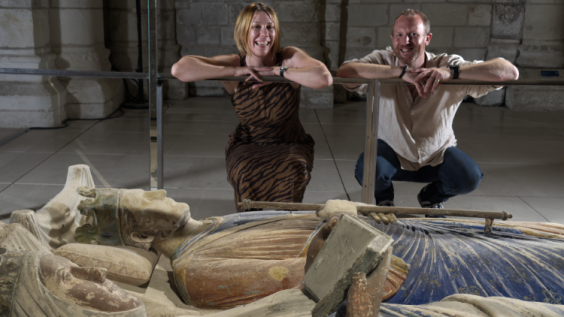
Tristan Hughes and curator Claire Willetts discuss the Great Baddow Hoard
Image Credit: History Hit / Museum of Chelmsford
Ciphers, wolves, and winged horses
To understand what these coins reveal about the sophisticated society that minted them, Tristan meets Dr. Eleanor Ghey, Curator of Iron Age Coin Hoards at the British Museum.
As Iron Age Britons left no written records, these coins serve as vital, miniature works of art that offer a rare window into their technology, belief systems, and worldview. Dr. Ghey emphasises that these staters were not pocket change used for everyday market transactions like buying bread. Instead, they represented a high-level store of wealth used for major political transactions, tribal alliances, diplomatic gifts, or sacred offerings.
Using a microscope to examine the coins, Tristan and Dr. Ghey decode the intricate artwork stamped into the metal. On the front, known as the obverse side, an abstract cross-and-wreath pattern is visible. This design actually evolved from ancient Greek coins featuring the head of Apollo. Over centuries, European and British artists reinterpreted the classical motif into their own abstract, stylised aesthetic.
The reverse side overwhelmingly features horses running free to the right, with some displaying three tails, others sporting delicate dots for manes, and a few featuring subtle wings reminiscent of Pegasus.
Out of 935 coins, three stand completely apart. One features the striking, arch-backed silhouette of a ‘Norfolk Wolf’ with bared teeth, linked to East Anglia. Another is a thinner quarter-stater showing a horse pulling a chariot wheel. Most intriguing of all is a single imported Gallo-Belgic coin from Northeast France – the only coin in the hoard showing significant surface wear, proving it traveled miles across the Continent before being buried in Essex.

The coin depicting a ‘Norfolk wolf’ from The Great Baddow Hoard
Image Credit: History Hit / Museum of Chelmsford
Why was it buried?
The most tantalising element of the documentary centres on why this king’s ransom was placed into the earth. The timeline places the burial squarely in a period of intense political and social turmoil. Between 55 and 54 BC, Julius Caesar led two expeditions across the English Channel, pushing north of the Thames into Essex territory to extract tributes from local tribes before returning to Rome.
The film explores several compelling theories surrounding the burial. It may have been a massive collective payment or tribute gathered for Julius Caesar during his campaigns. Alternatively, as Roman forces advanced and tribal conflict flared, a local chieftain or community leader may have buried their wealth for safekeeping, intending – and failing – to return for it later.
The overwhelming uniformity of the coins, which were struck in a single sequence and buried together all at once, also leads Tristan and several experts to suspect a religious ceremony, acting as a grand votive offering to the gods during uncertain times. Finally, the presence of coins linked to Buckinghamshire and Norfolk suggests shifting territories, political deals, or emergency movements of people from neighbouring tribal regions into Essex.
Striking gold again
The documentary also takes viewers onto the field with Archaeology South-East (UCL). During follow-up geophysical surveys and test pit excavations at the Great Baddow site, senior archaeologist Rob Cullum made a thrilling live discovery, pulling two additional gold staters straight from the undisturbed soil and bringing the hoard’s official total to 935.
Cullum marvels that after working in archaeology for over a decade without finding gold, discovering over 900 coins in a single location is extraordinarily special.

Coin featuring a horse and possibly a chariot, from the Great Baddow Hoard
Image Credit: History Hit / Museum of Chelmsford
Whether buried as an offering to ancient gods, hidden from invading Roman legions, or compiled as a diplomatic bargain, the Great Baddow Hoard is fundamentally reshaping our understanding of Late Iron Age Britain. As Tristan concludes, wars are fought on the battlefield, but empires and societies are recorded in their art.
Stream The Great Baddow Hoard: Decoding the Iron Age exclusively on History Hit, and experience the drama, beauty, and mystery of this world-class treasure up close.
The exhibition, Timeless Treasure: The Great Baddow Hoard, is now open to the public at the Museum of Chelmsford.