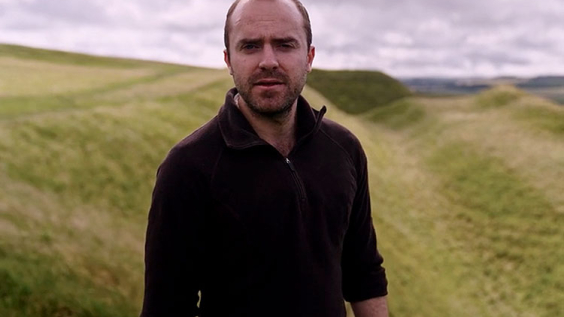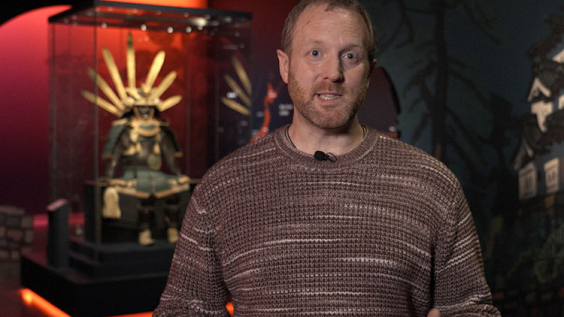



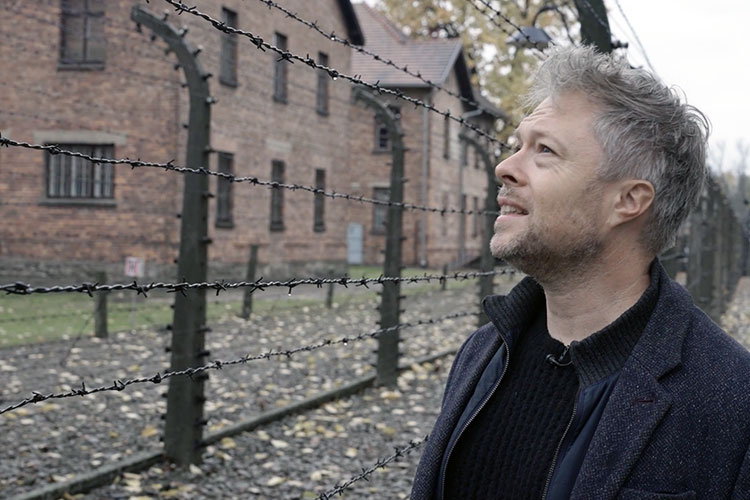

To mark Holocaust Memorial Day on 27 January, History Hit is proud to release a landmark original documentary: Auschwitz: The Evolution of Terror. Featuring unprecedented access to the Auschwitz-Birkenau site (facilitated by the Auschwitz-Birkenau State Museum), Dr James Bulgin, Head of Public History at the Imperial War Museums, conducts a meticulous investigation into the camp’s chilling transformation. He traces its path from a concentration camp for Polish political prisoners into the industrialised epicentre of one of the worst crimes in human history.
By examining the camp’s surviving structures, Dr Bulgin reveals how mass murder was organised, refined, and expanded over time. Joined by historians and experts, he reinforces a vital truth: Auschwitz was not a static symbol of evil, but a site that evolved through deliberate human decisions, administrative structures, and mechanical systems.
 Watch Now
“The access to people and places secured by History Hit was genuinely revelatory,” says Dr Bulgin. “Walking around spaces inaccessible to the general public that have been left as they were since the end of the war offered an unfiltered authenticity which was both sobering and eerily elucidating”.
Dan Snow, founder and creative director of History Hit, added: “What we’ve managed to achieve in this documentary, alongside James, is truly groundbreaking”. “These locations aren’t just places on a map; they are the silent witnesses to one of the darkest chapters of human history”.
From Krakow’s streets to Auschwitz’s gates
Dr Bulgin begins in Krakow, viewing one of only two remaining sections of the Ghetto wall. Established in March 1941, the wall featured rounded tops, a cruel reference to Jewish tombstones, signalling the fate intended for the 20,000 people trapped within.
James talks to historian Dr Alicja Jarkowska, who explains that Auschwitz was not chosen at random. Its proximity to Krakow and its rail links made it ideal for the Nazi vision of Lebensraum – a racial empire where occupied Poland would be cleared of many of its inhabitants to secure Germany’s future.

One of only two remaining sections of the Krakow ghetto (established in March 1941, and liquidated in March 1943).
Image Credit: History Hit
From concentration to extermination
James meets with guide and Auschwitz Educator Agata Miodowska, who explains that the first prisoners were German (30 in total), who were later made to guard the first 728 Polish political prisoners that arrived in June 1940 – considered the start date of the functioning of the camp. At this stage, Auschwitz I was a modest site of 20 single-story brick buildings, – a brutal labor camp, but not yet an extermination centre. However, the system of terror was already being codified.
James is granted rare access to Block 3, preserved almost exactly as it was upon liberation 80 years ago. Viewing the cramped bunk-beds, he notes how “Frozen in time, Block 3 provides a chilling snapshot of daily life in Auschwitz”. Inside, researchers made a terrifying discovery: blue staining on the walls. Initially, Zyklon B (a hydrogen cyanide pesticide) was used here to disinfect clothing. James observes: “The blue stains mark a chilling stage – actual traces of the chemical that would be used to kill hundreds of thousands.”

The blue staining on the walls is evidence of Zyklon B (a hydrogen cyanide pesticide) – initially used in this room to disinfect clothing.
Image Credit: History Hit
The transition to mass murder occurred nearby in Block 11, the penal barracks. In September 1941, the Nazis conducted their first experiments using Zyklon B on 850 Soviet and Polish prisoners. The experiment proved the chemical’s lethality but highlighted logistical “failures” – the small rooms took too long to ventilate. The lesson was purely technical: the Nazis needed a purpose-built, large-scale facility – leading to the construction of the first permanent gas chamber.
“It should come as no surprise that Auschwitz retains all of its ability to shock and horrify, but there’s something about this block in particular that is appalling. Not just because of the terrible suffering that those who were sent here were subject to, but because of the significance of what happened underneath my feet in this place”.
– Dr James Bulgin
The industrialisation of death at Birkenau
From 1941 onwards, Auschwitz entered a phase of rapid and deliberate expansion. By 1942, the centre of gravity shifted 3km away to Birkenau (Auschwitz II). Between March and June 1943, four massive gas chambers were brought into operation, each capable of killing 2,000 people at a time. As James points out, in a cruel twist, the Nazis forced the Sonderkommandos (Jewish prisoners) to operate these facilities.
Dr Bulgin examines the ‘Auschwitz Sketchbook’ – 22 drawings made by an anonymous prisoner, the only known illustrations created inside the camp depicting the extermination process. They show a site in constant flux, an engineering project designed to process 1.1 million victims. James notes a chilling paradox: the sheer volume of victims eventually overwhelmed even this industrialised machine, forcing the Sonderkommandos to cremate bodies on open-air pyres when the furnaces could no longer keep pace.
The perpetrators and the myth of ignorance
The documentary confronts the “normality” of the killers. Commandant Rudolf Höss lived with his family in ‘House 88’, within sight of the crematoria. From the upstairs windows, the killing zone was clearly visible.
Jacek Purski, Director at House 88, explains that the Höss family’s proximity to the gas chambers demonstrates a high level of ideological radicalisation. Höss was a professional criminal and a “graduate” of the SS structure at Dachau; he was not an accidental participant, but a prepared operative.

View of Auschwitz 1 from one of the windows at the house Auschwitz Commandant Rudolf Höss lived in with his family – ‘House 88’.
Image Credit: History Hit
The fragility of justice
Following the war, Höss was captured by a British War Crimes Investigation Team. He was tried and hanged in 1947 on a gallows constructed just steps from the Auschwitz crematorium.
Historian and author Thomas Harding (whose Great Uncle arrested Höss) notes, however, that Höss was the exception. While the 1945 Belsen trials confronted 45 staff members, the Holocaust required the active participation of tens of thousands. Only a tiny fraction were ever held accountable.
‘Auschwitz: The Evolution of Terror’ is a ground-level examination of how bureaucracy, engineering, and human choice created a nightmare. It forces us to confront the fact that these were not monsters from another world, but real people who made systematic choices to commit the unthinkable.