




When you think of ancient empires, you likely imagine the grandeur of powerful gods, majestic temples, and the triumphs of kings. But what about the fears that lurked in the dark, or the unseen forces that could bring disease, disaster, or even death to a household? For the people of ancient Mesopotamia, the world was alive not just with divine power, but with a terrifying pantheon of demons and supernatural beings.
In the second film in an exciting new partnership between History Hit and one of the world’s oldest and finest public museums, the University of Oxford’s Ashmolean Museum, Professor Suzannah Lipscomb journeys behind the scenes to uncover the fascinating world of Mesopotamian demons. Guided by curator Dr Nancy Highcock, Suzannah explores how ancient people sought protection in a world where the supernatural was woven into the fabric of everyday life in The Ashmolean Up Close: Demons of Mesopotamia.
 Watch Now
A world infused with the supernatural
Mesopotamia, meaning the land “between two rivers”, stretches across the Middle East in the historical region located in the fertile crescent between the Euphrates and the Tigres rivers (today it now largely encompasses modern-day Iraq and parts of Iran, Syria, Kuwait, and Turkey). It was home to many of the earliest civilizations, including the Assyrians. For these people, the line between the natural and supernatural was practically non-existent.
As Dr Highcock explains, “In Mesopotamia, the supernatural were all around us.” People believed malevolent demons and ghosts were ever-present, causing illnesses and other misfortunes, making it vital to keep one’s ancestors happy and ward of evil spirits. In such a volatile world, images held real power, and every doorway, window, and even the corner of a room was a potential entry point for evil forces.
To protect themselves and feel a sense of control, they created a remarkable array of objects to harness and control these forces. The programme begins with a powerful testament to this belief: a colossal relief of a protective spirit called an Abkalu. With the body of a man and the head of an eagle, this 9th-century BC relief once guarded a palace entrance. Suzannah and Dr Highcock examine the intricate details of the figure, which holds a sacred purifying tool in one hand, designed to ward off evil from the king’s throne room.

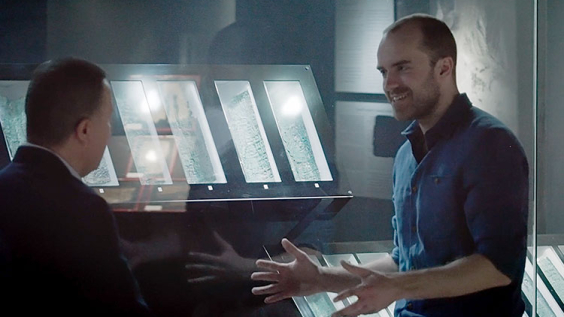
Dr Nancy Highcock (left) and Professor Suzannah Lipscombe (right) look at some of the Ancient Mesopotamian demons in the Ashmolean Museum’s collection.
Image Credit: History Hit
Harnessing demonic power
Protection wasn’t just for the elite. The programme offers a close look at smaller, more personal artefacts used by ordinary people, including a small clay head of a demon ‘Humbaba’. Dating from around 2,000 BC, this mask-like figure is recognisable from one of the oldest known works of literature, The Epic of Gilgamesh. Suzannah learns this tiny clay head was likely used as a protective charm hung on a household doorway, a way for everyday people to contain the power and violence of the demon.
Next, Suzannah examines an amulet designed to protect women and children. The amulet depicts a female demon ‘Lamashtu’, who was blamed for infant deaths and miscarriages. As Dr Highcock reveals, the Mesopotamians believed they could fight fire with fire. By capturing the image of a demon, miniaturising it, and putting it on an amulet, they could harness its power against itself.

Amulet depicting a terrifying female demon named Lamashtu.
Even the demons had their enemies. Suzannah is shown another finely carved amulet, this one depicting the wind god Pazuzu, a formidable monster with a powerful physique. Pazuzu was considered an antagonist to Lamashtu and was specifically used to fight off the child-murdering demon.
The amulet, inscribed in the first person (“I am Pazuzu…”), speaks to a culture where an image wasn’t just a representation; it was imbued with the power of the being itself. The inscription may have even been read aloud during critical moments, such as childbirth, to invoke the demon’s protective power.
Divine dogs and a battle for control
With the constant battle between supernatural forces, humans sought to align themselves with protective beings to gain a sense of control. The programme features another fascinating example of this practice: small clay dogs found at the ancient site of Kish. These dogs, buried at doorways or placed under thresholds, were given powerful names like “Destroyer of Life” and “Biter of the Enemy.” They were believed to actively ward off evil spirits, offering a tangible defence against an otherwise invisible threat.
These astonishing objects from The Ashmolean Museum’s collection offer a unique window into the ancient civilizations of Mesopotamia. They reveal a world where divine and demonic forces shaped daily life, and where people – from rulers to ordinary citizens – sought protection and peace in a volatile existence. Though these empires may have fallen long ago, through these enduring artefacts, their people and beliefs still speak to us today.
Join Professor Suzannah Lipscomb and Dr Nancy Highcock as they reveal the hidden, magical world of Mesopotamian demons in the new episode of The Ashmolean Up Close: Demons of Mesopotamia.