



The meanings of runes are often shrouded in mystery, but they also offer a fascinating connection to the Viking age and a direct insight into the values and character of the Viking people.
What are runes?
Runes are the letters of the runic alphabet, a system of writing that was initially developed and used by Germanic people in the 1st or 2nd Century AD. The alphabet is known as the futhark, after the first six letters of the runic alphabet – f, u, þ, a, r, k.
 Watch Now
There are three main forms of futhark; Elder Futhark has 24 characters and was predominantly used between 100 and 800 AD, Younger Futhark, used between the 8th and 12th centuries, reduced the number of characters to 16, while Anglo-Saxon Futhorc used 33 characters and was mostly used in England.
Younger Futhark, also known as Scandinavian Runes, was used during the Viking Age before being Latinised in the Christian era.
The names of the 16 Younger Futhark runes are:
- ᚠ fé (“wealth”)
- ᚢ úr (“iron”/”rain”)
- ᚦ Thurs (“giant”)
- ᚬ As/Oss (a Norse God)
- ᚱ reið (“ride”)
- ᚴ kaun (“ulcer”)
- ᚼ hagall (“hail”)
- ᚾ nauðr (“need”)
- ᛁ ísa/íss (“ice”)
- ᛅ ár (“plenty”)
- ᛋ sól (“sun”)
- ᛏ Týr (a Norse God)
- ᛒ björk/bjarkan/bjarken (“birch”)
- ᛘ maðr (“man”)
- ᛚ lögr (“sea”)
- ᛦ yr (“yew”)
Norse culture was predominantly oral rather than written, which is why the sagas were generally passed down orally (Old Norse was the spoken language of the Vikings) before finally being written down by scribes in the 13th Century. Which isn’t to say that the Vikings were all illiterate; in fact the runic alphabet is thought to have been widely understood but mostly used for memorial purposes, which is why thousands of runestones can be found throughout the Scandinavian countryside.
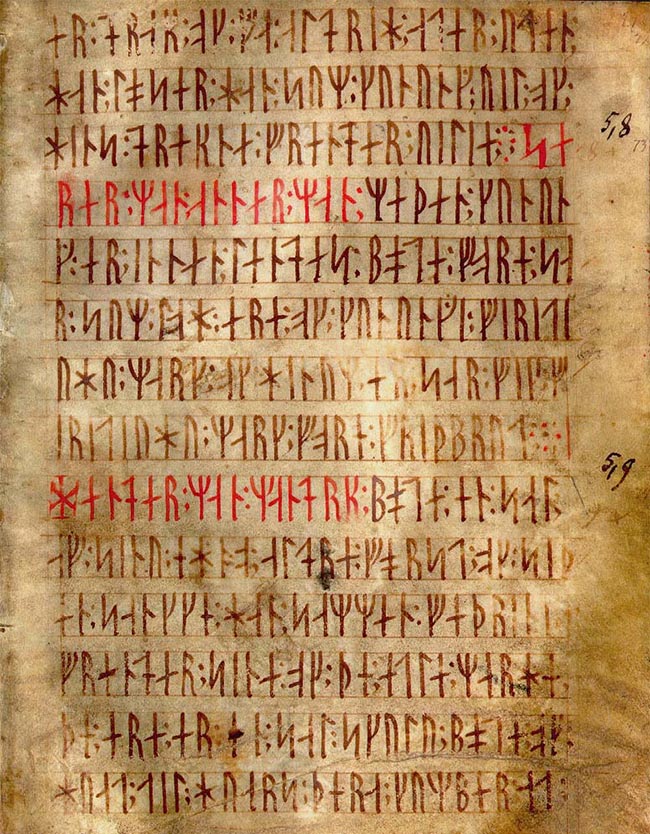
Codex runicus, a manuscript from c. 1300, written entirely in runes.
What are runestones?
Mostly raised during the Viking Age in the 10th and 11th centuries, runestones are stones, sometimes boulders or bedrock, covered in runic inscriptions. Typically, they are memorials to departed men, as this quote from the The Ynglinga saga suggests:
For men of consequence a mound should be raised to their memory, and for all other warriors who had been distinguished for manhood a standing stone, a custom that remained long after Odin’s time.
The most famous runestone is probably the Kjula Runestone in Södermanland, Sweden, which is inscribed with an Old Norse poem in the alliterative poetic meter known as fornyrðislag. The poem tells of a man called Spear, who was known for his extensive warfare:
Alríkr, Sigríðr’s son, raised the stone in memory of his father Spjót, who had been in the west, broken down and fought in townships. He knew all the journey’s fortresses.

The Kjula Runestone in Södermanland, Sweden.
The Kjula Runestone is a good example of the Viking runestone as a celebration of classic Viking values like honour, valour and heroism. Spear (Spjót) is commemorated as a fallen warrior who fought bravely abroad.