



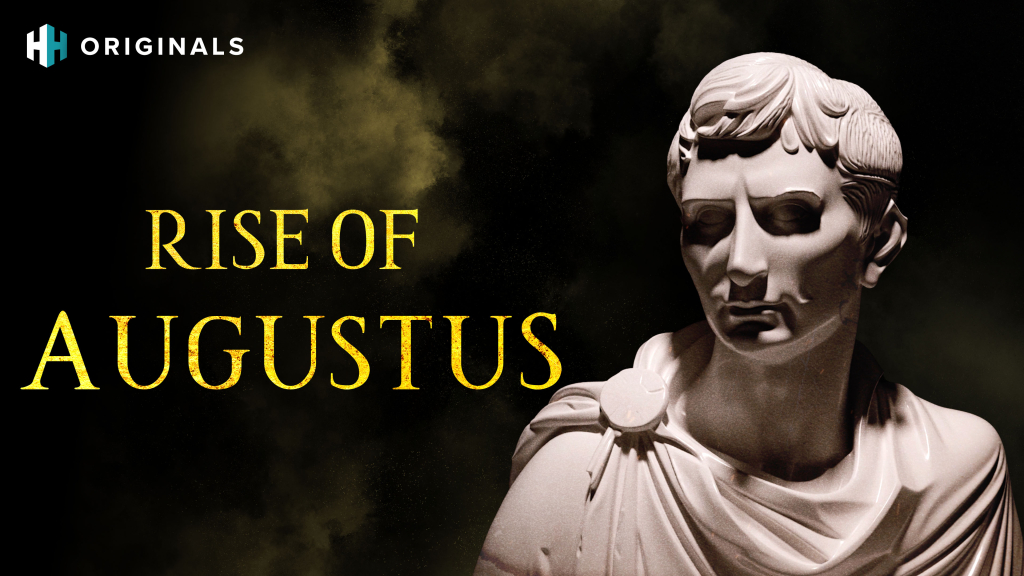
History remembers Julius Caesar. We are captivated by his crossing of the Rubicon, his sweeping military conquests of vast territories, and his bloody, iconic betrayal on the Ides of March. Yet Caesar did not truly create the Roman Empire. That feat belonged to his adopted heir, Gaius Octavius – the ruler who would become Augustus.
In Rise of Augustus, historians including Tristan Hughes, Dr Hannah Cornwell, Adrian Goldsworthy, and Dr Simon Elliot explore how a frail and inexperienced teenager transformed himself into the most powerful man in the Roman world. Caesar may have destabilised the Republic, but Augustus rebuilt its ruins into an empire that endured for centuries.
The documentary examines how Octavian survived an era of violence and political collapse through ruthless pragmatism, calculated alliances, and a remarkable understanding of public image. More than a military leader, Augustus was a political architect who understood that perception could be as powerful as armies.
 Watch Now
Born into a Republic in decline
Octavian was born in 63 BC during the final years of the Roman Republic. By then, Rome was already dominated by corruption, rivalry, and civil unrest. Powerful generals controlled private armies, while senators fought for influence and wealth.
Growing up fatherless, Octavian learned early that noble birth alone meant little. Calculated ambition and careful political positioning mattered far more. Aged 12, he delivered a public funeral speech for his grandmother Julia, the sister of Julius Caesar. The speech openly connected him to Caesar, already one of Rome’s most influential and controversial figures.
Caesar soon recognised potential in the young aristocrat and gradually drew him into his circle. But closeness to Caesar also meant danger.
Caesar’s war and the rise of an heir
When Julius Caesar crossed the Rubicon in 49 BC, he defied the Senate and triggered a civil war that divided Rome. Caesar’s enemies, led by Pompey the Great, fought to preserve the Republic, while Caesar pursued greater authority. The teenage Octavian found himself in a position of immediate, terrifying vulnerability.
The multi-continental civil war completely reshaped the Mediterranean, and eventually reached Egypt. The sudden, shocking execution of Pompey by local rulers hoping to win Caesar’s favour and the entrance of Cleopatra VII and her alliance with Caesar created a volatile political environment, especially after the birth of Caesarion, Cleopatra’s son. For Octavian, the existence of another possible heir threatened his future before it had properly begun.
Everything changed in 44 BC with Caesar’s assassination. A group of senators believed killing him would restore the Republic, but instead they plunged Rome into chaos.

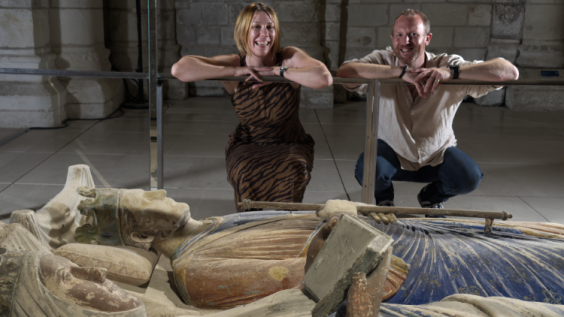
Dr Hannah Cornwell, Associate Professor in Roman History
Image Credit: History Hit
At just 18 years old, Octavian received astonishing news while studying across the Adriatic: Caesar had named him his adopted son and principal heir. Against his family’s advice, he returned to Rome to claim the inheritance and took the name Gaius Julius Caesar Octavianus.
Rome’s political elite underestimated him. The orator Cicero believed Octavian could be used against Mark Antony and later discarded. Instead, the teenager rapidly built support among Caesar’s veterans, raised a private army, and forced his election as consul at only 19.
Soon afterward, Octavian allied himself with Mark Antony and Marcus Lepidus to form the Second Triumvirate, a legally recognised dictatorship that stood above the Senate. To fund their war against Caesar’s assassins, they introduced proscriptions – official death lists that led to mass executions and confiscated property.
The violence shocked Rome. Even Cicero, once convinced he could control Octavian, became one of the victims.

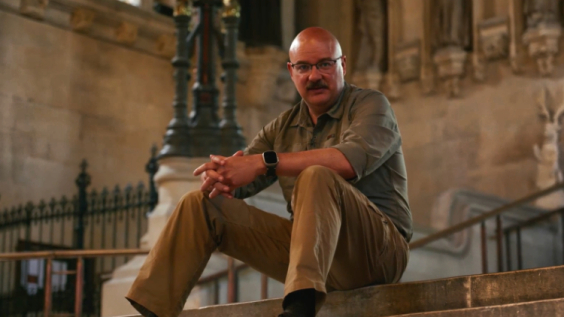
Dr Simon Elliot, historian and author
Image Credit: History Hit
Antony, Cleopatra, and the Battle for Rome
After defeating Brutus and Cassius at the Battle of Philippi, the triumvirs divided the Roman world. Antony took the wealthy eastern provinces, while Octavian controlled Italy and the West.
The alliance quickly deteriorated. Antony became increasingly tied to Cleopatra and Egypt, while Octavian remained in Rome building support. Using propaganda with extraordinary skill, Octavian portrayed Antony as a Roman leader corrupted by a foreign queen.
One of his boldest political moves came when he illegally seized Antony’s private will and read it publicly, fuelling outrage among Romans. Octavian then framed the coming conflict not as another civil war, but as a patriotic struggle against Cleopatra – a strategy that united Rome behind him.
The decisive confrontation came at the naval Battle of Actium in 31 BC. Octavian’s forces defeated Antony and Cleopatra, who later took their own lives in Alexandria. With their deaths, Octavian became the sole ruler of the Roman world.

Adrian Goldsworthy, historian and author
Image Credit: History Hit
The creation of Augustus
Although Octavian now held complete power, he had witnessed his great-uncle murdered for acting like a king, and refused to repeat the mistake.
Instead of openly becoming a monarch, he carefully preserved the illusion that the Republic still existed. He adopted the modest title Princeps, meaning “first citizen,” while quietly controlling the army, government, and finances. He also accepted the honorific name Augustus.
Under Augustus, Rome entered a long period of peace and stability after decades of civil war. Many citizens willingly accepted the loss of political freedom in exchange for order and prosperity under the illusion of a free republic.
The empire Augustus created lasted for centuries and reshaped the western world. His political system became the model for imperial rule long after Rome itself declined.
Rise of Augustus is more than the story of a Roman emperor. It is the story of how modern autocracy was born. Augustus succeeded not simply because he defeated his enemies, but because he mastered the art of ruling without appearing to rule.
Through intelligence, patience, and relentless calculation, the overlooked teenager who inherited Caesar’s name transformed himself into the architect of one of history’s greatest empires.