


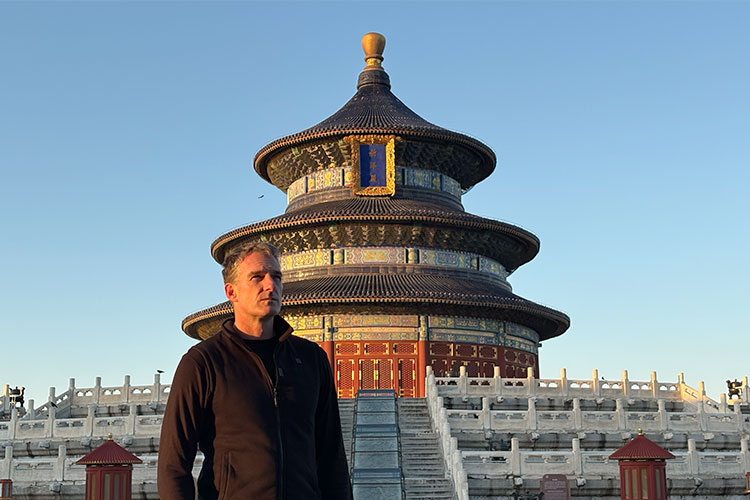

Beijing is a city of superlatives. While its shimmering metropolis of 22 million people spanning over 16,000 square kilometres appears resolutely focused on the future, it remains anchored by a 600-year-old “invisible spine.”
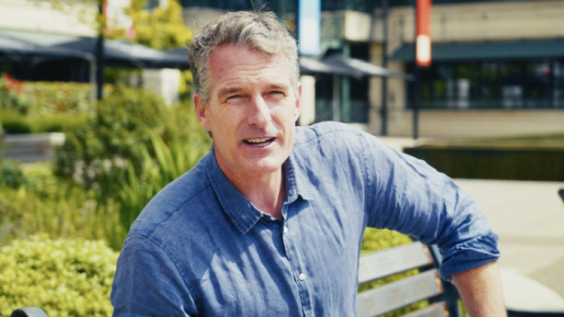
In History Hit’s new documentary, Beijing Central Axis: China’s Medieval Wonder, Dan Snow explores this perfectly straight meridian – a World Heritage site that still dictates the architectural symmetry and urban flow of the capital today. From its Yuan Dynasty foundations to the monumental projects of the Ming and Qing Dynasties, the axis connects icons like the Forbidden City and the Temple of Heaven, revealing a city whose modern footprint still honours a centuries-old imperial plan.
Cycling the length of this historic line, Dan follows in the footsteps of the emperors and labourers who built this vast capital, uncovering clues to China’s past hidden in plain sight. Featuring special access to some of Beijing’s most exclusive locations, the film offers a fascinating look at the ancient soul surviving within a modern giant – one of the most organised and awe-inspiring cities on Earth.
 Watch Now
The Mongol blueprint: from Dadu to Beijing
Dan begins his journey by bicycle in northern Beijing, tracing the city’s origins back to the 13th century. While the area has been settled for 3,000 years – a full millennium longer than London – it was Kublai Khan, grandson of Genghis Khan, who truly transformed the landscape.
In 1272, he established the Yuan Dynasty and renamed the city Dadu, the ‘Great Capital’. It was a staggering feat of urban planning, home to nearly a million people and enclosed by massive earthen walls that remain visible today. This was the Mongol city that mesmerised the Venetian explorer Marco Polo, whose accounts of its wealth and grid-like precision in his book ‘The Travels’ seemed like pure fantasy to medieval European ears.
The Kaogong ji: architecture as cosmology
Less than a century after Dadu’s completion, the Yuan Dynasty was overthrown by the Ming Dynasty, and Dadu was raised to the ground. However, in 1402, a new Ming Emperor seized the throne: the Yongle Emperor. Seeking a capital that reflected his absolute power, he ordered Beijing (the “Northern Capital”) to be reborn on Dadu’s foundations in 1403.

Scale model of Beijing at the Beijing Planning Exhibition Hall
Image Credit: Beijing Planning Exhibition Hall / History Hit
At the Beijing Planning Exhibition Hall, Dan examines a scale model that reveals the city’s true “spinal cord”: the Central Axis. Unlike London or Paris, which evolved organically along meandering rivers, Beijing was built to a strict manual. The Kaogong ji (‘Records of Trades’), a Zhou Dynasty text over 2,000 years old, served as a technical and cosmological guide for the “correct” design of almost anything.
Historian Jeremiah Jenne explains to Dan that the city’s layout was designed to mirror the heavens. Just as Polaris, the North Star, remains fixed in the sky, the Emperor was the fixed point on Earth – seated at the exact centre of a universal order.
The Drum and Bell
After gaining a bird’s-eye perspective of the city, Dan heads to the axis’s northern terminus: the historic Drum and Bell Towers. During the Ming Dynasty, these structures were the city’s official timekeepers. Their thunderous beats and chiming bells could be heard over 20km away, marking the vital pulses of daily life and dictating the rhythm of the imperial capital.

Dan at the Drum and Bell Towers, Beijing
Image Credit: History Hit
The heart of the Axis: The Forbidden City
Travelling south, Dan reaches Jingshan Park. This hill provides the ultimate vantage point, but is entirely man-made – constructed from the rubble of the demolished Mongol palace. According to the principles of feng shui, it was placed to protect the new Imperial headquarters from “evil spirits” drifting in from the north.
From this height, the Forbidden City reveals its true scale. Constructed between 1406 and 1420 to be the most opulent palace on Earth, it housed 24 emperors over five centuries. Today, it is now the most visited historical site on the planet, welcoming 15 million people annually.

View of The Forbidden City from Jingshan Park
Image Credit: History Hit
Inside the Hall of Supreme Harmony, Dan views the Dragon Throne – the seat of the ‘Imperial Dragon’. He explains how the palace, while a masterpiece of joinery, was a nightmare for fire safety. Built largely of wood, the main halls were tragically burned by a lightning strike within a year of completion, leaving the Ming emperors in a constant state of vigilance.
Life in the shadows: The Hutongs
Beijing was never just a palace; it was a living, breathing community. To find the pulse of “Old Beijing,” Dan explores the Hutongs – tightly packed alleyways where the craftsmen, artists, and servants of the palace once lived.
The word Hutong comes from the Mongolian word for “water,” as these neighbourhoods were built around communal wells. Meeting with cultural heritage expert Matthew Hu, Dan learns more about the Courtyard Institute. These homes were built with the same feng shui rigour as the palace. Designed to foster communal life, Matthew Hu describes them as “like villages in cities.”
The Temple of Heaven
On the Winter Solstice, the Central Axis became the stage for China’s most important religious ritual. The Emperor would make a solemn procession to the Temple of Heaven. Located slightly southeast of the axis – the direction of the rising sun and “positive” energy – this temple was where the “Son of Heaven” prayed for good harvests and for the empire.
Historian Zhang Huawei explains that during this procession, the city went into lockdown. Commoners were forced to shutter their windows; to look upon the Emperor as he moved toward the temple was strictly forbidden.

Dan talks to historian Zhang Huawei
Image Credit: History Hit
Modern harmony: the Axis extends
Dan finishes his journey along the axis at the Yongdingmen Gate, the southern gateway of Beijing. Though demolished in the 1950s to make way for roads, it was meticulously reconstructed in the early 2000s.
Dan then concludes his visit at the Bird’s Nest Stadium, the centrepiece of the 2008 Summer Olympics. Strategically placed as a modern northern extension of the Central Axis, the stadium proves that Beijing’s 600-year-old “spine” is still growing. In Beijing, the ancient and the avant-garde sit in perfect harmony, balanced on a line drawn by emperors centuries ago.