



Long before a unified Kingdom of England existed, the British Isles were a chaotic patchwork of rival warlords, shifting alliances, and clashing cultures. In the turbulent centuries following the collapse of Roman rule around 410 AD, pagan invaders – Angles, Saxons, and Jutes – carved out territories alongside native Brittonic kingdoms. A united Christian nation was far from a foregone conclusion.
In History Hit’s gripping 2-part documentary series Cross and Sword, historian Matt Lewis investigates this forgotten era popularly known as the ‘Dark Ages’. Journeying across ancient landscapes, sacred ruins, and high-tech archaeological labs, Matt explores the violent turning points where the fate of Britain hung in the balance.
 Watch Now
The Powerhouse of the North: Ad Gefrin
The story of England’s fragile origins begins in its rugged north. In the early 7th century, a fierce and ambitious warlord named Æthelfrith united the northern realms of Bernicia and Deira, to establish the formidable Kingdom of Northumbria.
At the foot of Yeavering Bell in Northumberland lay Ad Gefrin, the summer palace of Northumbria’s early kings. Archaeology has revealed an expansive complex of wooden halls and a unique timber theatre used for storytelling, royal assemblies, and public law-giving.
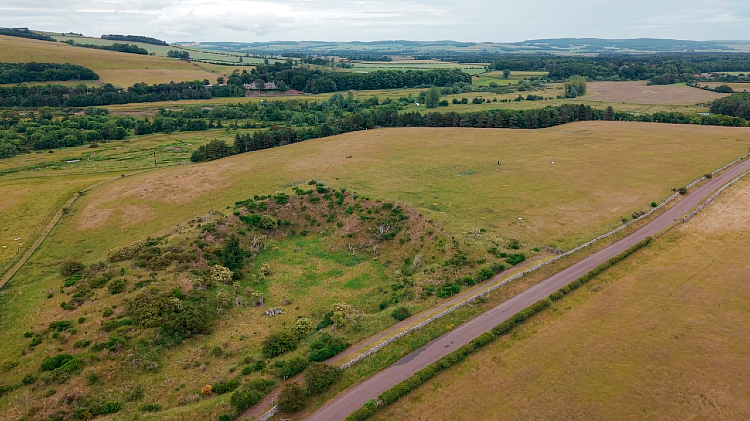
The site of Ad Gefrin
Image Credit: History Hit
Speaking with Anglo-Saxon expert Dr. Chris Ferguson, Matt Lewis uncovers how Northumbria’s rulers used sites like Ad Gefrin to project power, tapping into prehistoric monuments to claim an ancient right to rule:
“You go in that great hall to see the royal court assembled, to see that power,” explains Dr. Ferguson. “It’s as much about people agreeing to your rule as it is about sword and battle.”
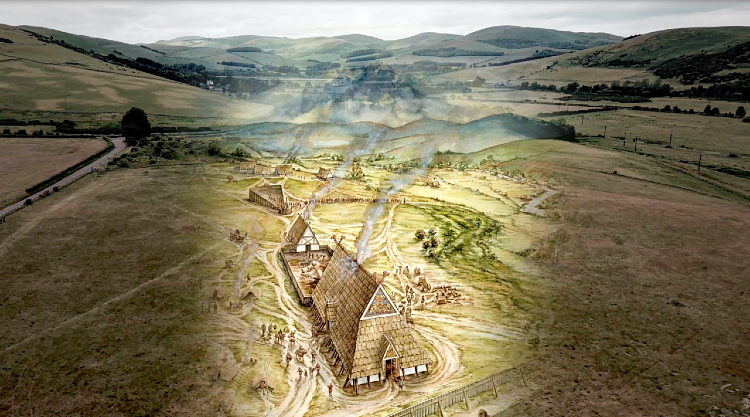
Artist’s impression of how Ad Gefrin would have looked at its height
Image Credit: History Hit
Gold, glass, and female power in the Mead Hall
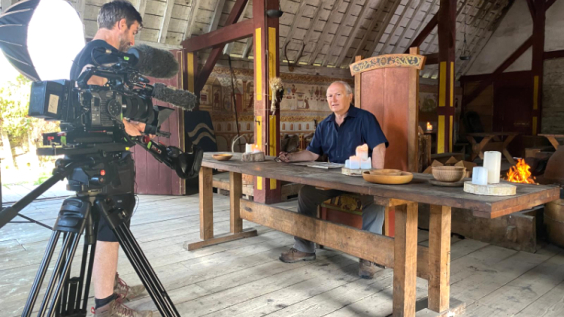
Stepping inside a magnificent, full-scale recreation of King Edwin’s hall at the Ad Gefrin Centre in Wooler, Matt explores a thriving, highly sophisticated world that shatters the traditional “Dark Ages” stereotypes.
Far from primitive outposts, 7th-century Northumbrian courts were hubs of international influence, filled with imported luxury goods, sacred feasting rituals, and complex political dynamics.
Re-enactor Charlotte Fielding and project director Dr. Chris Ferguson showcase breathtaking high-status artefacts – from rare recycled Roman glassware to the famous Loftus Princess grave goods – revealing the surprising authority held by elite royal women in these grand spaces and the vital role they played in maintaining political stability.
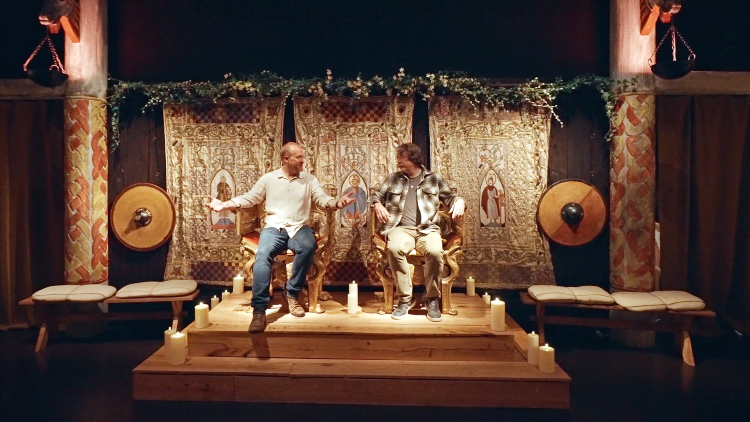
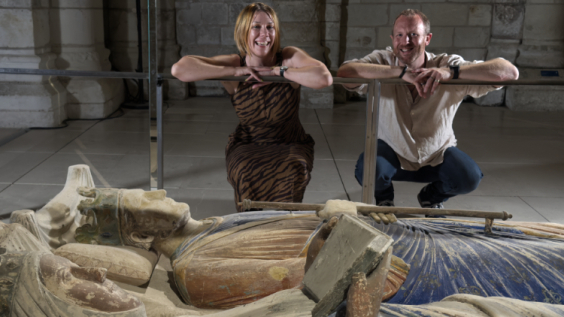
Matt Lewis and Dr. Chris Ferguson in the full-scale recreation of King Edwin’s hall at the Ad Gefrin Centre in Wooler
Image Credit: History Hit
Conversion and collision
Under Æthelfrith’s successor, King Edwin, Northumbria reached the height of its early power. Dubbed Bretwalda (“ruler of all Britain”) by the Venerable Bede, Edwin forged a critical alliance by marrying Æthelburg, a Christian princess from Kent.
In 627 AD, persuaded by his wife and the missionary Paulinus, Edwin made the momentous decision that would reshape the island’s future: converting to Christianity and baptising his court in local rivers.
Bede famously recorded a poetic speech by one of Edwin’s advisors that convinced Edwin’s nobles to abandon their old gods, comparing human existence to a sparrow flying briefly through a warm, lit hall in winter.
“The present life of man seems like the swift flight of a sparrow through the room… It vanishes into the dark winter from which it had emerged. If therefore this new doctrine contains something more certain, it seems justly to deserve to be followed.”
Yet Edwin’s rapid rise sparked a brutal backlash. Cadwallon, the Christian King of Gwynedd (North Wales), viewed the Anglo-Saxons as hostile usurpers. Forging an unlikely alliance with Penda, the ruthless pagan king of Mercia, Cadwallon marched north to destroy Edwin’s kingdom.
The cataclysm at Hatfield
On 12 October 633 AD, the two armies met in a devastating clash known as the Battle of Hatfield. King Edwin was killed, his army slaughtered, and Northumbria plunged into chaos.
While historians have long debated where this decisive battle actually took place, Matt visits St. Mary’s Church in Cuckney, Nottinghamshire, to investigate a thrilling archaeological mystery. Could a forgotten mass grave beneath the church floor – containing dozens of skeletons bearing signs of weapon trauma – mark the true, bloody site of Edwin’s last stand?
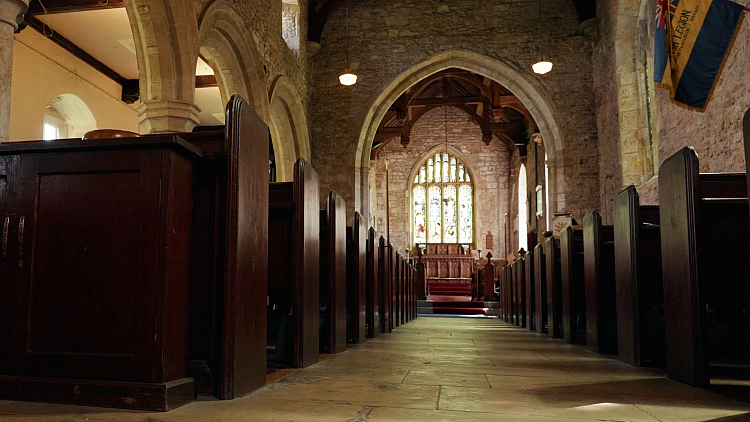
Floor of St Mary’s Church in Cuckney, Nottinghamshire – could a forgotten mass grave lie beneath?
Image Credit: History Hit
A realm in ruins
In the tragic aftermath of Hatfield, Northumbria was left broken, its fledgling Christian faith on the brink of complete collapse. Yet as the memory of the fallen king gave rise to legends of sainthood in the depths of Sherwood Forest, a new threat – and a new hope – was gathering on the horizon.
From exile in Western Scotland, a returning prince named Oswald was preparing to make his bid for the crown. How would he fight back against Cadwallon and Penda? And could Christianity survive the onslaught?