



This article is an edited transcript of World War Two SAS Veteran with Mike Sadler, available on History Hit TV.
 Listen Now
The first SAS mission took place in North Africa during World War Two and was a disaster. Its men tried to parachute into the desert in a high wind, in the dark, and all with very little experience.
The Long Range Desert Group, a reconnaissance and intelligence gathering unit which I was in at the time, picked up a few survivors, but more than half of the men who took part were killed.
David Stirling, the mastermind of the SAS, was very keen to do another operation as soon as possible so that his unit wouldn’t be dismissed as a disaster and wiped out.
He managed to arrange for the LRDG to take them to their targets for their first successful operation.
It was the first time that we had met the SAS. We drove up from Kufra in southern Libya to Jalu, which was halfway up towards the coast, and met this ragged team of survivors.
We were then allocated a team to go to various airfields. I got Blair Mayne, one of the legendary figures of World War Two in the British Army.

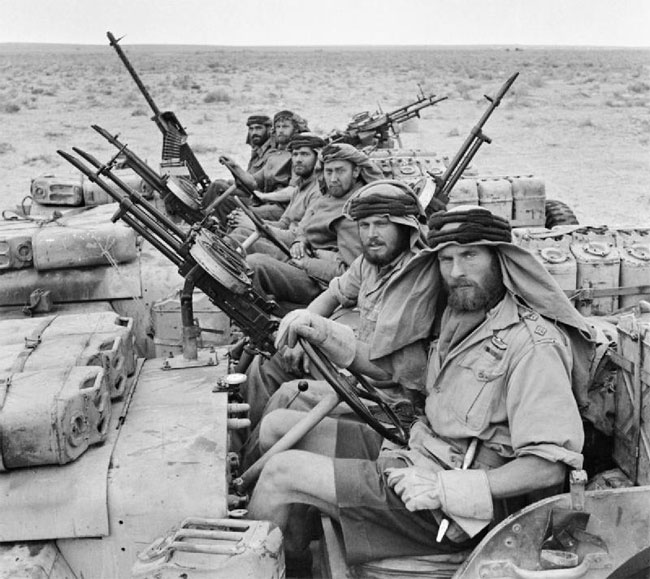
An SAS unit in North Africa. Navigation in the desert was “like being at sea”.
We set off for quite a long westward journey to Tamet. I think it took two or three days.
That part of it was all great fun in those days. I loved the desert and I loved the navigation.
It was a voyage of discovery because the maps, except in the very coastal regions, had nothing much on them except longitude and latitude lines and the odd dotted line marking a camel track or something. It was entirely like being at sea.
When we arrived at Tamet, there was a very long, deep wadi leading up to where the airfield was. We got down in there and Mayne’s men set off on what proved to be a very successful raid. I think they planted bombs on about 30 aeroplanes.
Getting away
That was the most successful of those early SAS raids. On another, Jock Lewes was hit by a striking aircraft. That was the snag about such raids, you were always chased afterwards.
Lewes was hit and killed. He was one of the co-founders of the SAS with Stirling, so he was a great loss.
Escaping the raids was a matter of both hiding and getting out of there as fast as you could, because you couldn’t get that far away.
 Listen Now
On one of the raids, my duty was to go to one corner of the airfield while the others drove Jeeps around, shooting up the aircraft. I had to wait until dawn in case somebody had been lost. So I only got away from the airfield at dawn, after the raid, and found myself driving through a German column that had set out into the desert to look for us.
I drove through the column from the back and nobody noticed. I don’t think they expected anyone to be behind. They’d stopped to have a cup of tea on the roadside, and I drove on and out.
Luckily, I then joined up with somebody further down. Everything tended to rely on a bit of luck back then, because we didn’t really know what was going on most of the time.
It was outdoor life and it was quite exciting, if rather alarming at times. I wasn’t all that keen on being shot at, but who was?

David Stirling with an SAS jeep patrol in North Africa.
It was a very hard life. We didn’t have enough water or food for quite long periods. But still, I personally enjoyed it on the whole. You forget about the bad moments to some extent.
I can remember the good times, like camping in the evening when we got a little ration of rum and lime last thing in the day to restore our spirits. And, if you put it in a plate under one of the cars, the breeze would cool it down and make a very nice drink. That’s the sort of thing I remember with pleasure.
 Watch Now