




By the dawn of the 1st century BC, the Roman Republic stood as the Mediterranean’s undisputed titan. For four centuries, this formidable machine had been fuelled by a radical concept: libertas – the principle that no single man should ever hold absolute power. The Senate ruled, power was shared, and the system seemed unbreakable.
But in 100 BC, a child was born into an aristocratic yet faded lineage – a man who would dismantle this 400-year-old system and build something new.
In the gripping documentary Rise of Caesar, renowned historians Adrian Goldsworthy, Dr. Simon Elliott, and Dr. Hannah Cornwell, alongside History Hit’s Tristan Hughes, peel back the layers of the man, the myth, and the massive political ego that transformed the Western world forever. Together, they trace Gaius Julius Caesar’s journey from a fugitive teenager to a ‘warlord’ who gambled everything on a single river crossing.
 Watch Now
The crucible of ambition
Born into the Gens Julia – an ancient aristocratic family claiming descent from the goddess Venus – Caesar’s lineage was prestigious, yet his family lacked the wealth and political clout of Rome’s top-tier elite.
Caesar’s hunger for power was forged in crisis. When he was just a teenager, his father died suddenly, thrusting him into the role of family patriarch. This premature responsibility forced a rapid maturity. As Tristan Hughes explains, the political landscape was already fracturing between the conservative Sulla and Caesar’s radical uncle, Marius.
The ‘Marian reforms’ had recently transformed the Roman army from a citizen militia into a professional force loyal to their generals rather than the state. “This suddenly gives you the power of a warlord,” notes Dr. Simon Elliott. When Sulla emerged victorious in a bloody civil war, Caesar found himself on a hit list. Only through his family’s influence was he pardoned – though Sulla famously warned that “in this Caesar, there are many Mariuses.”
The Cursus Honorum: climbing the ladder
To reach the top, Caesar had to navigate the Cursus Honorum (the “Ladder of Offices”). This was a rigid hierarchy of financial, judicial, and administrative roles that every ambitious Roman aristocrat was required to climb.
Caesar’s ascent was marked by a relentless pursuit of renown. After winning the Civic Crown – the Roman equivalent of the Victoria Cross – for saving a comrade’s life in battle, he returned to Rome to master the art of law and oratory. He famously took on high-profile legal cases just to get noticed, even if it meant making enemies of the senior nobility.
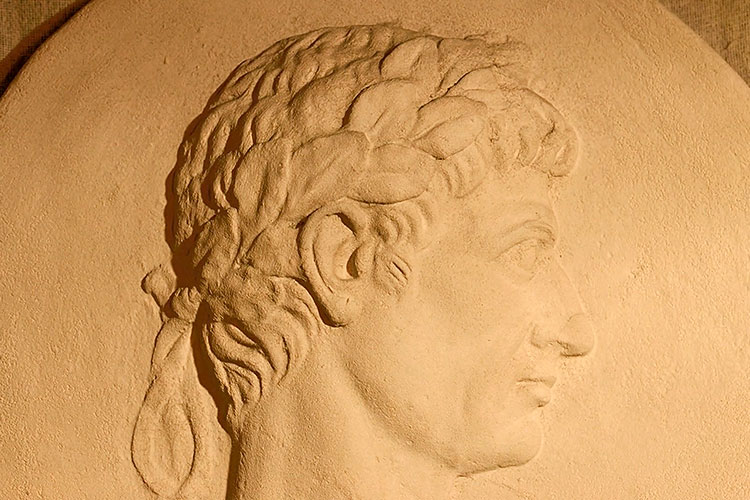
Caesar with Civic Crown
Image Credit: History Hit
His journey was never dull; while traveling to Rhodes to study, he was captured by pirates. In a display of the “immense self-confidence” Adrian Goldsworthy highlights, Caesar laughed at their low ransom demand, insisted they double it, and joked that he would return to crucify them – a promise he grimly kept.
Bread, circuses, and massive debt
By the 60s BC, Caesar understood that in Rome, politics was a rich man’s game. To win the hearts of the masses, he spent lavishly. As an Aedile in 65 BC, he staged games featuring 320 pairs of gladiators. “Being active in Roman politics is not cheap,” says Dr. Hannah Cornwell.
To fund this “bread and circuses” strategy, Caesar turned to Crassus, the wealthiest man in Rome. This calculated risk helped secure his election as Pontifex Maximus in 63 BC – the high priesthood of Rome. This move provided him with the sacrosanctity and influence needed to begin his true power play.
The documentary then details Caesar’s rivalry with Cato and his time serving as Praetor, before explaining how Caesar stayed ahead of his creditors by securing governorships abroad, first in Spain, and later in Gaul, where the spoils of war finally began to settle his astronomical debts.
The First Triumvirate
By 60 BC, Caesar realised that the Senate’s shared power was a wall he couldn’t climb alone. He orchestrated the First Triumvirate, a secret and staggering political alliance with Pompey the Great, Rome’s most celebrated general, and Crassus, its wealthiest citizen.
This was the moment the Republic truly began to wobble – the alliance effectively bypassed the Senate, allowing Caesar to secure the consulship and, subsequently, the governorship of Gaul.

Assignment of Roman provinces to Caesar, Pompey, and Crassus.
Gaul and the British expeditions
To rule Rome, Caesar knew he needed two things: gold and glory. The documentary takes us into the Gallic Wars, where Caesar’s genius for logistics and psychological warfare was on full display. He didn’t just conquer territories; he systematically erased opposition.
In 55 and 54 BC, Caesar turned his gaze toward the mysterious island of Britain. While these expeditions were militarily inconclusive, they were propaganda masterpieces. By crossing the “Ocean” at the edge of the known world, Caesar framed himself as a pioneer-hero, outshining even Pompey’s eastern victories.
The point of no return: the Rubicon
By 50 BC, Caesar had become too powerful for the Roman establishment to ignore. His former ally, Pompey, had aligned with the conservative faction led by Cato the Younger. The Senate issued an ultimatum: disband your army or be declared an enemy of the state (hostis). Caesar knew that returning to Rome without his legions meant certain prosecution and political ruin.
On 10 January 49 BC, Caesar arrived at the Rubicon, a small, unremarkable river in Northern Italy marking his provincial boundary. He’d been told to cross it with an army would be an act of high treason. With the famous words, “Alea iacta est” (The die is cast), he crossed. The Republic was dead; the Civil War had begun.
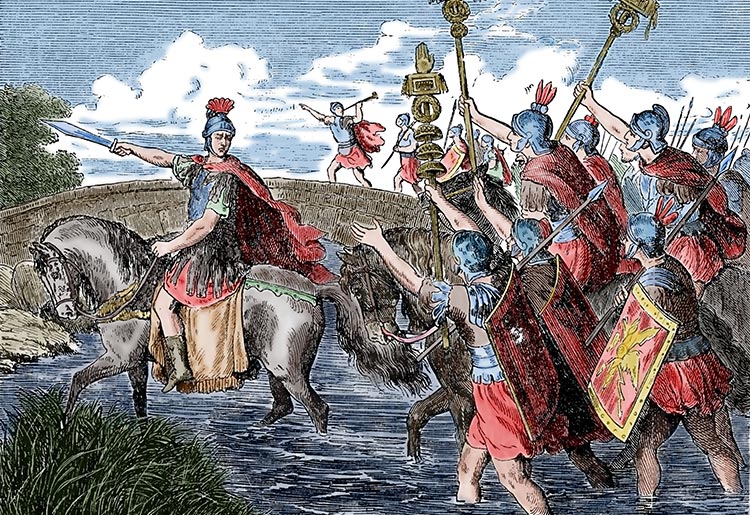
Caesar crossing the Rubicon, 49 BC
Image Credit: Lanmas / Alamy Stock Photo
Dictatorship and the Ides of March
The aftermath saw Caesar sweep through Italy, defeating Pompey at Pharsalus. His victory was the death knell for Republican governance. Eventually declared Dictator Perpetuo (Dictator for Life), he began a whirlwind of reforms, including the creation of the Julian Calendar and an expansion of the Senate to include his loyal supporters.
However, his absolute power became his death warrant. To the old guard, Caesar wasn’t a reformer; he was a tyrant. On the Ides of March – 15 March 44 BC – the very principles the Republic was built upon – shared power and the rejection of kingship – struck back. Led by Brutus and Cassius, a group of senators assassinated Caesar in the Theatre of Pompey. While they hoped to restore the Republic, they only succeeded in accelerating its collapse, paving the way for his heir, Augustus, to become the first Emperor.
Step into the world of ancient Rome and learn more about what led to the gamble that ended an era in Rise of Caesar.