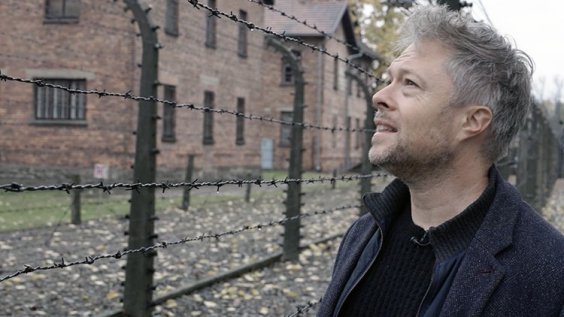



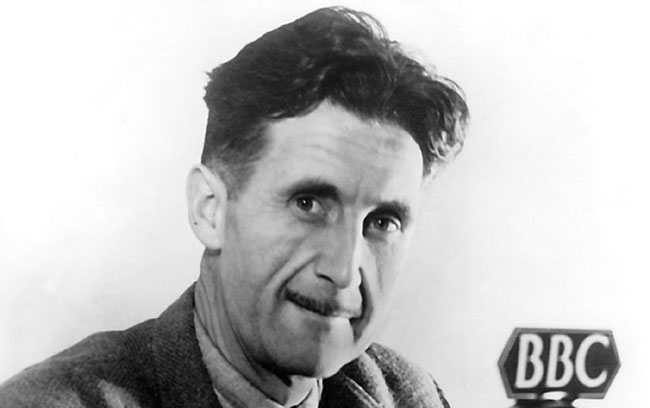

Christopher Hitchens once wrote that there were three big issues of the 20th century – imperialism, fascism and Stalinism – and George Orwell got them all right.
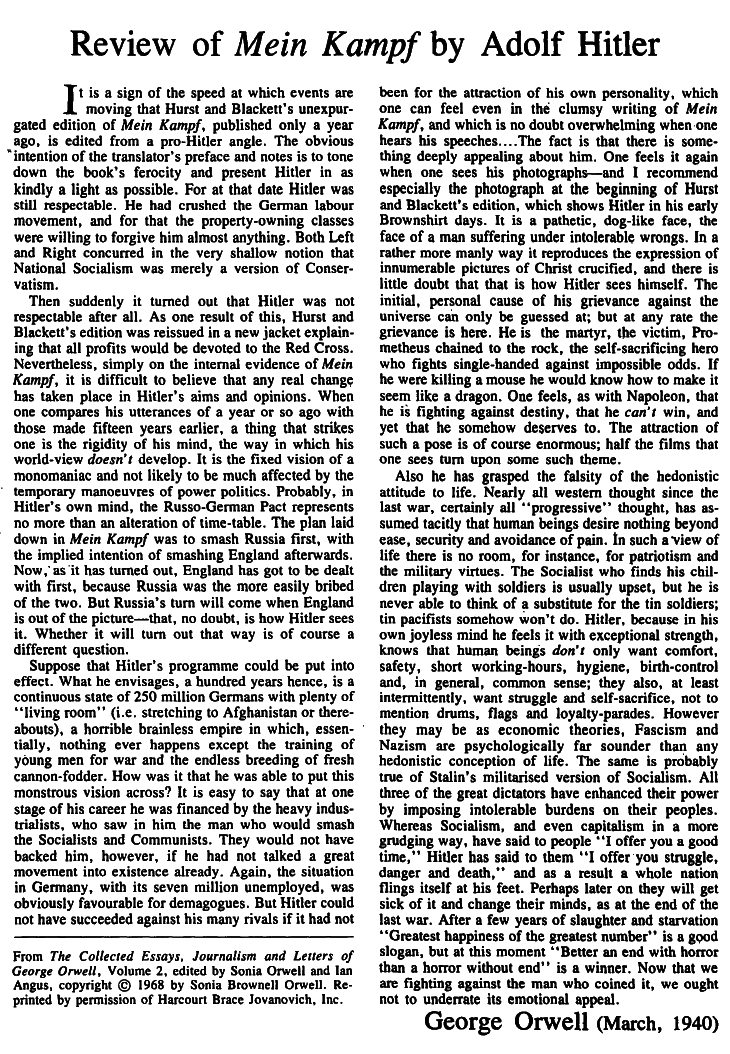
These powers of prescience and perception are evident in this review, published at a time when the upper classes were backpedalling hard on their initial support for the rise of the Fuhrer and the Third Reich. Orwell acknowledges from the outset that this review of Mein Kampf lacks the ‘pro Hitler angle’ of previous editions.
Who was George Orwell?
George Orwell was an English Socialist writer. He was libertarian and egalitarian and he was also hostile to the Soviet Communist Party.
Orwell had long held a great hatred for Fascism, a form of radical authoritarian ultranationalism, characterised by totalitarianism (when a dictatorial regime that had complete control over everything).
 Watch Now
Before war with Germany broke out, Orwell had taken part in the Spanish Civil War (1936-39) on the Republican side, specifically to fight Fascism.
When World War Two erupted in 1939, Orwell attempted to sign up for the British Army. He was deemed unfit for any kind of military service, however, because he was tubercular. Nevertheless Orwell was able to serve in the Home Guard.
Although Orwell was unable to join the army and fight Adolf Hitler’s Third Reich on the front lines, he was able to attack the German dictator and his far-right regime in his writing.
This was most clearly shown in his review of Mein Kampf in March 1940.
 Watch Now
Orwell makes two superb observations in his review:
1. He interprets Hitler’s expansionist intentions correctly. Hitler possesses ‘the fixed vision of a monomaniac’ and he intends to smash England first and then Russia, and ultimately to create ‘a contiguous state of 250 million Germans…a horrible brainless empire in which, essentially, nothing ever happens excepts the training of young men for war and the endless breeding of fresh cannon-fodder.
2. Hitler’s appeal has two fundamental components. First that Hitler’s image is of the aggrieved, that he emits the aura of the martyr that resonates with a beleaguered German population. Second that he knows that humans ‘at least intermittently’ yearn for ‘struggle and self-sacrifice.’