



For centuries, the word ‘Samurai’ has conjured a singular, enduring image: a solitary, fearless warrior, clad in lacquered armour, wielding a razor-sharp katana with lethal grace. This figure is the quintessential paragon of “Bushido” – the ‘Way of the Warrior’ – defined by unwavering loyalty and a strict code of honour.
Yet how much of this is historical fact, and how much is a brilliant exercise in 19th-century branding? The truth is far more complex, and infinitely more fascinating, than the legend.
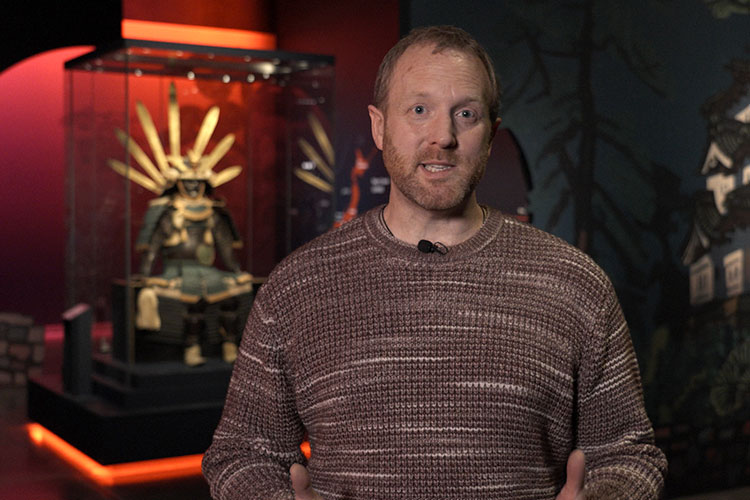
The British Museum has recently unveiled an extraordinary new exhibition, bringing together 280 objects spanning six centuries of Japanese history. History Hit was granted exclusive, behind-the-scenes access to this incredible collection as it was readied for display. In our latest documentary, Samurai: Fighting the Myth, historian Matt Lewis goes beyond the glass cases to uncover the complex, adaptable, and often surprising reality of Japan’s elite warrior class.
 Watch Now
From mercenaries to masters: rise of the gentry
To understand the samurai, one must first dismantle the idea that they were always a landed aristocracy. Talking to British Museum curator and Japan specialist Dr Rosina Buckland, Matt Lewis explores the humble, often brutal origins of these warriors.
“The earliest appearance of these warriors as we think of them now is the 900s,” Dr Buckland explains. “You get this emergence of a class of mercenaries, and they are proxy warriors for these factions within the Imperial Court that are fighting against each other.”
Over time, these ‘swords for hire’ gained land and influence in rural regions, evolving into a landed gentry. By the late 12th century, following a series of brutal rebellions, the samurai wrested political control away from the Imperial Court in Kyoto. Establishing a military government in Kamakura in the east, they began a reign that would endure for nearly 700 years.
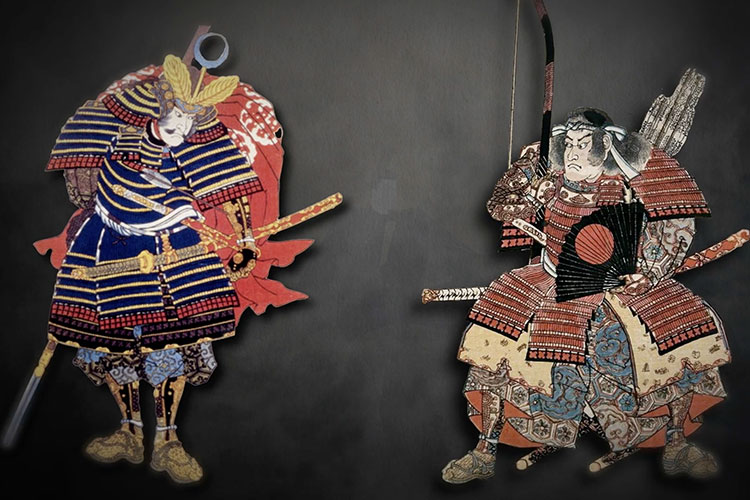
Japanese woodblock prints depicting samurai warriors, specifically portraying the historical figures Morimoto Gidayū Hidetora and Horimoto Gidayū Takatoshi.
Image Credit: History Hit
The three phases of the samurai
The long history of the samurai can be broken into three distinct eras:
Warfare (1185 – 1603): An age of constant internal strife, culminating in the Sengoku (Warring States) period, where rival clans battled for total dominance.
Peace (1603 – 1868): Following unification, the Edo period transformed the samurai. This “long peace” saw them transition from frontline soldiers to the nation’s administrators, government ministers, and ceremonial guardians.
Myth (1868 – present): Following the collapse of the Shogunate, the samurai passed into legend, and the modern misconceptions we hold today began to take root.
Engineering armour
Together with Dr Buckland, Matt takes a close-up look at a full suit of samurai armour. Far from being merely decorative, every lace and plate was a masterpiece of protective engineering.
“The helmet in a suit of armour is often the oldest part” explains Rosina. The striking star helmet (kabuto) featured in the documentary dates back to 1519, an era of intense combat. Designed for a high-ranking samurai, it was meant to be distinctive on the battlefield while directing the fighting.
Matt and Dr Buckland discuss the intricate lacing of multiple overlapping iron plates, designed to absorb the impact of a blow while remaining flexible, as well as the articulated neck guards (shikoro) that offered protection without sacrificing mobility. The helmet features a dragon – a symbol of strength in East Asia – and a face mask (men po) with a fierce battle expression, designed to intimidate the enemy.
Interestingly, the armour also reveals early ‘globalisation’. Following the arrival of Portuguese traders in the 1500s, Japanese armourers began incorporating European styles – such as the rounded breastplate – into their designs to better defend against the new technology of musket fire.
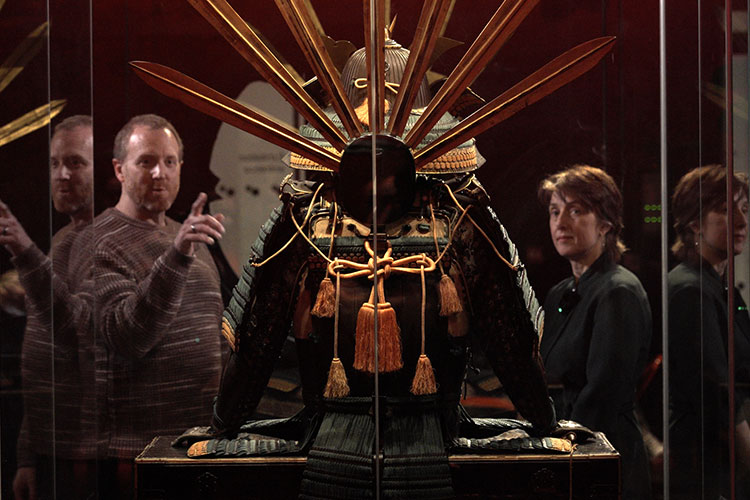
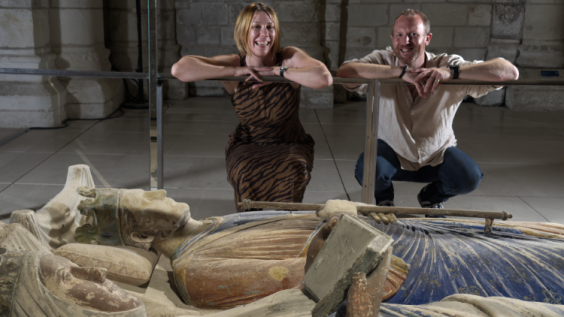
Matt Lewis and Dr Rosina Buckland discuss a suit of samurai armour at The British Museum’s Samurai exhibition
Image Credit: History Hit
Mounted archers and “The Way of the Warrior”
Contrary to the ‘lone swordsman’ trope, the early samurai were primarily mounted archers. Combat usually took place in small, chaotic skirmishes in densely vegetated uplands. It was only in later centuries, as armies grew and battlefields widened, that infantry and the iconic curved blade (katana) became the central focus of warfare.
Underpinning this martial skill was Bushido, or ‘the way of the warrior’. This principle of honour and loyalty was the strategic glue that held clan alliances together in a world where betrayal could mean the total annihilation of a family line.
Beyond the battlefield
After decades of civil war, Tokegawa Ieyasu emerged victorious in 1603, establishing the Tokegawa Shogunate. This unified Japan under a central military rule that presided over two centuries of relative peace.
Perhaps the most surprising revelation in the exhibition is what the samurai did when they weren’t fighting. During the Edo period, warfare became an identity rather than a daily reality, leading to a deep involvement in the arts. High-ranking samurai became masters of elaborate theatrical performances (Noh Drama), formal and highly ritualised tea preparation (Chanoyu), calligraphy and painting, and interestingly the connoisseurship of Chinese antiques.
Samurai women
The documentary also challenges the male-centric view of samurai society. While men held the public roles, women were the formidable ‘heads of the household’, managing complex operations involving dozens of staff and the vital education of heirs. In times of crisis, the wife of a regional lord was often left in charge of the defence of the castle, wielding significant tactical and political power.
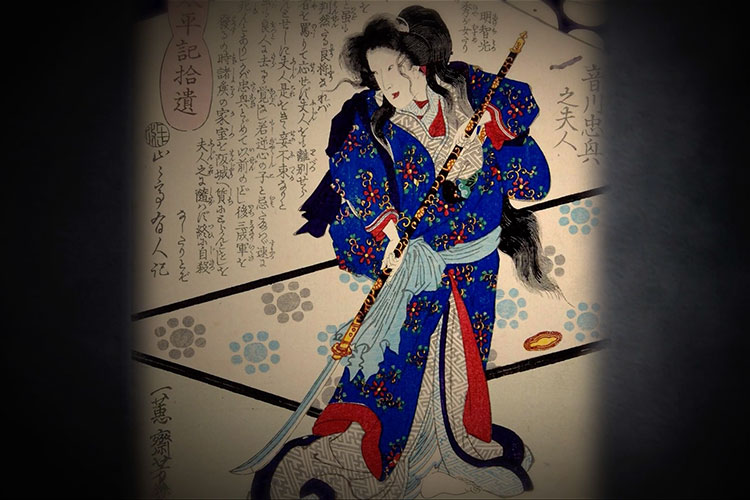
Reproduction of 1867 ukiyo-e woodblock print created by the artist Utagawa Yoshiiku.
Image Credit: History Hit
The birth of a legend
Why did the myth of the ‘lone swordsman’ samurai persist so strongly in the West? Dr Buckland explains that the samurai were meticulous “image-makers” themselves – “they’re very concerned with projecting the correct image” she says.
When the West encountered Japan extensively in the late 19th century, it lapped up this visual material. There was a fashion in Europe at the time for medieval imagery, and Japan offered an ‘ideal warrior’ that was wholeheartedly imported. To the Western imagination, the myth was simply more attractive than the administrative reality.
The end of an era, the start of a legacy
By 1868, the samurai had become an expensive relic. Reorganised under a new constitutional monarchy, they were stripped of their status and stipends, forced to find work in a rapidly modernising world. For a generation, they were seen as remnants of an obsolete past.
It was only when they were safely distant in history that nostalgia bloomed. This sentiment, combined with international fascination, rehabilitated the samurai into the global icon we recognise today.
The British Museum’s exhibition is a rare opportunity to see the artefacts that survived this transition – from the mud of the warring states to the refined tea rooms of Edo.