



The date of 6 June 1944 remains permanently fixed within our collective global memory – D-Day. This marked the start of Operation Overlord, the monumental Allied amphibious invasion of Nazi-occupied France. The statistics of that morning are staggering: 4,000 landing craft, 1,200 warships, 11,000 planes, and 150,000 troops. Yet behind the grand strategy lie the brutal, deeply personal stories of human survival and sacrifice.
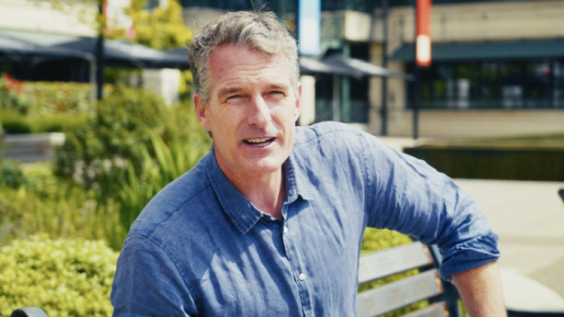
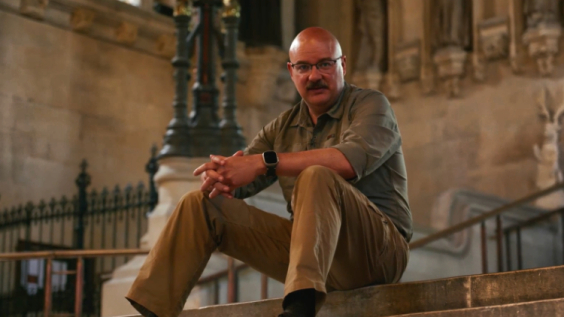
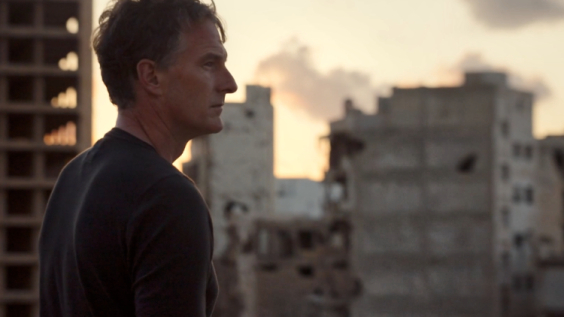
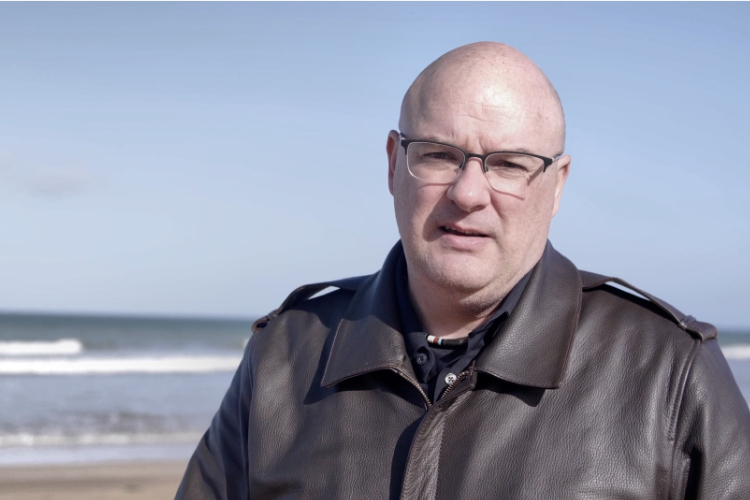
In History Hit’s compelling documentary, Omaha: 24 Hours in Normandy, conflict analyst Professor Michael Livingston steps onto the sands of France, scales the coastal bluffs, and explores historic villages. Moving away from the abstract calculations of high command, he meticulously dissects the first critical 24 hours of the landings to reveal how a morning that began in utter catastrophe ultimately transformed the course of the Second World War.
 Watch Now
Into the jaws of hell
To provide a human lens to this massive offensive, Professor Livingston traces the footsteps of Private First Class Thompson Gallety Dicks, an alumnus of The Citadel – the prestigious Military College of South Carolina where Livingston teaches today. Dicks was a rifleman in A Company, 116th Infantry Regiment, 29th Infantry Division. On the morning of 6 June, A Company formed the absolute tip of the Allied spearhead, tasked with landing in the very first wave at the sector code-named Dog Green on Omaha Beach.
Their objective was critical: secure the paved Dog One Draw, the only paved exit off the beach leading inland to the town of Vierville-sur-Mer. Allied planners were not merely looking to secure a foothold on the sand; they sought to carve a pocket at least five miles deep into Normandy on day one, eventually securing the vital arterial highways leading directly to Paris.
But the physical reality confronting them was a death trap. Weighed down by 30 pounds of water-logged gear, the men dropped from their landing craft straight into the interlocking firing lines of Germany’s Widerstandsnests (Resistance Nests). Within 30 minutes, two-thirds of A Company were dead or wounded. The spearhead was entirely blunted.
The 30-pound death trap
To understand the immense physical strain confronting these men as they approached the shore, Michael joins battlefield guide and historian John Fletcher on the coast of Vierville-sur-Mer. Fletcher dons the standard GI kit issued for the assault, making the exhausting reality of the operation immediately apparent.
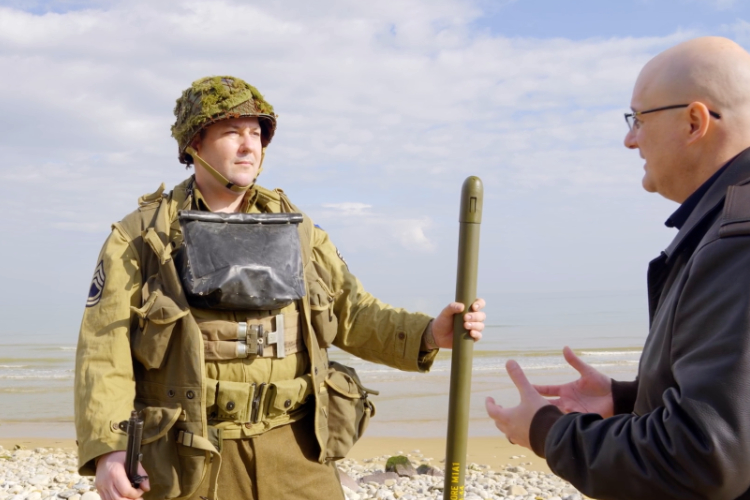
Battlefield guide and historian John Fletcher dons the standard GI kit issued for the assault.
Image Credit: History Hit
Troops wore heavy wool uniforms and poplin field jackets chemical-treated to protect against potential gas attacks. On top of this damp clothing, an assault trooper wore a cartridge belt packed with 80 ammunition rounds, a 10-pound M1 Garand rifle, a gas mask, and a canvas assault vest stuffed with first-aid packets and morphine. Many also hauled explosive Bangalore torpedoes to clear barbed wire.
This massive equipment load weighed up to 30 pounds before even accounting for the water weight accumulated in the surf. Tragically, this top-heavy gear flipped many soldiers upside down if they inflated their life belts incorrectly, causing them to drown headfirst in the deeper channels of the incoming tide.
Thirty minutes of devastation
The physical geography of Omaha Beach presented an ideal landing zone for ships, but a literal slaughterhouse for infantry. Beyond the expansive 250 metres of open tidal sand stood towering, steep bluffs, passable only through natural valleys called draws. A Company’s target was Dog One, the most vital of these targets, as it was the only fully paved draw leading inland.
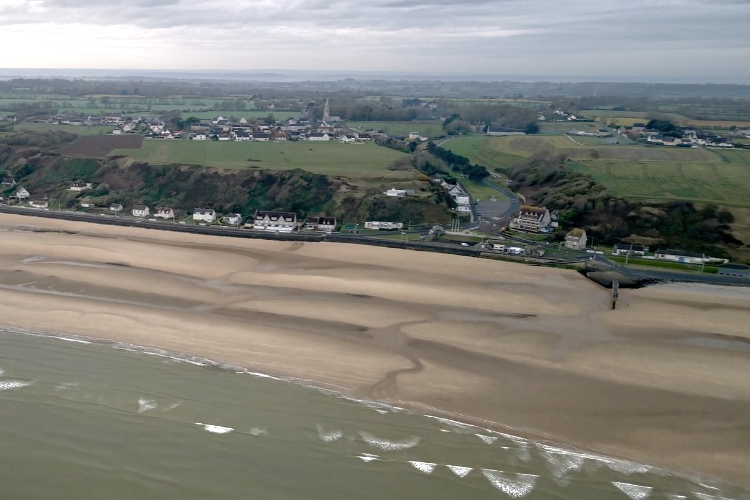
Dog One as seen today, Omaha Beach
Image Credit: History Hit
Waiting there were a terrifying array of interlocking German defensive fortifications known as Widerstandsnests (Resistance Nests). Historian Paul Woodage explains a crucial layout detail often missed in popular media: German coastal guns were not pointed out toward the open sea. Instead, the heavily reinforced concrete bunkers were engineered to face sideways down the beach. This clever positioning protected the 5-centimetre and 88-millimetre artillery pieces from direct naval bombardment while transforming the wide-open shoreline into a pre-calculated killing zone.
Worse still, the pre-landing Allied aerial and naval bombardments failed to penetrate the thick concrete casemates, leaving the German weapon systems entirely intact. When the ramps of A Company’s landing craft dropped at 06:36, the defenders unleashed a torrent of automatic and artillery fire, wiping out two-thirds of the 200 men of A Company within 30 minutes, including their company commander, Captain Taylor N. Fellers, and young PFC Thompson Dicks. By 07:00, the spearhead had been completely blunted. A Company had effectively ceased to exist.
Maverick initiative
With the primary landing sector transformed into a hellscape of smoke and blood, succeeding waves of troops drifted east due to strong coastal currents. B Company landed hundreds of yards away from their intended destination, pinned against the shingle, leaderless and shell-shocked.
The turning point came with the arrival of 51-year-old Brigadier General Norman “Dutch” Cota. Known for his unflinching leadership, Cota refused to seek cover. Walking upright among the pinned men (likely with a cigar clamped in his teeth), he delivered a legendary rallying cry: “Gentlemen, we are being killed on the beaches. Let us go inland and be killed!”
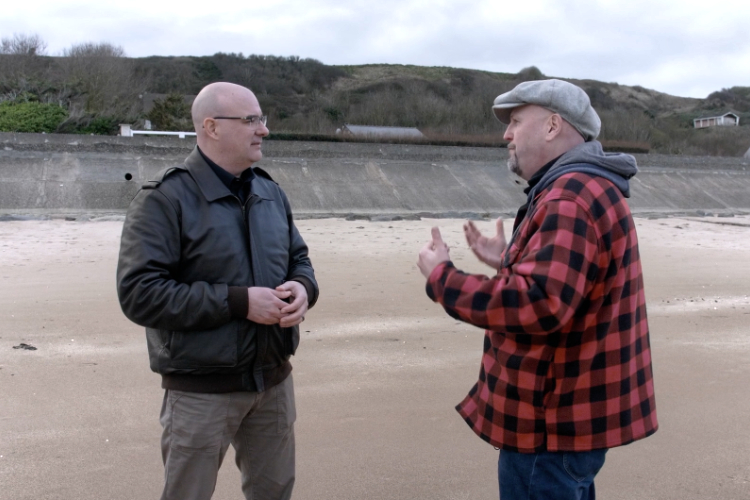
Prof Livingston and Historian Paul Woodage at Omaha Beach, discussing the impact Brigadier General Norman “Dutch” Cota made.
Cota’s exceptional bravery catalysed a powerful snowball effect across the beach. He physically reorganised the disparate units, directing teams to blow the barbed wire with Bangalore torpedoes. By scrambling up the steep, muddy gullies rather than the deadly paved draws, the Americans successfully flanked the German bunkers from behind.
Simultaneously, a small band of 29 men led by Lieutenant Walter Taylor pushed independently inland, capturing a German headquarters at the Chateau de Vaumisel. Pushing even further south to a vital crossroads, Taylor’s small band briefly engaged three truckloads of German reinforcements, marking the deepest penetration achieved by any unit landing on that sector of Omaha Beach on the morning of D-Day.
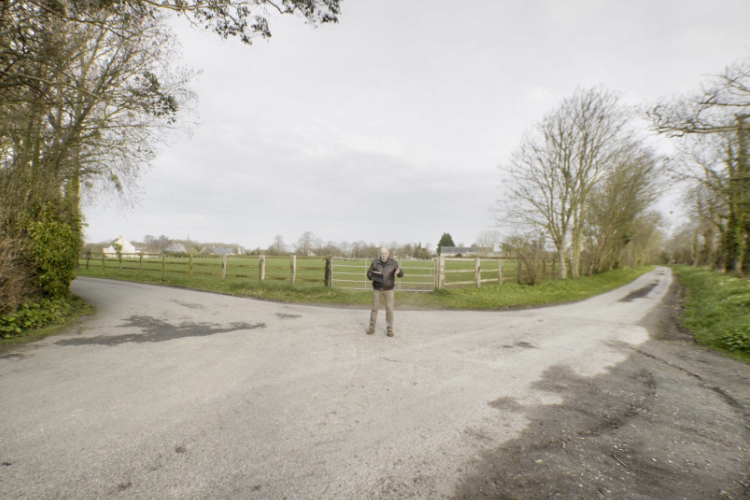
Professor Livingston at the crossroads reached by Lieutenant Walter Taylor and his men.
Image Credit: History Hit
The gateway opens
Meanwhile, back on the edge of the bluffs, General Cota focused on the primary objective that had eluded the first wave. The Allies desperately needed the paved Dog One Draw opened to move tanks, artillery, and supply trucks off the shoreline.
Directing a precise naval bombardment from the rear, American forces finally overwhelmed the defenders of Widerstandsnest 72. At 15:00, after 9 hours of relentless, exhausting combat, engineers directed by Cota successfully blasted through the 9-foot-tall concrete anti-tank wall blocking the Dog One Draw, allowing tanks and supply trucks to stream off the blood-soaked sand. The gateway to Europe was finally open.
A legacy written in sand and stone
Omaha: 24 Hours in Normandy concludes with a moving visit to the Normandy American Cemetery, situated on the very cliffs overlooking the now-peaceful waters of Omaha Beach.
Omaha Beach was undeniably a place of horrific sacrifice, costing over 4,000 Allied casualties in a single day. It is often remembered as a near-disaster, yet as Professor Livingston powerfully demonstrates, it was ultimately a triumph of individual initiative.
The sacrifice of the first wave drew the enemy’s fire, buying precious time for the survivors and subsequent waves to exploit the chinks in the Atlantic Wall, secure the beachhead, and open the long road to Berlin – and eventual liberation of Europe.