



The origins of the name ‘Africa’ are not entirely clear. We get the word from the Roman province gained via their first conquest on the continent. Romans used the term ‘Afri’ to refer to the inhabitants of Carthage, and more specifically a native tribe of Libya. There is evidence that the word originates with one of the native languages of the region, perhaps Berber.

Ruins of a Temple to Jupiter in Sabratha, northwestern Libya. Credit: Franzfoto (Wikimedia Commons).
North Africa before the Romans
Before Roman involvement, North Africa was basically divided into the regions of Egypt, Libya, Numidia and Mauretania. Berber tribes populated Ancient Libya, while Egypt, after thousands of years of dynastic rule, was conquered by the Persians and later the Greeks, who defeated the Persians under Alexander the Great, only to form the Ptolemaic dynasty — the final pharaohs of Egypt.
Roman provinces in Africa
After conquering Carthage (in modern Tunisia) at the end of the Third Punic War in 146 BC, Rome established the province of Africa around the destroyed city. The province grew to encompass the coastlines of north-eastern Algeria and western Libya. However, Roman lands in northern Africa were by no means limited to the Roman province of ‘Africa’.
Other Roman provinces on the African continent comprised the tip of Libya, called Cyrenaica (making up a full province along with the island of Crete), Numidia (south of Africa and east along the coast until Cyrenaica) and Egypt, as well as Mauretania Caesariensis and Mauretania Tingitana (northern portions of Algeria and Morocco).
Rome’s military presence in Africa was relatively small, with chiefly local soldiers manning the garrisons by the 2nd century AD.
North Africa’s role in the Roman Empire

An 1875 drawing of the amphitheatre at Thysdrus in Berber Africa.
Besides Carthage, North Africa was not significantly urbanised before Roman rule and the absolute destruction of the city assured that it wouldn’t be settled again for some time, though the story of pouring of salt over the land is most likely a later invention.
In order to facilitate trade, especially of the agricultural variety, various emperors set up colonies along the North African coast. These became home to a considerable amount of Jews, who had been exiled from Judea after rebellions like the Great Revolt.
Rome had the people, but the people needed bread. Africa was rich in fertile soil and became known as the ‘granary of the Empire’.
 Listen Now
The Severan dynasty
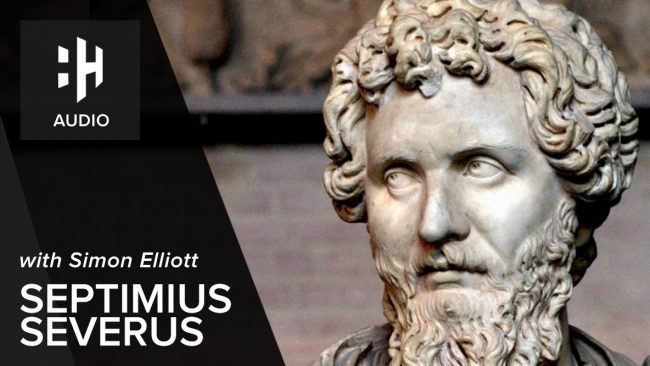
Rome’s North African provinces flourished and became flushed with wealth, intellectual life and culture. This enabled the rise of the African Roman Emperors, the Severan Dynasty, beginning with Septimius Severus who ruled from 193 to 211 AD.
From the province of Africa and with Phoenician ethnicity, Septimius was declared Emperor after the death of Commodus, though he had to defeat the armies of Pescennius Niger, who had also been proclaimed Emperor by Rome’s legions in Syria, to become Rome’s sole ruler.
 Listen Now
4 more Severan Emperors would follow and rule until 235 AD as sole or co-emperors (with a short break from 217 – 218): Caracalla, Geta, Elagabalus and Alexander Severus.
Besides the odd rebellion due to high taxation, worker oppression and economic crises, North Africa generally experienced prosperity under Roman rule, right up to the Vandal conquest of the province of Africa in in 439.