



In today’s society we have become all too aware of the scale of “spin”, and “fake news” that is produced for public consumption. The concept is hardly new, and of course most of us are aware of phrases like “history is written by the winners”.
However, in 1st century Britain, regardless of whether the Romans suffered defeats or enjoyed victories, there was only one side who wrote the history, and that gives us a bit of a problem.
Take Tacitus’ “Agricola”, for example, and how it relates to northern Scotland. Because the archaeology for so long seemed to match his account of events, it has been taken as truth for centuries – despite the author’s many weaknesses and critical comments about his work.
 Listen Now
Tacitus was taking the official despatches and private memoirs of his father-in-law, and writing an account of his career designed to praise old-fashioned Roman values, and criticise tyranny. His audience was the Roman senatorial class – of which he was a member – which had just suffered what it saw as tyranny under the Emperor Domitian.
Whilst it is relatively common these days to consider how much bias Tacitus put in his accounts, there has been little attempt to examine the facts he puts forward. How much can we really rely on Tacitus as a source?
Who was Agricola?
Apart from the “Agricola”, the man is only known in Britain from one inscription in St Albans, and yet he is perhaps the most famous governor of Britannia. Such is the power of the written word.
Let’s take his early career to begin with. What does Tacitus tell us? Well, to begin with he says Agricola served in Britain under Paulinus, under whom Anglesey was conquered, Bolanus, and Cerealis, both of whom were the principal agents in subduing the Brigantes.
When he returns to Britannia as governor himself, Tacitus tells us that Agricola mounted a campaign which included an assault on Anglesey, and campaigned in the north, subduing “unknown tribes”.

Map showing Agricola’s campaigns in northern Britain, according to Tacitus. Credit: Notuncurious / Commons.
It has been conclusively proven that the forts at Carlisle and Piercebridge (on the Tees) predate Agricola’s governorship. So not only had the areas been campaigned in, they had also had permanent garrisons installed for several years by the time Agricola arrived.
So who were these “unknown tribes?” It is to be assumed that those immediately to the north were well known to the Romans after a few years. The fort at Elginhaugh, on the outskirts of Edinburgh, is conclusively dated to 77/78 AD, within a year of Agricola’s arrival in Britannia – also indicating that permanent garrisons were in place within a year of his arrival. This does not match Tacitus’ account.
Mons Graupius: sorting fact from fiction
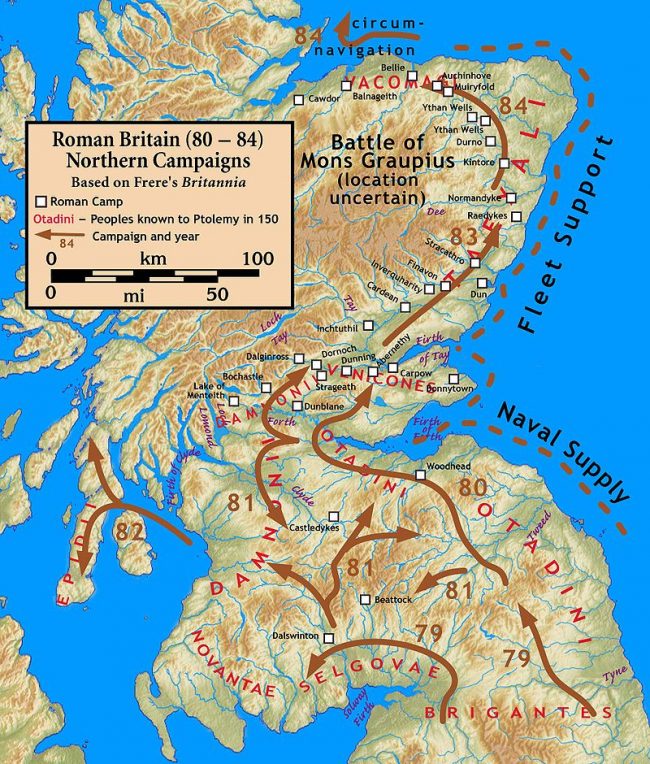
A zoomed-in map showing the Northern Campaigns of Agricola, 80-84, based on information from Tacitus and archaeological discoveries. Credit: myself / Commons.
So what of the climax of the “Agricola” – the final campaign which led to the annihilation of the Scots, and the Caledonian Calgacus’ famous freedom speech? Well, there are a number of very important things to consider here. First is that the previous year, Tacitus claims that the unlucky Ninth Legion, having been mauled in Britain previously, suffered another defeat in their camp, and that after the assault of the Britons was beaten off, the legions marched back to winter quarters.
The legions then do not march out until late in the season the following year, and when they do it is “marching light” which is to say they had no baggage train, meaning they were carrying food with them. This limits their march to about a week. Tacitus says that the fleet went on ahead to spread terror in advance, which means that the army had to be campaigning fairly close to the coast or major rivers navigable to the fleet.
The legions then set up a camp and find the Britons waiting ready to fight them the following morning. Tacitus describes the deployment of the troops and the enemy, and best guesses of the size of the Roman force come up with a figure of about 23,000 men. This would require a marching camp of perhaps 82 acres, based upon figures relating to army camps in the 18th century.
Regrettably there are none within 15% of this size in northern Scotland, and even those are probably later in date. It’s also a shame that there are no known marching camps which actually match the criteria needed for the battle to have taken place as described by Tacitus in terms of size and topography.
 Listen Now
Problems
So, as far as Tacitus’ account is concerned, there are no marching camps in north Scotland which match the size of the army he describes, added to which none of the camps are situated somewhere which matches the site of the battle as he describes. It’s not looking too hopeful.
However, recent discoveries in Aberdeen and Ayr of new marching camps dating to the 1st century AD show that the archaeological record is far from complete. It is possible that new camps may be discovered which will be a closer match for Tacitus’ battle description, and that would be truly exciting.
However, it would probably be within 7 days march of the Ardoch fort, which was used as a mustering ground for campaigns (and therefore to the south of the Grampians) – and almost certainly indicate a far smaller battle than Tacitus describes.
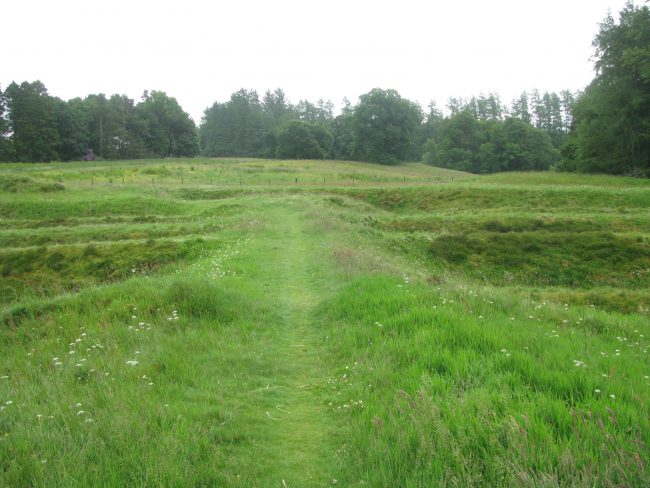
The remains of Ardoch Roman fort today. Photo by the author.
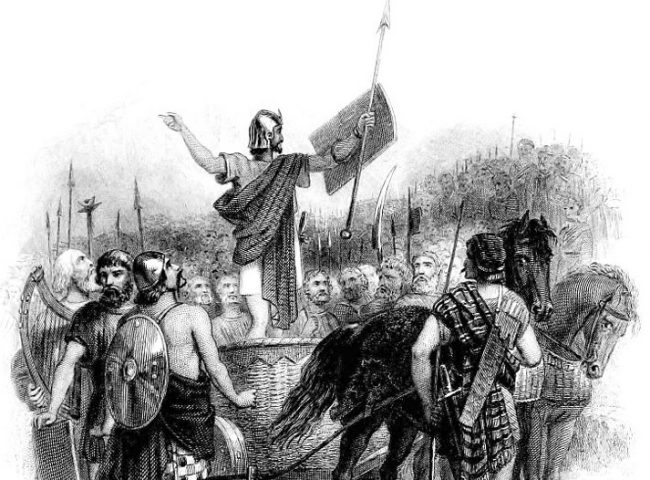
And what of Calgacus’ famous freedom speech and the massed ranks of the Caledonian Britons? The speech was given to highlight senatorial opinion about the tyrannous rule of Domitian, and would have had little relevance to the Britons of the day.
As for Calgacus himself, it isn’t very likely that a Caledonian chieftain bore this name. Agricola and his men would not have bothered checking names of the enemy. In fact, it is altogether possible that Calgacus (maybe meaning sword-bearer) was a name inspired by Vellocatus, the armour-bearer of Queen Cartimandua of the Brigantes.
 Listen Now
Legacy
At present, it is far from clear that the Battle of Mons Graupius as described by Tacitus took place at all. And yet the story has evocative power. The Grampian mountains were named after it. The story bears a significant role in the creation of the Scots as fearsome barbarian warriors, that even Rome could not tame.
Tacitus wrote for his audience, and not for posterity, and yet his words echo down the centuries. Spin, fake news or otherwise, nothing speaks to the imagination like a good story.
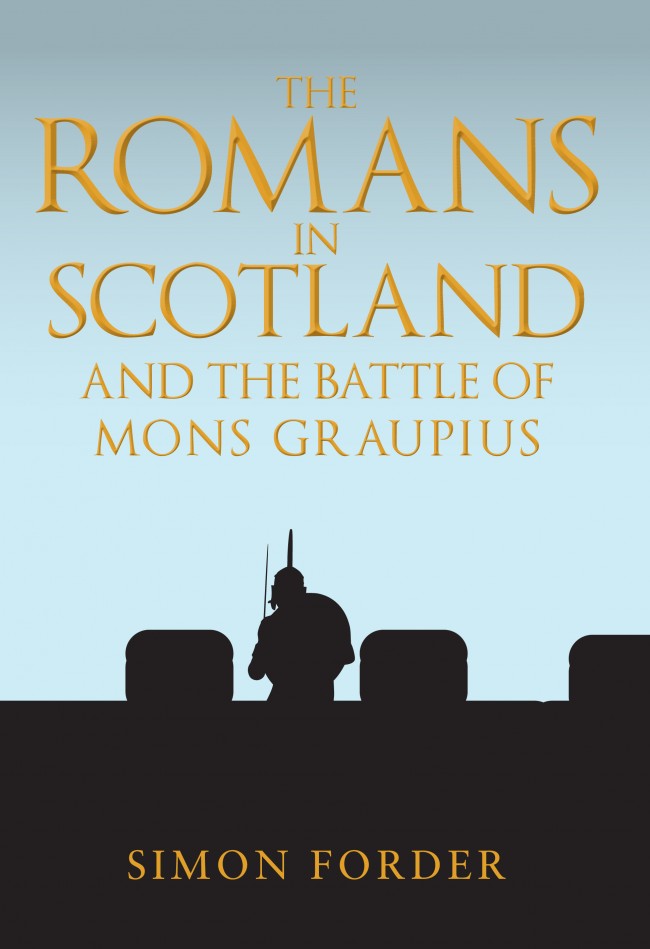
Simon Forder is a historian and has travelled all over Great Britain, in mainland Europe and Scandinavia visiting fortified sites. His latest book, ‘The Romans in Scotland and the Battle of Mons Graupius‘, was published on 15 August 2019 by Amberley Publishing