



For five centuries, the image of Anne Boleyn has been analysed, scrutinised, and reimagined. Yet while her name is synonymous with the seismic shift of the English Reformation, a fundamental question remains: Do we actually know what she looked like?
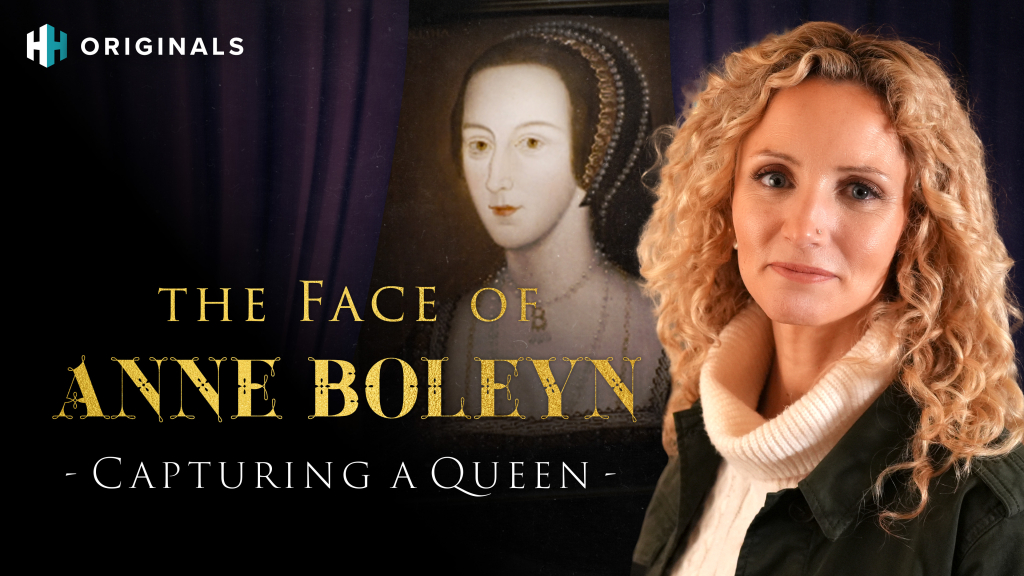
In History Hit’s compelling documentary ‘The Face of Anne Boleyn: Capturing a Queen’, Professor Suzannah Lipscomb visits Hever Castle – Anne’s childhood home – to explore a landmark exhibition, Capturing a Queen, that brings together the largest collection of Anne’s portraits ever assembled. The documentary highlights the cutting-edge forensic science being used to determine if any of these surviving portraits’ “faces” capture the real woman, or if they are merely products of dynastic propaganda.
 Watch Now
Beauty vs. deformity
The mystery begins with conflicting contemporary accounts. Contemporaries of Anne often noted her “beguiling dark eyes” and an elegant, olive-toned complexion. However, as Professor Lipscomb notes, “When it comes to Anne Boleyn, we need to think about who is writing the account.” The most enduring – and infamous description came decades after her death.
In 1585, Catholic polemicist Nicholas Sander claimed Anne had a projecting tooth, a large cyst under her chin, and six fingers on her right hand. Writing 50 years after her execution, Sander’s “witch-like” caricature was a calculated attempt to delegitimise her daughter, Elizabeth I. This tug-of-war between admiration and vilification has coloured every artistic representation of Anne for centuries.
The “Most Happy” discovery
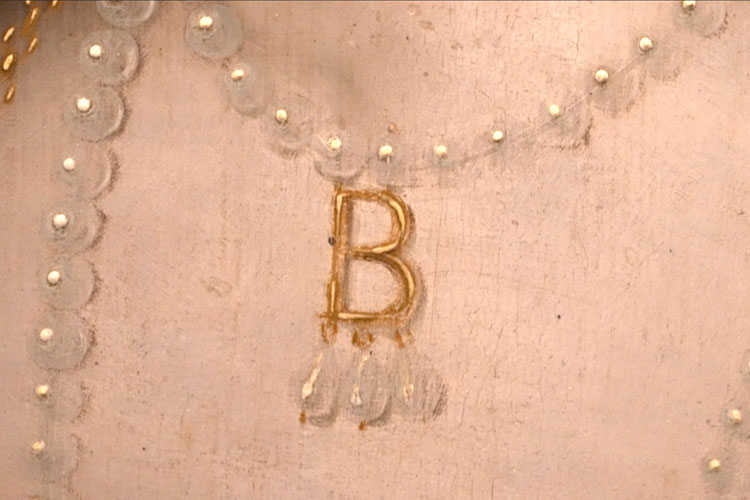
The documentary explores the collection of portraits of Anne from the 16th century, many of which depict her wearing a ‘B’ necklace – the iconic pearl strand that has become Anne’s visual shorthand. It also highlights a rare artefact: ‘The Moost Happi Medal’.
Loaned from the British Museum, this lead medallion from 1534 was cast when Anne was thought to be pregnant with a son. It is the only contemporary likeness of Anne undisputed by historians. Though damaged, it serves as a ‘Rosetta Stone’ for her features, providing a vital prototype to compare against later, potentially fictionalised paintings.
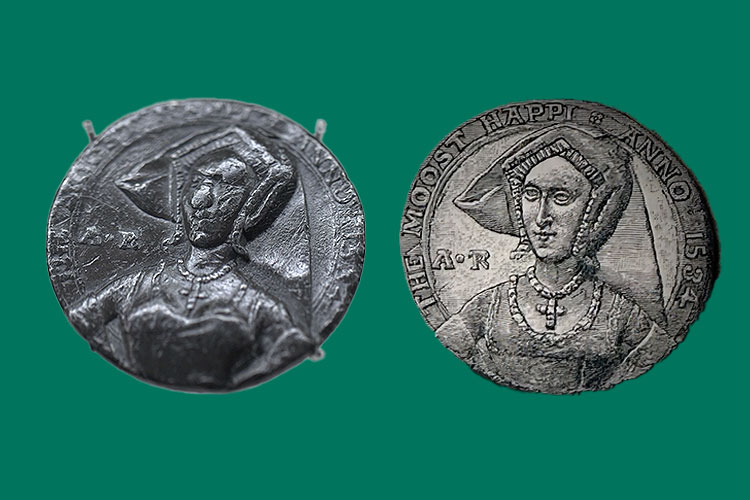
‘The Moost Happi Medal’ – Left: original medal, damaged. Right: original sketch
Image Credit: British Museum / Hever Castle / History Hit
Icons of authority
In her lifetime, Anne was often defined by her personal iconography, which would have been familiar to everyone at court. These included a crowned falcon perched on a rose-bearing stump (a potent symbol of fertility and her promise of a male heir), and a leopard (a fierce emblem of royal authority). Such symbols of Anne were also found on her personal possessions.
At Hever, Suzannah examines Anne’s personal velvet-covered Book of Ecclesiastes. As Assistant Curator Kate McCaffrey remarks, “Her DNA is all over this.” It is in these intimate objects that we find a more authentic trace of Anne than many stylised portraits.
A dynastic mask
After her execution in 1536, Anne’s image was effectively purged from the royal record. It only resurfaced decades later during the reign of her daughter, Elizabeth I, as wealthy patrons commissioned ‘corridor portraits’ to signal Protestant loyalty to the Queen.
Scientific analysis, however, reveals a startling truth: many of these images were created using standardised “patterns” or stencils. Under-drawings suggest artists weren’t painting a woman they remembered, but were likely mapping Elizabeth I’s long, elegant face backward onto her mother.
During a perilous period for Elizabeth I’s reign, this “Elizabethanising” of Anne served to visually cement the Queen’s legitimacy to the court. As Suzannah summarises, this also implies that by the 1580s, painters didn’t know what Anne Boleyn looked like, so they were essentially “creating Anne from scratch on the basis of her daughter.”
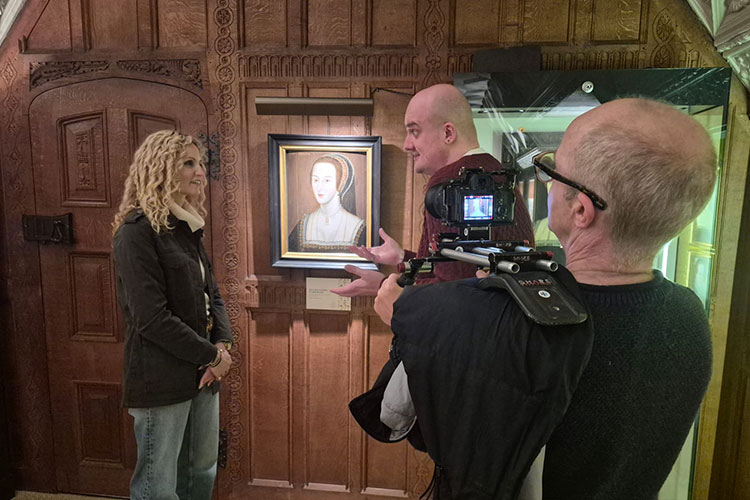
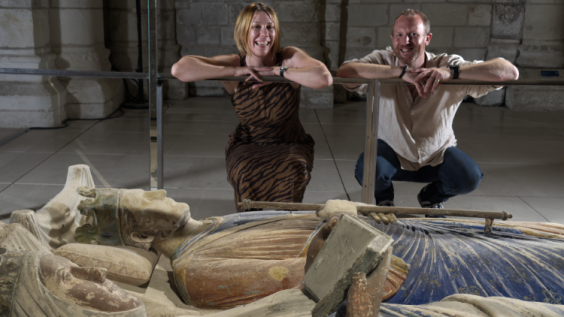
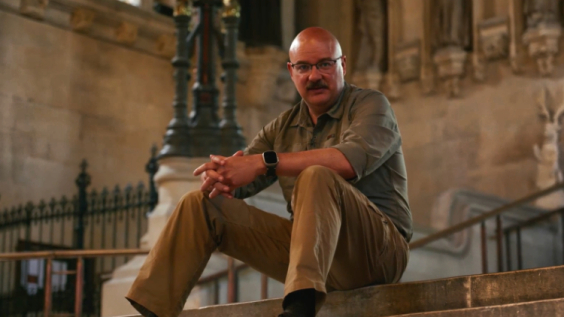
Production shot of Prof Suzannah Lipscomb and Dr. Owen Emmerson discussing one of Anne Boleyn’s portraits on display at Hever Castle
Image Credit: History Hit
The Hever Rose portrait
A lot of the research done at Hever Castle has been focused on a well-known portrait in their own collection – the ‘Hever Rose Portrait’.
Unlike the standardised Elizabethan patterns, this painting displays distinct facial variations and a deliberate later inclusion of Anne’s hands – showing a normal number of fingers – holding a rose of Lancaster, likely a direct rebuttal to Sanders’ ‘six-fingered’ rumours.
Dendrochronology has dated the wood panel used in the portrait to 1583. The portrait was sent to the Hamilton Kerr Institute at the Fitzwilliam Museum where an array of non-invasive technologies – including infra-red, x-rays, X-radiography and micro-invasive sampling – were used to help peer through the centuries of pigment and analyse the chemical composition of the paint. Research scientist Paul Van Laar explains that
“The exciting thing about many of these techniques is that we can look beneath what we see with the naked eye. We see the top paint layer but we never know what’s hidden underneath”.
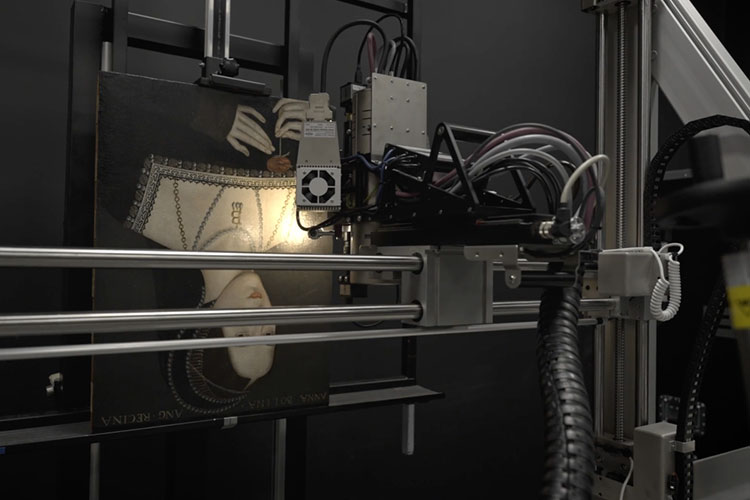
Analysis of the Hever Rose portrait of Anne Boleyn
Image Credit: History Hit
The findings suggest that while this specific portrait was painted in 1583 – a perilous year for Elizabeth I’s reign – it was transferred from a master “pattern” that likely pre-dates the painting by decades. Could that master image date back to Anne’s own lifetime? This offers a tantalising possibility: a surviving link to a master image created during Anne’s actual lifetime.
The search continues
Finding the “real” Anne is about more than aesthetics. As Dr. Owen Emmerson observes, her contemporaries valued her “style, charisma, and intelligence” over her physical features. Yet, the quest to find the real face of Anne Boleyn is more than mere curiosity. Reclaiming her true likeness is an act of historical justice – stripping away the propaganda of her enemies and the political filters of her descendants to see the woman herself.