



In the summer of 1940, Britain stood at the precipice. The Nazi war machine had stormed through Europe in a matter of weeks, the nightmare of Dunkirk was still fresh and had left the British Army depleted, and Hitler’s forces controlled the coastline from the Arctic Circle to the Pyrenees. To the rest of the world, Britain was surely next as Hitler’s ‘Operation Sea Lion’ loomed on the horizon.
Yet, in Britain’s darkest hour, Winston Churchill was secretly commissioning something far more extraordinary – and infinitely more brutal. Buried beneath the rolling hills of the English countryside was a secret network of civilian cells trained not to survive an invasion, but to sabotage it from within.
In History Hit’s new documentary, Churchill’s Secret Army, Dan Snow joins forces with historian Andy Chatterton from the Coleshill Auxiliary Research Team (CART) to unearth the incredible, forgotten story of the Auxiliary Units: a network of ‘Stay Behinds’ – ordinary men prepared to do the unthinkable.
 Watch Now
A guerrilla army in the shadows
Traditional history often focuses on the ‘thin crust’ of Britain’s coastal defences: the pillboxes, anti-tank ‘teeth’, and the heroic volunteers of the Home Guard. But while professional soldiers prepared for a head-on confrontation on the beaches, Churchill was assembling an invisible secondary force.
The Auxiliary Units (nicknamed the “Stay Behinds”) represented a radical rethinking of warfare. These men – often local farmers, gamekeepers, and miners – were chosen for their intimate, “back of the hand” knowledge of the terrain. They were the ones who could move through the woods at night as easily as they did in the day. Their mission was high-stakes sabotage: disappearing as the Germans advanced, only to emerge from the earth at night to blow up bridges, destroy ammo dumps, and assassinate high-ranking officers – crippling the enemy’s momentum to give the regular British Army precious time needed to counter-attack.
Operational bases
The reality of joining the Auxiliary Units was grim. Recruits were trained in the most silent and efficient ways to kill, practicing unarmed combat and learning exactly where to strike with a blade to ensure a silent death.
The secrecy required them to live in ‘Operational Bases’ (OBs) – remarkable underground structures hidden in caves, quarries, or even beneath innocuous outside toilets. Equipped with basic supplies and large quantities of explosives, these bunkers were designed to be a final home. Once an invasion began, the life expectancy for an auxiliary was estimated at just 2 weeks.

Andy Chatterton and Dan Snow discuss the training and tactics involved in being in the Auxiliary Units.
The brutality of secrecy
The secrecy was so absolute that families often had no idea why their husbands or fathers were slipping away into the night. But this silence had a darker edge. Auxiliaries were trained to be “utterly, utterly brutal” says Andy, striking psychological terror into the German ranks through the mutilation of enemy bodies.
Most controversially, their orders included the assassination of any British collaborator, or even a fellow citizen who accidentally stumbled upon a hidden base. Secrecy was the only shield the Auxiliary Units had, and they were prepared to protect it at any cost.

Entrance to a concealed ‘Operational Base’ (OB) site.
Image Credit: History Hit
Unearthing the bunkers
For decades, these secret bunkers were left to rot, their locations kept only in the memories of the men who served. Because no official maps were ever made, researchers today rely on oral histories, forensic analysis, and pure luck. Evidence can be as subtle as a stray bit of wire trailed up a tree or a specific type of metal grate hidden in the forest floor.
Today, Andy and his team have located over 300 of these bunkers. In the documentary, Dan and Andy trek through steep terrain to locate newly identified bases, finding the physical remains of a network that most Britons never knew existed – from sticky bomb casings and pressure switches, to blown escape tunnels.

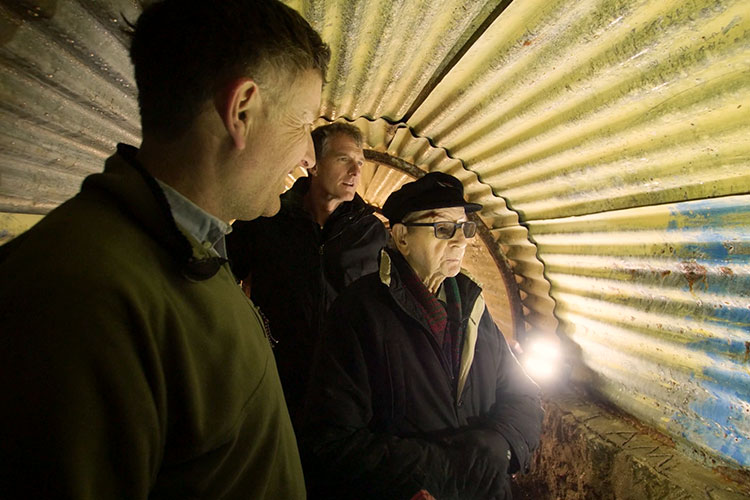
Andy Chatterton and Dan Snow inside a newly identified OB site.
Image Credit: History Hit
The Special Duties Branch
Alongside the saboteurs was the Special Duties Branch, an intelligence network responsible for relaying German movements. Their ingenuity was legendary; Dan explores a concealed bunker hidden beneath a functioning outside toilet, accessible only by a cunning release mechanism. As Dan says, “This is so exciting. I thought I’d seen it all and this really is like nothing I’ve experienced in 25 years.”

Andy Chatterton shows Dan the secret bunker entrance underneath an outside toilet.
Even if the Germans discovered the primary room, a second hidden wall – opened by a secret hook on a shelf – concealed the wireless operator. It was a setup designed for high-stakes espionage where the only exit strategy was often a final message followed by suicide to avoid capture.
The last of the auxiliaries
Dan meets 99-year-old Ken Welch, potentially the last surviving member of the ‘Exiliers.’ Ken shares the remarkable story of following his father into the woods as a teenager, only to discover his family’s patriarch was part of a secret army that he himself would later join.

Ken Welch identifies himself in a photograph of his time in the Auxiliaries. Ken’s father is also pictured to the far left of the photograph)
Ken just thought he was just joining a secret kind of Home Guard, which he was very excited about, “but I never considered the consequences if we were invaded” he says. “It didn’t worry me, like I didn’t think nothing’s going to happen to me”.
A few years ago, researchers began digging into Ken’s auxiliary story and started combing the landscape for the potential location of his bunker, and astonishingly they found it. Dan and Andy take Ken back to his OB site he served in, which Ken hadn’t returned to since the end of the war – until now.
When the units were finally disbanded in 1944, there were no parades. They were issued a simple letter of thanks explaining that because their lives had depended on secrecy, no public thanks would ever be possible. They were even told they had to buy their own commemorative pin badge – their only token of recognition for preparing to die for their country. Andy explains how quite a few auxiliaries “just shut up the OB and went on with their ordinary life”.

Ken Welch with Dan Snow at Ken’s former OB site.
From the coal mines of Wales to the dense forests of the South Coast, these ‘OB’ sites stand as silent monuments to the men who were prepared to stay behind and fight a war in the dark.
Watch now on History Hit to discover the secret history of the ‘Stay Behinds’ and the civilian cells that formed Britain’s last line of defence. You can follow Dan Snow as he crawls into underground bunkers that have remained sealed for 80 years and examine the ‘Countryman’s Diary,’ a lethal sabotage manual ingeniously disguised as a harmless rural almanac.
Churchill’s Secret Army is a haunting look at the absolute lengths Britain was willing to go to avoid surrender – a story of ordinary civilians prepared to do extraordinary, brutal things in the name of freedom, only to be asked to simply forget it ever happened once the danger had passed.