


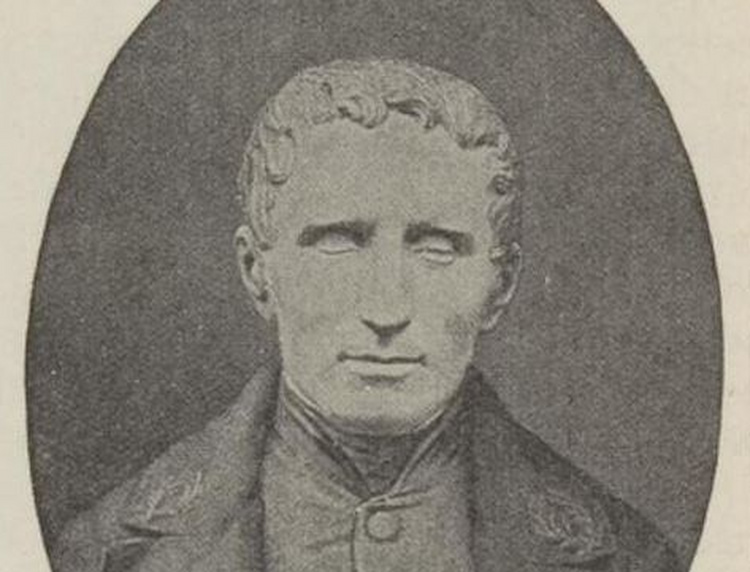

Braille is a system internationally recognised for its simplicity in enabling the blind and visually impaired to communicate. But did you know that it all stemmed from the brilliance of a 15-year-old boy called Louis, living 200 years ago? This is his story.
An early tragedy
Louis Braille, the fourth child of Monique and Simon-Rene Braille, was born on 4 January 1809 in Coupvray, a small town roughly 20 miles east of Paris. Simone-Rene worked as the village saddler making a successful living as a leatherer and maker of horse tack.

The childhood home of Louis Braille.
From the age of three, Louis was already playing in his father’s workshop with any of the tools he could get his hands on. One unfortunate day in 1812, Louis was trying to make holes in a piece of leather with an awl (a very sharp, pointy tool used to puncture holes in a variety of tough materials). He bent down close to the material in concentration and pressed hard to drive the point of the awl into the leather. The awl slipped and struck him in his right eye.
The three year old – in terrible agony – was hurriedly taken to the local physician who patched up the damaged eye. Upon realising that the injury was severe, Louis was packed off to Paris the next day to seek the advice of a surgeon. Tragically, no amount of treatment could save his eye and it wasn’t long before the wound became infected and spread to the left eye. By the time Louis was five he was entirely blind.
The Royal Institution for Blind Youth
Until he was ten, Louis went to school in Coupvray where he was marked out as a step above the rest – he had a brilliant mind and sparky creativity. In February 1819, he left home to attend The Royal Institution for Blind Youth (Institut National des Jeunes Aveugles) in Paris, which was one of the first schools for blind children in the world.
Although the school often struggled to make ends meet, it provided a safe and stable environment in which children who suffered from the same disability could learn and live together. The school’s founder was Valentin Haüy. Although he was not blind himself, he had devoted his life to helping the blind. This included his designs for a system to enable blind people to read, using the raised imprints of Latin letters. Students learnt to trace their fingers over the letters to read the text.
Although it was an admirable scheme, the invention was not without flaws – reading was slow, the texts lacked depth, the books were heavy and expensive and whilst the children could read, writing was almost impossible. The one major revelation was that touch worked.
Night writing
Louis was determined to invent a better system that would allow blind people to communicate more effectively. In 1821, he learned of another communication system called “night writing” invented by Charles Barbier of the French Army. It was a code of 12 dots and dashes impressed into thick paper in different orders and patterns to represent different sounds.
These impressions allowed soldiers to communicate with each other on the battlefield without needing to speak or expose themselves through bright lights. Although the invention was deemed too complex to be used in military situations, Barbier was convinced it had legs with helping the blind. Louis thought likewise.
Joining the dots
In 1824, by the time Louis was 15 years old, he had managed to reduce Barbier’s 12 dots into just six. He found 63 different ways to use a six-dot cell in an area no larger than a fingertip. He assigned separate combinations of dots to different letters and punctuation marks.

Louis Braille’s first French alphabet using his new system.
The system was published in 1829. Ironically, it was created using an awl – the same tool that had led him to his original eye injury in childhood. After school, he completed a teaching apprenticeship. By his 24th birthday, Louis was offered a full professorship of history, geometry and algebra.
Alterations and Improvements
In 1837 Louis published a second version where the dashes were removed. He would make a constant stream of tweaks and alterations throughout his life.
In his late twenties Louis developed a respiratory illness – most likely tuberculosis. By the time he was 40, it had become persistent and he was forced to move back to his hometown of Coupvray. Three years later his condition worsened again and he was admitted to the infirmary at the Royal Institution. Louis Braille died here on 6 January 1852, two days after his 43rd birthday.

This postage stamp commemorating Braille was created in 1975 in East Germany.
Although Louis was no longer there to advocate his system, blind people recognised its brilliance and it was finally implemented in The Royal Institution for Blind Youth in 1854. It rapidly spread through France and soon internationally – officially adopted in the US in 1916 and in the UK in 1932. Nowadays, there are about 39 million blind people worldwide who, because of Louis Braille, are able to read, write and communicate using the system we now call Braille.